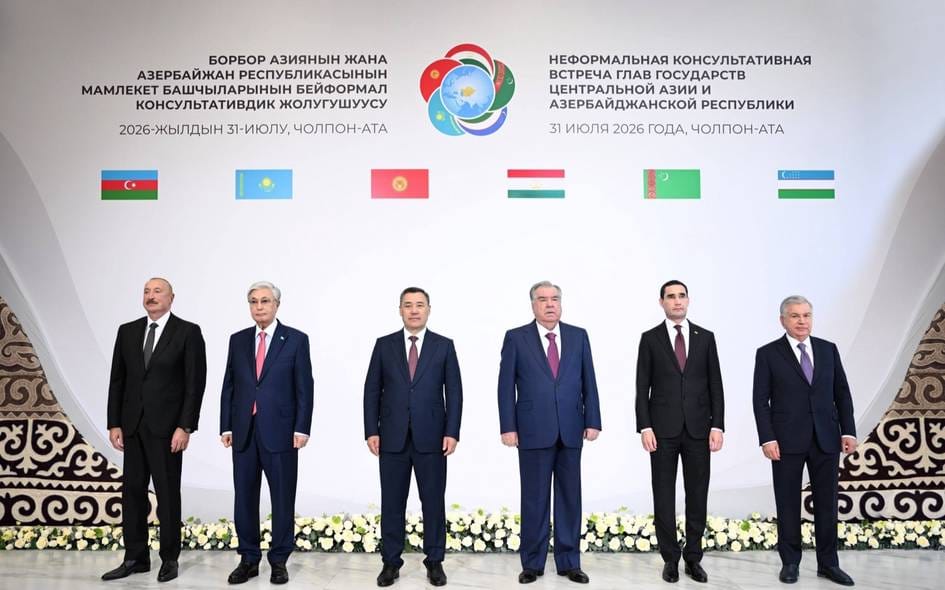
Ammon News - Abdulhamid Hamid Al-Kba - On 31 July 2026, six presidents sat around one table in Cholpon-Ata, the quiet city on the shores of Lake Issyk-Kul.
The scene was not merely protocol. It felt more like a moment in which the region was testing itself: Have the Central Asian states moved beyond the phase of rebuilding trust, or are they still searching for a common language of action?
Since 2018, these states have chosen an informal consultative format, deliberately avoiding heavy structures and supranational powers.
The goal appeared simple: to restore dialogue after years of intermittent bilateral engagement. Yet in Tashkent in 2025, a decision was taken that altered the equation — the admission of Azerbaijan as a full participant.
From that moment, the format was no longer limited to Central Asia. It extended across the Caspian to touch the South Caucasus, as if the region had decided to open its western window after a long period of inward focus.
The Cholpon-Ata meeting placed this step under the test of implementation. The presidents spoke, each in his own manner, but the common thread was clear: the shift from words to plans, and from announcements to results.
Kyrgyz President Sadyr Japarov advanced the idea of a unified tourist visa, recalling the Silk Road heritage, ancient cities and mountain lakes, while highlighting the China–Kyrgyzstan–Uzbekistan railway and the Kambar-Ata project.
Turkmen President Serdar Berdimuhamedov announced that Avaza would host the next summit in October, stressing that the six-party mechanism would bring the peoples closer.
Azerbaijani President Ilham Aliyev pledged that Azerbaijan would be an active member, not an observer.
Kazakh President Kassym-Jomart Tokayev went further, calling for a concrete action plan to implement the Treaty of Friendship — now completed with the accession of Tajikistan and Turkmenistan — and describing the current period as the most successful in the region’s modern history.
Tajik President Emomali Rahmon warned of global turbulence and proposed a regional oil refinery, while Uzbek President Shavkat Mirziyoyev outlined a broader vision linking Central Asia with the South Caucasus and Afghanistan through transport, trade and digitalisation.
These statements, diverse as they are, reveal something deeper than formal consensus. Each president carries national priorities, yet all recognise that remaining alone is no longer a safe option.
The figures confirm this. Kazakhstan’s trade with its Central Asian neighbours rose 28.9 per cent to $4.2 billion in the first five months of 2026, of which $3.2 billion were exports. These were distributed among Uzbekistan ($2.3 billion), Kyrgyzstan ($1 billion), Tajikistan ($615 million) and Turkmenistan ($215 million), while trade with Azerbaijan exceeded $150 million. The region now absorbs roughly 40 per cent of Kazakhstan’s exports of finished goods.
These are not mere statistics. They show that trust has begun to translate into real economic flows, even if those flows remain uneven.
Here the real test begins.
The consultative format has moved from the phase of restoring trust to a more demanding stage. Azerbaijan’s participation gives the trans-Caspian dimension tangible momentum, particularly through the Middle Corridor. Yet the flexibility that once served as an advantage — the absence of a supranational bureaucracy — risks becoming a liability if decisions lack rigorous follow-up mechanisms.
Implementing the Treaty of Friendship requires an action plan with clear deadlines and responsible agencies, not merely closing statements. Coordinating positions with external partners, whether major powers or regional organisations, remains a delicate challenge: how can the states defend shared interests without appearing as a closed bloc or as an instrument in anyone’s hands?
This transformation cannot be separated from the calculations of the major powers.
Russia, which has long viewed Central Asia as a traditional sphere of influence, may regard the new mechanism as an attempt to reduce dependence on Moscow, especially as the Middle Corridor deepens and bypasses Russian territory. China, the region’s largest economic partner through the Belt and Road Initiative, will watch carefully any coordination that strengthens the states’ collective bargaining power on investments, debt and transport corridors. The United States and the West, for their part, will see an opportunity to promote logistical alternatives beyond Russian and Chinese influence, while remaining wary of any tendency toward regional closure that overlooks their security and energy interests.
The challenge for the six states is to manage this balance with skill — to convert coordination into a source of collective negotiating strength without it being interpreted as a direct challenge to any external actor, or as a tool in the service of one.
Parallel to the calculations of the major powers, the growing engagement of the Gulf Cooperation Council (GCC) states introduces a dynamic third vector into this regional equation. No longer merely distant historical partners, the Gulf monarchies — led by Saudi Arabia and the UAE — increasingly view Central Asia and the South Caucasus as a strategic frontier for investment diversification, the green energy transition and supply-chain security. In 2026, as institutional frameworks such as the GCC–Central Asia strategic dialogue gain traction, Gulf sovereign wealth funds are increasingly positioning themselves as important and relatively flexible sources of investment capital. For the six states around the Cholpon-Ata table, this partnership offers a valuable economic counterweight, enabling them to finance cross-border corridors and infrastructure without deepening asymmetric dependence on Moscow or Beijing.
As for institutional mechanisms, the absence of a supranational bureaucracy was an advantage during the trust-building phase, yet it is becoming a potential constraint today. The answer does not lie in replicating the heavy European Union model, but in designing a light and flexible structure: a small permanent secretariat, based on rotation or in a neutral location, tasked with following up decisions, preparing regular reports and submitting practical proposals. Alongside it, specialised joint ministerial councils — covering transport, energy, trade and tourism — could meet at least twice a year, supported by permanent technical working groups. These bodies would not require sovereign powers, only a clear mandate with defined timelines and measurable performance indicators. In this way, trust can be transformed from a slogan into a light institutional commitment that preserves national sovereignty while ensuring that announcements do not evaporate once the summit ends.
Practical challenges remain. Disparities in economic capacity, the sensitivity of issues such as water and energy, and the difficulty of turning tourism or industrial initiatives into genuine cross-border projects may all slow progress. The consultative meetings have succeeded in creating a platform for dialogue. Their true success, however, will be measured by their ability to compel ministries and executive agencies to work together, rather than by the exchange of views among leaders alone. Trust, however high it rises, remains a suspended bridge unless its pillars are driven into the ground.
Anyone observing the scene with detachment will recognise that the region stands at a crossroads. Either this mechanism becomes a genuine instrument for reducing reliance on single routes and enhancing resilience to external shocks, or it remains a cordial annual gathering that is soon forgotten. Trade figures offer grounds for optimism, and the political discourse has grown more mature. Yet history teaches that trust alone does not build states — implementation does.
In the end, the Cholpon-Ata meeting was not merely another summit. It was a moment in which the region tested its capacity to turn words into action and flexibility into commitment. If the six states succeed in adopting an action plan for the treaty, developing transport corridors and converting tourism and energy initiatives into reality, the coming years may well rank among the most cohesive in the modern history of Central Asia. If decisions remain at the level of announcements, the opportunity will pass — as many have before — leaving empty tables and promises that dissolve like morning mist on the shores of Issyk-Kul.
The road is open. The next step is no longer a choice.
*Abdulhamid Hamid Al-Kba - Opinion writer specializing in Central Asia and Azerbaijan affairs



 comment replay








 الرجاء الانتظار ...