Muayad Al-Samaraee
First: Environmental Opportunities
1.Transforming carbon credits from a marginal tool into a strategic financial asset — through a physically signed MRV system that links each credit to a unique fingerprint (coordinates, timestamp, sensor signature, cryptographic digital signature) on an immutable ledger.
2.Avoiding emissions from conventional desalination — a solar-powered desalination plant with a capacity of 50,000 m³/day produces 150,000–250,000 tons of CO₂e annually, verifiable.
3.Generating credits from clean energy and water efficiency improvements — a third source of credits alongside avoided desalination emissions.
4.Plastic recycling — a second pilot project in Jordan within the MRV scope.
5.Pricing the cost of avoided damage — estimated at $50–100/ton in some sectors according to World Bank studies, reflecting the true environmental value.
6.Health benefit — reduced respiratory and cardiovascular diseases according to WHO methodologies, as a component of multi-source pricing.
7.Turning water scarcity into a monetizable asset — a model replicable in every country in the region.
8.Exportability of the MRV and pricing model to countries outside the region, expanding global environmental impact.
9.Later integration of core SAMANSIC technologies after independent scientific verification, opening a broader environmental horizon.
Second: Economic Opportunities
1.Global carbon market growing from ~$2 billion (2020) to $50–100 billion by 2030 — voluntary prices of $8–30/ton in emerging markets with upward expectations.
2.Credit sales revenue: $2–5 million (Year 2), $15–25 million (Year 3), $60–100 million (Year 5).
3.MRV-as-a-Service — exporting the platform as a service to regional countries as an early revenue source.
4."Guaranteed floor price" contract with institutional buyers (banks and funds) to reduce price risk.
5.Listing credits as assets in sovereign wealth funds and central banks — with an approved accounting classification (IFRS/IPSAS) and independent valuation.
6.Sovereign Eco-Units — an institutional financial instrument paving the way for full monetary issuance.
7.Dual revenue from desalination: water sales at $0.5–0.8/m³ + credit sales.
8.Digital sovereignty dividend — distributing 5–10% of the revenues of the first 500,000 tons to citizens ($2–3 million in Year 3, $8–12 million in Year 5).
9.Investor IRR: 8–10% (Year 3) and 12–18% (Year 5).
10.Job creation: 500 (Year 2), 2,000 (Year 3), 8,000 (Year 5).
11.Self-financing through compound innovation — each component funds the next, making the project "more robust" and less dependent on external financing.
12.Manufacturing triad (Turkey, Indonesia, Egypt) — industrial and geographic depth, risk diversification, and export markets across three major spheres of influence.
13.Islamic finance through green sukuk (Bahrain) as an additional financing channel.
14.Global green finance market >$35 trillion as a backdrop for attracting capital.
Third: How Does the Project Constitute an Exceptional Competitive Advantage for Companies Involved in Carbon: Economics within Ministries of Environment?
1. Transforming the ministry from a regulatory body into an issuer of a financial asset
Ministries of Environment become owners/supervisors of a system that produces verified, priced credits eligible for listing in sovereign funds — a shift from "environmental protection as a cost" to "the environment as a sovereign asset."
2. A four-fold pricing methodology that individual companies cannot possess
Price = market price + cost of avoided damage + health benefit + sovereign value. This gives the ministry a regional pricing reference approved by a scientific governance board — a competitive advantage no single company can build alone.
3. Physically signed MRV as an exportable regional standard
The ministry becomes the accreditation reference (alongside Verra and Gold Standard), giving its national companies a position in the global carbon economics value chain.
4. Guaranteed floor price contracts
Reduce price risk for companies and make climate investment "profitable rather than costly" — a direct translation into competitive advantage for companies operating under the ministry's umbrella.
5. Regional accounting framework for listing credits as assets
A globally exportable standard, giving local companies a head start in adopting a standard that advanced markets have not yet adopted.
6. Access to green and climate finance (GCF, IFC, development banks)
A financing structure of $250–400 million from these channels opens funding doors for companies that are closed to traditional projects.
7. MRV integration with green sukuk and Islamic finance
An additional financing channel (Bahrain) giving companies rare structural flexibility.
8. Reputation protection through clear separation
The project separates the implementable from what is protected by intellectual property secrets, protecting partner companies from the risk of association with unproven claims — a prerequisite for dealing with ministries of environment and international institutions.
9. Political and social impact (digital sovereignty dividend)
The citizen becomes a partner rather than a spectator, creating a political base that supports companies operating in this sector and protects them from legislative fluctuations.
10. Replicability and exportability
The MRV and pricing model is sellable to countries outside the region — meaning the companies involved serve not only a local market but become exporters of carbon economics services.
11. Innovation sovereignty as a strategic asset
The project offers "proven execution capability, not paper promises" — the criterion ministries of environment seek when choosing their partners, giving the companies involved an edge in regional tenders and projects.
12. A clear timeline (60 months)
From MRV (12–18 months) to pricing (9–15) to listing (18–24) to sovereign units (24–36) — allowing companies to plan their investments with confidence and making the ministry a partner in a binding timeline rather than open-ended promises.
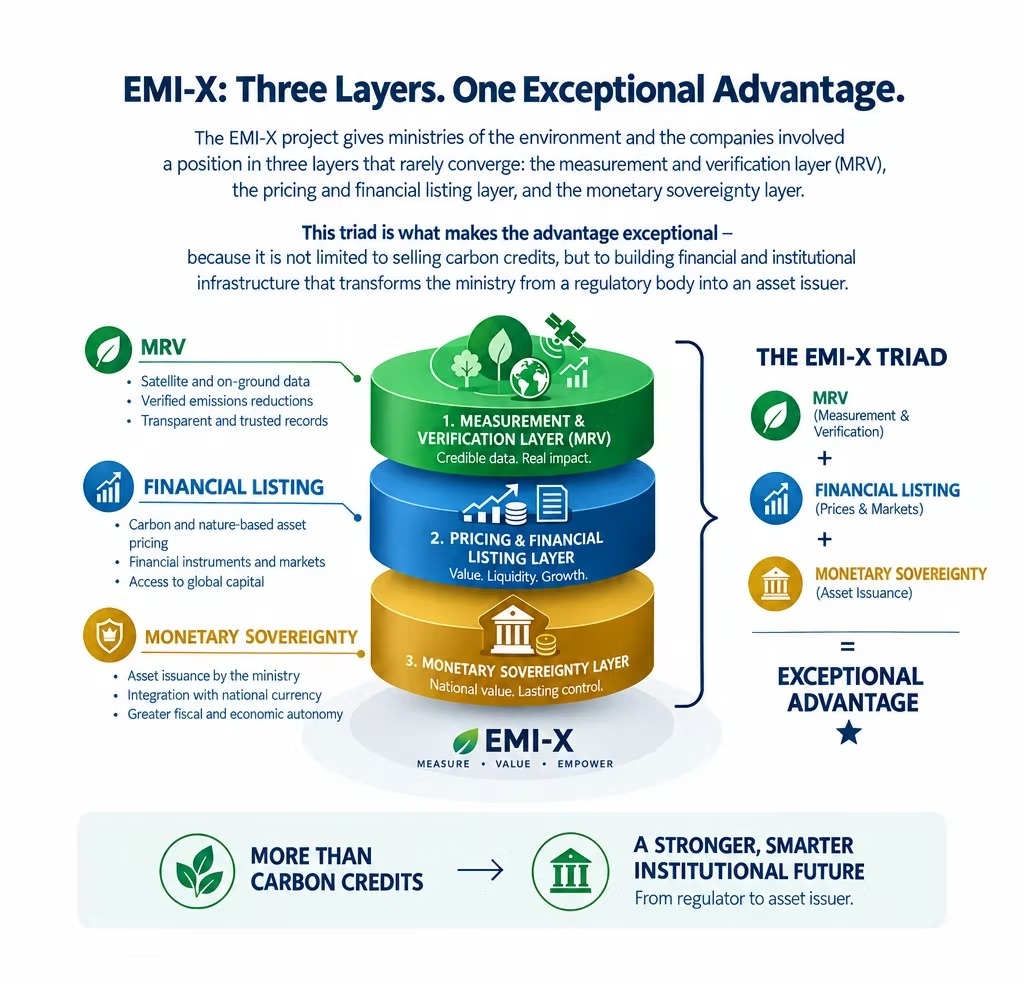
Summary: EMI-X project gives ministries of the environment and the companies involved a position in three layers that rarely converge: the measurement and verification layer (MRV), the pricing and financial listing layer, and the monetary sovereignty layer. This triad is what makes the advantage "exceptional" — because it is not limited to selling carbon credits, but to building financial and institutional infrastructure that transforms the ministry from a regulatory body into an asset issuer, and the company from an executor into a partner in an exportable regional standard.
The Innovation behind EMI-X
Environmental Monetary Infrastructure Project (EMI-X)
A Start Decision: From Marginal Carbon Credits to a Strategic Sovereign Financial Asset
Executive Introduction: A Start Decision, Not Just Another Investment Opportunity
•The Environmental Monetary Infrastructure (EMI-X) project presents itself as a start decision backed by twenty-five years of empirical research (2001–2026), encompassing sixteen executed projects, granted US patents, and endorsed international partnerships valued at up to USD 40 billion. It is not another investment project, but a financial and institutional infrastructure built from scratch to transform verified carbon credits from a marginal environmental instrument into a strategic financial asset eligible for inclusion in sovereign wealth funds and central banks, and usable as partial collateral for sovereign monetary issuance.
•The project is governed by a strict principle: "Economy first, technology later." It separates the faith-based engine of research from the investment foundation and requires independent scientific verification before integrating any technology. This means that everything presented in this report is immediately implementable and does not rely on any unproven technology, while leaving the door open to integrating central technologies later after they pass independent scientific verification. Through this principle, the project offers investors and officials what deserves trust: a disciplined investment foundation, a defined scope, and clear boundaries between what is executable and what is protected by intellectual property secrets.
First: The Methodology — "Composite Innovation" as the Foundation for Execution
•The project is based on the "Composite Innovation" methodology applied by the cross-border SAMANSIC alliance, led by Muayad S. Dawood Al-Samaraee. The methodology engineers relationships between sectors so that each sector finances the next in a self-financing closed loop. It has proven its viability through five documented cases: interlocking building blocks serving housing, defense, environment, and education together; converting a civilian training aircraft into a sovereign intelligence platform; a geological survey that compressed two years of work into 24 hours; an AI protocol integrating geological, biological, and computational axes; and a vaccines alliance that transformed into an urban air transport project with an initial investment of USD 10 billion. The methodology is embodied in the fact that each of the project's seven components finances and reinforces the next, ultimately forming a tightly closed instrument whose resources do not leak into separate objectives.
•It is essential to affirm, for anyone evaluating this project, that Muayad S. Dawood Al-Samaraee's practical and executive career emerged under dire circumstances (wars, pandemics, resource scarcity, and institutional fragmentation) where traditional academic institutions and isolated laboratories were unavailable. This career is a global feat in national security engineering and technological sovereignty, where capabilities are built from scratch, civilian technologies are adapted to serve sovereign objectives, and international alliances spanning continents are managed under crisis conditions. Therefore, the evaluation of this work must proceed from its executive and real-world impact (providing vaccines, building aircraft, surveying resources, securing air transport, and launching air transport projects), not from how well it conforms to paper-based academic templates. The real achievement here is innovation sovereignty and execution capability — strategic assets that transcend the limits of traditional academic documentation. These are precisely the assets EMI-X offers the investor: proven execution capability, not paper promises.
Second: What Does Muayad S. Dawood Al-Samaraee Want from His Twenty-Five-Year Sacrifice?
•He wants a composite victory for a methodology — not a personal victory or individual glory. He wants the "Composite Innovation" methodology he built over a quarter-century under dire circumstances to prove that environmental challenges can be transformed into opportunities for prosperity, that climate investment can be profitable rather than costly, that citizens can become partners rather than spectators, and that the region can be a source of solutions rather than a recipient of them. He wants to prove that innovation sovereignty and execution capability — not paper-based academic documentation — are the true strategic assets worthy of investment, and that achievement is measured by its executive impact on the ground, not by its conformity to ready-made templates.
•In short: he wants to see the methodology proven through five documented cases and to open the door for every partner who wants to build a new financial layer that transforms environmental challenges into opportunities for prosperity — not to immortalize his name, but for the methodology to immortalize its impact.
Third: Project Executive Summary
•This project offers a cross-border investment framework to build a regional system that transforms verified carbon credits into a strategic financial asset included in sovereign wealth funds and central banks, used as partial collateral for sovereign monetary issuance, with physically signed measurement, reporting, and verification (MRV) systems, a citizen dividend distribution mechanism, and a regional role distribution among research and development, manufacturing, financing, and market countries.
•The governing principle is "Economy first, technology later": it does not rely on any unproven technology such as ionic pyramids, the Omega system, or the biological age restoration protocol. Instead, it builds the financial and institutional layer that is immediately applicable, while leaving the door open to integrating central technologies after they pass independent scientific verification.
•The proposed geographic scope includes Jordan as the center for research, development, and accreditation; Turkey, Indonesia, and Egypt for manufacturing and construction; Iraq for energy and resources; Saudi Arabia for financing; the UAE for technology and space; Qatar for carbon markets; Bahrain for Islamic finance; and Oman for logistics. The targeted investment volume ranges between USD 1.2 and 1.8 billion over five years in the founding phase, with an expected return of 12% to 18% annually in the operational phase.
Fourth: Investment Logic — Why Now?
•The timing is based on several simultaneous drivers. The global carbon market is growing from about USD 2 billion in 2020 to estimates ranging between USD 50 and 100 billion by 2030, with voluntary prices ranging between USD 8 and 30 per ton in emerging markets and expectations of further rise. Sovereign wealth funds are seeking alternative assets not linked to oil, and verified carbon credits represent an emerging asset class eligible for inclusion. The global green finance market exceeds USD 35 trillion, and developing countries need instruments to attract capital. Renewable-powered desalination has become economically viable at a cost ranging between USD 0.5 and 1.0 per cubic meter, and adding carbon credits transforms cost into revenue. The existing institutional infrastructure in the region supports the project: Jordan has a sovereign fund under establishment, a voluntary carbon market, and green hydrogen agreements exceeding USD 2 billion in value; the UAE offers the most flexible regulatory market; and Turkey, Indonesia, and Egypt possess a broad industrial manufacturing base and extensive experience in building major infrastructure, making them natural pillars for the project's manufacturing triad.
Fifth: Component One — Physically Signed MRV System
•This system is the technical foundation of the project. It links each carbon credit to a unique physical fingerprint including coordinates, timestamp, sensor fingerprint, and encrypted digital signature, on an immutable ledger. Without reliable MRV, carbon cannot be priced or listed as an asset. This component requires no unproven technology; it uses commercial sensors, IoT, satellites, drones, and approved distributed ledger technologies. Immediate implementation begins with a pilot in Jordan covering two sites: a solar-powered water desalination project and a plastic recycling project, in partnership with the Jordanian Ministry of Environment to approve the methodology. The estimated cost is between USD 8 and 12 million, covering the platform, sensors, training, and independent auditing, with a timeline of 12 to 18 months. Scalability lies in exporting it as a service (MRV-as-a-Service) to regional countries, providing an early revenue source.
Sixth: Component Two — Multi-Source Carbon Pricing
•This component prices each carbon credit through four integrated components: the market price ranging between USD 8 and 30 per ton in regional voluntary markets; the avoided damage cost estimated by World Bank studies at between USD 50 and 100 per ton in some sectors; the health benefit represented by reduced respiratory and cardiovascular diseases according to WHO methodologies; and the sovereign value determined by a political and regulatory coefficient reflecting the asset's value as monetary collateral and a sovereign instrument. Immediate implementation includes issuing a regional pricing methodology approved by a scientific governance board in partnership with a university or research center, and applying a pilot on 500,000 tons of CO2 from the desalination and recycling project. The cost is between USD 3 and 5 million, covering studies, verification, and accreditation, with a timeline of 9 to 15 months. The core innovation is a "guaranteed floor price" contract with institutional buyers from banks and funds, reducing price risk for the investor.
Seventh: Component Three — Listing Credits as an Asset in the Sovereign Fund and Central Bank
•This component transfers verified and priced credits to the sovereign wealth fund as strategic assets, with an approved accounting classification according to IFRS or IPSAS standards and independent valuation. Immediate implementation includes integrating credits into the Jordanian sovereign fund under establishment with initial funding ranging between USD 200 and 300 million, and conducting a pilot in an existing sovereign fund in the UAE or Qatar as a trial asset valued at USD 50 to 100 million. The cost is between USD 5 and 8 million, covering legal and accounting consultancy, valuation, and structuring, with a timeline of 18 to 24 months. The main output is a regional accounting standard for listing carbon credits as assets — a globally exportable standard.
Eighth: Component Four — Linking Monetary Issuance to a Legal Collateral Ratio
•This component issues a sovereign digital currency covered by the fund's assets, including carbon credits, with a legal collateral ratio higher than one — for example, between 1.05 and 1.20 — according to the formula V(t) = ρ · NAV_adj(t), where NAV_adj is the risk-adjusted net asset value. Immediate implementation is limited in the first phase: a full currency is not issued; instead, "Sovereign Eco-Units" are launched as a financial instrument linked to credits, traded between institutions and paving the way for full monetary issuance later. A pilot is implemented in the UAE to benefit from regulatory flexibility, or in Jordan in coordination with the central bank. The cost is between USD 10 and 15 million, covering legal, technical, and regulatory structuring, with a timeline of 24 to 36 months. The fundamental reservation is that full monetary issuance requires a legislative framework and banking supervision, and is not implemented before the success of the Sovereign Eco-Units pilot.
Ninth: Component Five — Digital Sovereignty Dividend
•This component is a mechanism for distributing part of the environmental asset revenues — from carbon credits, MRV fees, and fund returns — directly to citizens, either in cash, as a balance in a digital wallet, or as a discount on services such as electricity and water. Immediate implementation includes a pilot in Jordan to distribute 5% to 10% of the returns from the first 500,000 tons to residents of the project area, through a simple digital wallet linked to the national identity. The cost is between USD 4 and 6 million, covering the platform, integration, and awareness, with a timeline of 12 to 18 months. The strategic impact is creating a political base for the project, as the citizen becomes a partner in its success.
Tenth: Component Six — Regional Role Distribution Model and the Manufacturing Triad
•This model distributes value chain tasks among countries according to their comparative advantages. Jordan handles research, development, intellectual property, and MRV accreditation; Iraq handles energy and resources; Saudi Arabia handles financing and investment through the regional fund; the UAE handles technology and space and provides a flexible pilot environment; Qatar handles carbon markets and green finance; Bahrain handles Islamic finance through green sukuk; and Oman handles logistics and maritime connectivity. Manufacturing and construction are distributed across an integrated triad: Turkey, Indonesia, and Egypt, giving the project production capacity geographically distributed across Asia Minor, Southeast Asia, and North Africa. This reduces the risk of dependence on a single manufacturing location, broadens the supplier and contractor base, and opens additional export markets for the EMI-X model across three major economic spheres of influence.
•Immediate implementation begins with a regional framework agreement among three starting countries — Jordan, the UAE, and Saudi Arabia — and the establishment of a general secretariat in Amman, a scientific governance board, and a joint investment fund with initial capital ranging between USD 300 and 500 million, while opening a parallel negotiation track with Turkey, Indonesia, and Egypt to determine manufacturing and construction shares. The cost is between USD 6 and 10 million, covering establishment, legal, and negotiation, with a timeline of 12 to 18 months.
Eleventh: Component Seven — Turning Water Scarcity into an Asset
•This component builds desalination plants powered by renewable energy, generates carbon credits from avoided emissions from traditional desalination, from clean energy, and from improved water efficiency, then sells both water and credits together. Immediate implementation includes a pilot in Jordan for a 50,000 cubic meter per day solar-powered desalination plant, with expected annual production of between 150,000 and 250,000 tons of CO2 equivalent that is verifiable. Revenue is dual: water sales at a price ranging between USD 0.5 and 0.8 per cubic meter, and credit sales according to multi-source pricing. The cost is between USD 120 and 180 million as infrastructure investment, with a timeline of 24 to 36 months for construction and 12 months for trial operation. The impact is transforming the existential challenge of water scarcity into a liquidatable asset — a model replicable in every country of the region.
Twelfth: Institutional and Financing Structure
•The structure includes seven main entities. EMI-X Holding is the cross-border parent company headquartered in a flexible financial center such as DIFC or ADGM. EMI-X R&D handles research, development, and intellectual property in Jordan. EMI-X Manufacturing handles manufacturing and construction through the Turkey–Indonesia–Egypt triad. EMI-X MRV manages the measurement and verification platform in Jordan and the UAE. Regional Carbon Exchange is the credit exchange in Qatar. Regional Investment Fund is the regional fund in Saudi Arabia. Digital Dividend Platform is the dividend distribution platform in Jordan.
•The financing structure of USD 1.2 to 1.8 billion over five years is distributed across five sources: a regional fund from governments and sovereign funds at USD 400 to 600 million (33%); institutional investors from banks, insurance, and ESG at USD 300 to 450 million (25%); green and climate finance from development banks, GCF, and IFC at USD 250 to 400 million (21%); private sector partnerships through BOT and concessions at USD 150 to 250 million (14%); and research and technology grants at USD 50 to 100 million (6%). The use distribution includes infrastructure at USD 700 to 900 million, the MRV and technology platform at USD 80 to 120 million, legal and regulatory structuring at USD 60 to 90 million, research, development, and accreditation at USD 100 to 150 million, working capital and reserves at USD 150 to 250 million, and digital sovereignty dividend distribution at USD 80 to 120 million.
Thirteenth: Five-Year Roadmap
•Phase Zero: Founding extends from Month 1 to Month 6 and includes establishing EMI-X Holding in DIFC or ADGM, signing a framework agreement between the interested parties and the innovator (the SAMANSIC Coalition), appointing a scientific governance board of five to seven international experts, launching an MRV feasibility study, and opening a negotiation track with Turkey, Indonesia, and Egypt to determine manufacturing shares. Its output is a legal entity, an agreement, and a team.
•Phase One: Institutional Building extends from Month 6 to Month 18 and includes launching the MRV platform in the Jordan pilot, approving the multi-source pricing methodology, structuring the regional fund at USD 300 to 500 million, starting the desalination pilot at 50,000 cubic meters per day, and signing manufacturing memoranda of understanding with Turkey, Indonesia, and Egypt. The output is the first 100,000 tons of verified, priced carbon.
•Phase Two: Proof extends from Month 18 to Month 30 and includes listing credits in a sovereign fund as a pilot, launching Sovereign Eco-Units for institutional trading, piloting the digital sovereignty dividend in one region, operating the trial desalination plant, and beginning manufacturing production in Turkey, Indonesia, and Egypt. Its output is the first revenue from credit sales and the first citizen distribution.
•Phase Three: Expansion extends from Month 30 to Month 48 and includes expanding MRV to three countries, launching the regional carbon exchange in Qatar, structuring a trial monetary issuance in a flexible regulatory environment, expanding desalination to 200,000 cubic meters per day, and operating the manufacturing triad production lines at full capacity. Its output is 1 to 2 million tons of verified carbon annually.
•Phase Four: Maturity and Export extends from Month 48 to Month 60 and includes full operation of the seven components, exporting the MRV and pricing model to countries outside the region, assessing the possibility of integrating SAMANSIC central technologies after scientific verification, and expanding the manufacturing network to additional markets in Asia, Africa, and Europe. Its output is a mature, replicable regional model.
Fourteenth: Risks and Mitigation Plans
•The main risks include nine. The risk of MRV methodology non-adoption has medium probability and high impact, mitigated by early partnership with environment ministries, independent auditing from day one, and adoption of international standards such as Verra and Gold Standard. Carbon price volatility risk has high probability and medium impact, mitigated by guaranteed floor price contracts and diversification of the four pricing sources. Regulatory rejection of monetary issuance has medium probability and high impact, mitigated by starting with sovereign units instead of a full currency and cooperating with the central bank from the outset. Political and geopolitical risks have medium probability and high impact, mitigated by cross-border structuring in DIFC, country diversification, and investment protection agreements. MRV technical risks have low probability and medium impact, mitigated by using mature technologies, sensor redundancy, and human auditing. Reputational association with SAMANSIC has medium probability and medium impact, mitigated by legal separation and an independent brand, as EMI-X does not adopt SAMANSIC's unproven claims. Market risks related to credit demand have medium probability and medium impact, mitigated by advance contracts with institutional buyers and market diversification between voluntary and compliance markets. Desalination implementation risks have low probability and medium impact, mitigated by experienced international contractors and a realistic timeline. Manufacturing coordination risk among three countries has medium probability and medium impact, mitigated by clear framework agreements, production quota distribution, and a unified arbitration mechanism.
Fifteenth: Key Performance Indicators
•The indicators include verified carbon credits annually reaching 100,000 tons in Year 2, 500,000 tons in Year 3, and 2 million tons in Year 5; credit sales revenue ranging between USD 2 and 5 million in Year 2, USD 15 to 25 million in Year 3, and USD 60 to 100 million in Year 5; desalinated water reaching 50,000 cubic meters per day in Year 2, 100,000 in Year 3, and 200,000 in Year 5; number of participating countries reaching 3 in Year 2, 6 in Year 3, and 10 in Year 5 after joining the manufacturing triad; digital sovereignty dividend distributed reaching zero in Year 2, USD 2 to 3 million in Year 3, and USD 8 to 12 million in Year 5; direct jobs reaching 500 in Year 2, 2,000 in Year 3, and 8,000 in Year 5; and investor IRR reaching 8% to 10% in Year 3 and 12% to 18% in Year 5.
Sixteenth: What the Project Does Not Include
A Clear Separation Between the Executable and What Is Protected by Intellectual Property Secrets
•To protect the investor and the project from reputational risks, the project does not include proving the efficiency of ionic pyramids, but it does not prevent building an ionic pyramid before proving dismantling efficiency on an independent experimental scale, given the importance of the pyramid's location and the existence of a geobiological mining unit for the proposed cryptocurrency — an economically viable matter. However, disclosing the efficiency of the pyramids facilitates linking the cryptocurrency's value to the global carbon bond market, enabling everyone to dispense with referring back to the innovator. The door remains open to adding a research and development unit later if experiments prove viable. The project also does not include disclosing the secrets of the biological age restoration protocol, and therefore everyone cannot dispense with referring back to the innovator; without the innovator, it is not introduced as a product or service before rigorous scientific review and publication of results. Nor does it include the Omega geophysical reading system (for the same reasons), so it is not used as a basis for any financial or governance decision. Nor does it include the geobiological currency as full collateral; a full currency is not issued, but only limited experimental Sovereign Eco-Units.
•It is essential to clarify that the innovator retained technical secrets for himself so that the idea would not be stolen and exploited inversely against the interest of human capacity development and community security support. There is nothing that has not been verified, but there is what has not had its secrets disclosed — a legitimate right under the foundations of intellectual property for any innovator. The reason for this separation is that the project aims at an executable investment, not the promotion of unproven technologies. This protects the investor, protects the project from reputational risks, and leaves the door open to integrating technologies later if they prove viable.
•It is also essential to clarify that everyone can benefit from the project if the goal is humanitarian and non-profit, but they will be unable to achieve profits without cooperating with the innovator. Therefore, the innovator left the opportunity for climate reform open to everyone, but retained the secrets of the project's economic sustainability in a way that does not allow bypassing cooperation with the innovator. This balance — between opening the humanitarian impact and protecting the secret of economic sustainability — is what makes partnership with the innovator a practical necessity, not a formal condition, and ensures that the project's benefit returns to everyone without exploiting the economic foundation built over a quarter-century of work.
Seventeenth: Immediate 90-Day Action Plan
•In Week 1–2, a legal advisor is appointed for DIFC structuring. In Week 2–4, initial contacts are made with environmental ministries in Jordan and the UAE. In Week 4–6, a scientific governance board of five experts is formed. In Week 6–8, an MRV feasibility study is launched through a request for proposals from an international consultant. In Week 8–10, the tripartite framework agreement is drafted. In Weeks 10–12, an investor presentation is prepared. In Week 12, the founding meeting with government partners is held.
Eighteenth: Conclusion — Why Is This Project Implementable?
•This project is implementable for six reasons. First, it does not rely on unproven technology; all its components — MRV, carbon pricing, asset listing, and renewable desalination — have successful global precedents. Second, it benefits from existing institutional infrastructure such as the Jordanian sovereign fund under establishment, the voluntary carbon market, and green hydrogen agreements. Third, it creates early revenues through MRV-as-a-Service, credit sales, and water sales — cash flows that begin in Year 2 and Year 3. Fourth, it distributes risks regionally through role distribution, reducing dependence on a single country, with a manufacturing triad distributed across Turkey, Indonesia, and Egypt giving the project unprecedented industrial and geographic depth. Fifth, it clearly separates what is executable from what is protected by intellectual property secrets, protecting the investor and building credibility. Sixth, it is scalable and exportable, as the MRV and pricing model can be sold to countries outside the region.
•In other words, this project takes the economic philosophy, institutional framework, and financial instruments from SAMANSIC — the part that is usable and studyable — and leaves central technology and technical secrets aside until they are scientifically proven or cooperation terms are agreed upon. The result is a cross-border investment project immediately implementable, with calculated risks, multiple revenue sources, and a measurable environmental and developmental impact.
Nineteenth: The Only Real Loss Is Hesitation
•The project loses nothing essential if it adopts self-financing through Composite Innovation. On the contrary, it gains the ability to start now, achieves environmental, educational, and economic goals that cannot be solved without this model, and builds a financial safety valve protecting it from external financing fluctuations. The only loss is abandoning the idea that the project needs a billion dollars to start. It does need it — but in Year 3, not in Month 1. Composite Innovation is what gets it there. In other words: self-financing does not make the project smaller — it makes it more resilient. A project that starts small with self-financing and achieves tangible environmental and educational impact is the project that deserves large financing later.
Conclusion: A Call for Partnership
•This project is not just an investment opportunity — it is a strategic decision to build a new financial layer that transforms environmental challenges into opportunities for prosperity, makes climate investment profitable rather than costly, makes citizens partners rather than spectators, and makes the region a source of solutions rather than a recipient of them. The door is open to every partner — a government, a sovereign fund, a bank, a green finance institution, or an institutional investor — who wants to be part of building this financial and institutional infrastructure from scratch. The methodology has proven its viability. Execution capability is proven. And the time is now.
For more information and to join the alliance, don't hesitate to get in touch with the EMI-X Secretariat.
Muayad S. Dawood Alsamaraee
SAMANSIC Coalition Founder
Chief Sovereign Executive Innovation Architect (Composite Innovation Scientist)
Head of Innovative Technology and Geopolitical Strategy
Leader of the Sustainable Cross-Border Collective-Intelligence Innovation Network
www.samansic.com I
www.siina.org I
samansic@siina.org




 comment replay












 الرجاء الانتظار ...