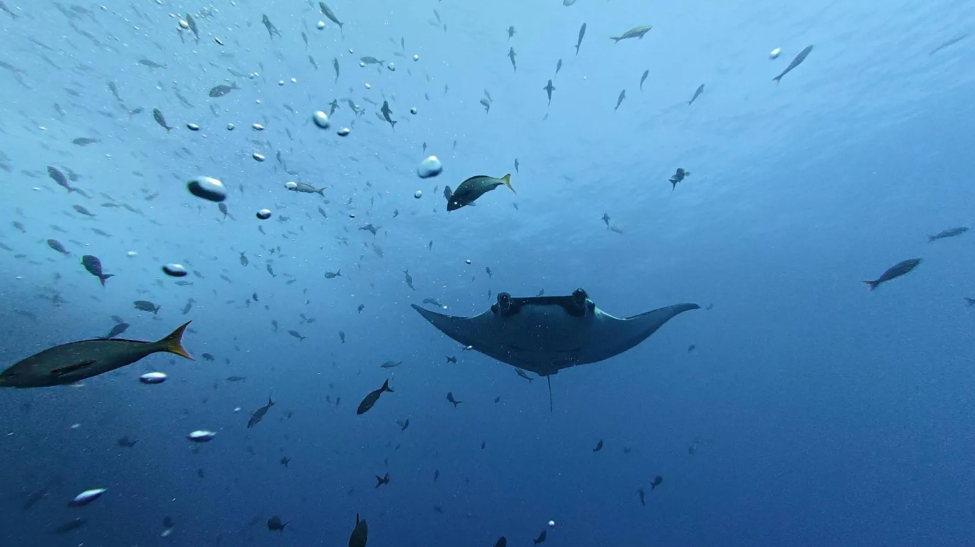
Ammon News - Anyone who has watched a manta ray glide over a reef knows how unhurried these marine animals can look. Yet researchers working off Costa Rica found their movements are varied, with juveniles staying nearby and close to shore while adults venture hundreds of kilometres.
Manta rays are among the ocean's largest fish, with wing-like fins that can span up to about 8 meters (26 feet) and the largest brain of any fish.
Researchers tracked endangered oceanic manta rays between 2018 and 2025, fitting 59 of them with acoustic transmitters and tracking 12 with satellite tags, along with photo identification.
"By combining different technologies ... we were able to piece together a highly detailed map of their movements and their use of coastal cleaning stations," said Jeffry Madrigal-Mesén, director of the research group Mantas Costa Rica and lead author of the study published in the journal Frontiers in Fish Science, opens new tab.
A coastal cleaning station is a rocky reef site where small fish remove parasites from the skin of the manta rays in an example of symbiotic behaviour.
Researchers found that smaller, immature mantas stayed within Costa Rica's coastal waters, called its exclusive economic zone. Larger, mature animals undertook long-distance journeys, some reaching as far as the waters off Guatemala.
"This makes us believe that smaller mantas do not risk these long migrations, likely due to the threat of large predators like orcas and tiger sharks," Madrigal-Mesén said.
The smaller animals in the study measured around 3 to 3.5 meters across (10 to 11.5 feet), compared with around 4 to 4.5 meters (13 to 15 feet) for those making the longer journeys.
DANGER FROM PREDATORS
A juvenile, at around 3 meters across, would still appear enormous to most swimmers. Yet that size may not be enough protection.
Madrigal-Mesén said that "their massive size is one of their main defence mechanisms. It is quite common to see animals missing portions of their bodies, and in many cases, the shape of the wounds strongly suggests they are bites from other large marine predators."
What prompts mantas to eventually join the migratory population remains unclear, although researchers suspect that reaching feeding and breeding grounds in highly productive waters across Central America may play a role.
The manta rays also repeatedly return to the same coastal cleaning stations. Observations of feeding, courtship and recent mating suggest these sites may also function as social hubs. Scientists do not yet know how mantas navigate back to particular sites.
"Based on the bathymetry of the different sites we monitor, there must be a relationship with the rock formations. We humans have favourite places we like to go to," Madrigal-Mesén said. "Why couldn't mantas have a preference for one cleaning station over another?"
The findings also suggest the mantas may not roam as far as once thought. Researchers initially suspected that animals seen in Costa Rica might migrate from populations in Ecuador or Mexico. The tracking data instead raises the possibility that Central America has its own distinct population, something the team is now investigating through genetic work.
Mantas are particularly vulnerable because, like other rays and sharks, they reproduce slowly and take years to reach sexual maturity. Madrigal-Mesén said that once the animals left Cocos Island, a volcanic island in the Pacific Ocean, and most monitored coastal sites, they entered waters with no protection, exposing them to threats including fishing and vessel traffic.
"Studies like this help us recognise that these coastal havens only protect them for a specific time of the year. ... This is why it is so critical to protect the marine corridors these migratory species travel through."
Coastal mantas also showed strong site fidelity, with very few moving between monitoring sites even when they were only tens of kilometres apart.
One male became a particularly striking example. Nicknamed "Mickey Mouse" for its distinctive spot pattern, the ray was repeatedly photographed at Cabo Blanco and tracked using both satellite and acoustic tags, showing a strong attachment to the site.
But researchers have not seen this ray in Costa Rica for more than a year.
"We have a lot of affection for him," Madrigal-Mesén added. "We hope he comes back soon."
Reuters



 comment replay









 الرجاء الانتظار ...