Ammon News - A giant deep-sea creature that spent more than 40 years in a German university collection has been at the center of a new breakthrough by marine scientists.
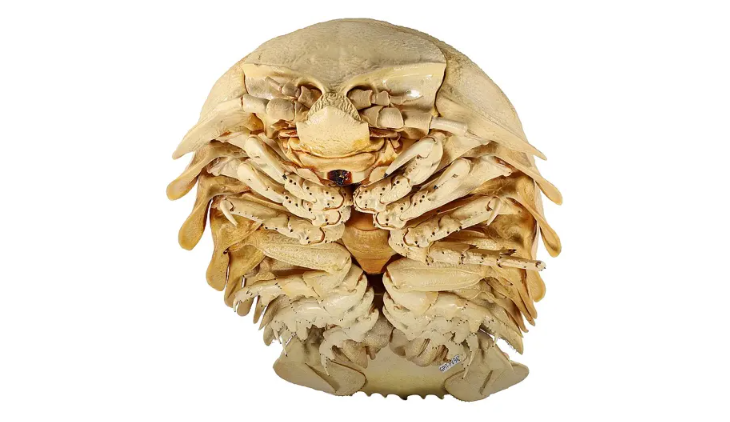
The nearly 13-inch-long giant isopod, which was originally collected in Puerto Rico in the 1980s, has been identified as an entirely new species, according to a study published in the journal Scientific Reports.
“Our Tübingen specimen from Puerto Rico, measuring 32.2 centimeters (12.7 inches) in length, falls into the category of ‘colossogiants,’ ” paleontology student Benedikt Kästle said, according to Phys.org.
Kästle made the discovery alongside Dr. Ingmar Werneburg, curator of the University of Tübingen’s Paleontological Collection in Germany. The pair named the new species Bathynomus tuebingoborikensis, combining the name of their university town with Boríken, the Indigenous Taíno name for Puerto Rico.
The creature had been part of the university’s collection since the 1980s, when paleontologist Dolf Seilacher acquired it at a research station in Puerto Rico and brought it back to Germany for educational purposes.
Decades later, Kästle and Werneburg took a closer look at the dried specimen using modern imaging technology. After comparing its anatomy with other giant isopods, they determined that it belonged to a previously unknown species.
Giant isopods are crustaceans that live deep beneath the ocean’s surface and look like enormous versions of pill bugs, also known as roly-polies.
Their bodies are covered in hard, segmented shells, and some can grow up to 20 inches long. They have been found at depths reaching approximately 8,200 feet.
The newly identified species is particularly large, but its size isn’t the only thing that makes it interesting.
Researchers found that it is closely related to another giant isopod species discovered off Mexico’s Yucatán Peninsula. That connection is helping scientists better understand where these creatures came from and how they spread across the world’s oceans.
According to the study, giant isopods likely originated in what is now the Gulf of Mexico more than 15 million years ago.
“At that time, the Isthmus of Panama was open, leaving a strait between North and South America, and the marine animals were able to spread westward, initially as far as Japan,” Werneburg said.
Over millions of years, the creatures spread into other oceans, with some evolving to become much larger than their relatives.
Researchers believe a particularly enormous group emerged around 5.3 million years ago, as Earth’s climate cooled, before spreading from Australia through Antarctic waters toward South and Central America.
Never miss a story — sign up for PEOPLE’s free daily newsletter to stay up-to-date on the best of what PEOPLE has to offer, from celebrity news to compelling human interest stories.
The Puerto Rican specimen belongs to that group, offering scientists another piece of the puzzle about the evolution of these unusual deep-sea animals.
The discovery also shows why scientists continue studying specimens that have been sitting in museum collections for decades.
As Kästle explained, “The new species is very closely related to another giant species found off the Yucatán Peninsula in Mexico.”
People



 comment replay









 الرجاء الانتظار ...