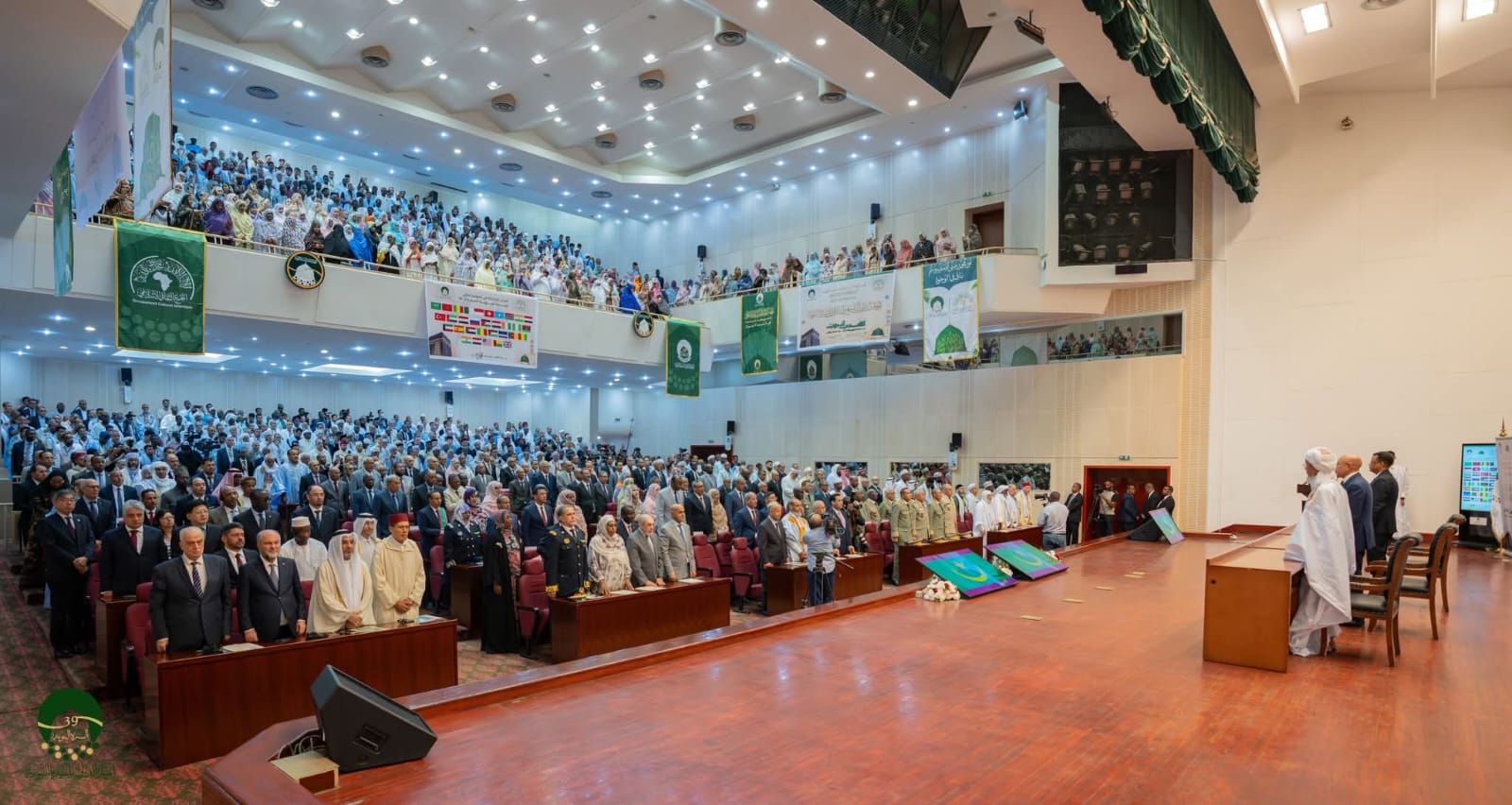
Ammon News - The 39th edition of the Conference on the Prophet’s Biography opened on Monday, September 14, 2026, in Mauritania’s capital, Nouakchott. Organized by the Islamic Cultural Assembly in Mauritania and West Africa, under the high patronage of Mauritanian President Mohamed Ould Cheikh El Ghazouani and under the supervision of the Ministry of Islamic Affairs and Original Education, the conference brings together scholars, researchers, imams, intellectuals, and religious and cultural figures from Mauritania and a number of Arab, African, and Islamic countries.
The opening ceremony began with a recitation of verses from the Holy Quran, followed by the playing of the Mauritanian national anthem. The program also featured segments of Prophetic praise poetry, as well as a documentary highlighting the historical development of the conference since its launch in 1989. Other segments were dedicated to young people, Muslim minorities, scholars, imams, and scientific and religious institutions.
In his address at the opening ceremony, President Mohamed Ould Cheikh El Ghazouani stressed that diversity and difference are inherent characteristics of human existence, emphasizing that human dignity is intrinsic to every person simply by virtue of being human and does not depend on race, color, or any other characteristic.
He said the challenge lies in managing diversity effectively so that it does not turn into division and fragmentation, highlighting the importance of Prophetic guidance in promoting acceptance of others, justice, and fairness. He noted that the Prophet Muhammad transformed Muslims from narrow tribal loyalties to the concept of a unified community based on bonds that transcend particular affiliations.
The Mauritanian president also highlighted his country’s approach of engaging in dialogue with different parties and accepting differences, alongside strengthening institutions, the rule of law and justice, combating poverty and exclusion, and promoting national cohesion and shared values. He underscored the central role of scholars, intellectuals, and researchers in providing a sound understanding of religion and advancing moderation and balance.
For his part, Sheikh Mohamed El Hafiz El Nahoui, President of the Islamic Cultural Assembly in Mauritania and West Africa, said the Mauritanian president’s attendance at the opening represented strong support for the conference’s scholarly and religious mission. He stressed that interest in the Prophet’s biography should not be limited to academic knowledge, but should extend to drawing practical inspiration from it in building individuals and societies.
He emphasized that the Prophet embodied in his life the values of mercy, justice, and respectful engagement with those who held different views, noting that the society he established succeeded in bringing together people of different ethnicities, religions, and affiliations while safeguarding rights and upholding justice.
He called for making the Prophet’s biography a project for building individuals, strengthening national unity, promoting moderation, and rejecting extremism. He described engagement with the Prophetic model as a call to mutual understanding, dialogue, and cooperation, as well as to managing differences with wisdom and responsibility.
Sheikh Adam Shahidov, adviser to the President of the Chechen Republic, praised Mauritania’s sponsorship of the conference, saying that attention to the Prophet’s biography represents an important means of confronting extremism and consolidating religious foundations, particularly Ash‘ari theology, the Maliki school of jurisprudence, and Junaydi Sufism.
He highlighted Mauritania’s historic status as a center of scholarship and knowledge in the Islamic world, pointing to the role played by traditional Quranic schools and Mauritanian scholars in transmitting Islamic sciences to various parts of the Muslim world, including the Hijaz, Al-Azhar, and other major centers of learning.
He also emphasized the importance of scholarly and spiritual ties between Nouakchott and Grozny, noting that academic gatherings of this kind help build bridges of cooperation between scholars and religious institutions and revive the Prophetic model of mutual understanding and brotherhood, as exemplified by the Prophet’s establishment of bonds of brotherhood between the Muhajirun and the Ansar.
In his address, Dr. Mustafa Zahmouni, representing Morocco’s Minister of Endowments and Islamic Affairs, highlighted Mauritania’s scholarly and spiritual standing as a land of learning, scholars, and piety. He recalled the universal dimension of the Prophetic message, which brought humanity from the worship of human beings to the worship of God.
He also referred to the message sent by King Mohammed VI to scholars on the occasion of the 1,500th anniversary of the birth of the Prophet Muhammad, and highlighted the “Tasdid al-Tabligh” plan for guiding and refining religious discourse adopted by Morocco’s Supreme Council of Ulema, with the aim of serving the objectives of Islamic law and promoting moderation.
The conference is also attended by Sheikh Ould Saleh Al-Amin, Secretary-General of the Mauritanian Ulema Association; Sheikh Abdelmalek Anias, Secretary-General of the International Quran Prize; Sheikh Mohamed El Maamoun El Qasmi, Algerian Minister of State and Dean of the Great Mosque of Algiers; and Professor Dr. Nasruddin Umar, Indonesia’s Minister of Religious Affairs, alongside scholars, researchers, imams, and religious and cultural figures from participating Arab, African, and Islamic countries.
During the opening ceremony, a gift was presented to the Mauritanian president consisting of a copy of the Holy Quran and a collection of Mauritanian works on the Prophet’s biography, reflecting the conference’s close connection with Mauritania’s scholarly heritage and the contribution of its scholars to the study and preservation of the Prophetic biography.
The conference, hosted by the Al-Mokhtar Ould Daddah International Conference Center, will continue through September 16 under the theme: “Prophetic Guidance in Managing Diversity and Difference and Strengthening Common Ground.” The theme approaches the Prophet’s biography as a source of values underpinning dialogue, coexistence, justice, and cooperation, while seeking to transform difference from a source of division into an opportunity for mutual understanding and complementarity.
The theme of this year’s edition is inspired by the Quranic verse: “We have not sent you except as a mercy to the worlds” (Quran 21:107). Discussions will explore ways of drawing on the Prophetic model in addressing religious, cultural, and social diversity, promoting acceptance of others, safeguarding human dignity and rights, and strengthening shared values among societies.
The 39th edition is a continuation of a scholarly and cultural journey that began in 1989 and has, over the decades, brought together scholars, intellectuals, and researchers from Mauritania, the Arab world, Africa, and the wider Islamic world to discuss the Prophet’s biography and its relevance to the transformations taking place in contemporary societies.
Participants will examine the various dimensions of Prophetic guidance in managing diversity and difference and strengthening common ground, reinforcing the role of the Prophet’s biography as a source of human values, dialogue, and coexistence, and as a foundation for building more cohesive societies capable of managing their differences with wisdom and justice.



 comment replay











 الرجاء الانتظار ...