Ammon News - A new study shows that little, wrinkly Mercury may be shrinking faster than expected, the cosmos’ version of a grape shriveling into a raisin under the sun.
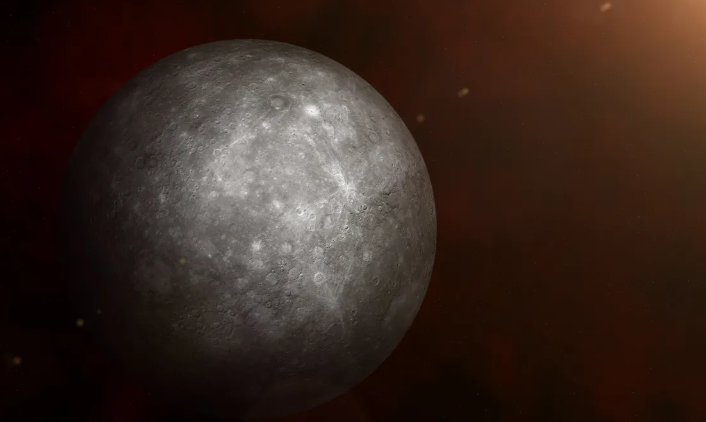
Scientists from the German Aerospace Center’s Institute of Space Research reported Thursday that Mercury’s shrinkage may be 30% greater than previously believed — a loss in diameter of as much as 14 miles (23 kilometers). That’s significant for a planet barely 3,000 miles (4,900 kilometers) across.
Mercury’s rough surface, continually reshaped by debris hurled from impact craters, may have hidden the true extent of the loss, according to the researchers whose findings appear in the journal Geophysical Research Letters.
The news comes one week after a pair of European and Japanese spacecraft shed its cruising platform and advanced toward Mercury, The Associated Press reported. Known as BepiColombo, the linked craft are expected to enter orbit around Mercury in November before splitting up for a fuller survey.
BepiColombo’s laser instrument should confirm how much Mercury is withering as a result of internal cooling, said Gaku Nishiyama, the study’s lead author who is taking part in the space mission.
The shrinkage could be even more than his team is estimating based on measurements from NASA’s Messenger spacecraft in the 2010s. Only one other spacecraft has ever visited Mercury, NASA’s Mariner 10 in the 1970s.
Our solar system’s smallest and innermost planet has been shrinking ever since its formation 4.5 billion years ago. Its hot iron core — oversized for such a small world — cools and contracts along with the mantle and crust, tightening the surface like a girdle to fit its new slimmer self.
Nishiyama and his team compared maps showing faults and other geologic signs of contraction at Mercury with newer maps highlighting surface roughness. They discovered that the roughest patches exhibited fewer shrinkage wrinkles. The missing wrinkles could be buried under impact debris, they said.
After accounting for these obscured regions, the researchers provided a fresh take on Mercury’s shrinkage that could shed light on other contracting worlds, said Nishiyama, who is affiliated with Hokkaido University in Japan.
“We are quite excited,” Nishiyama said in an email, adding that it feels like “we are approaching the reality of Mercury’s evolution.”



 comment replay












 الرجاء الانتظار ...