Ammon News - By Taylor Luck/ Jordan Times
MAFRAQ - Bugs, birds and weeds. Most farmers’ foes are welcome guests for vineyard owner Omar Zumot.
The owner of the first certified organic vineyard in the Middle East said he has taken a natural approach to breathe life into arid land near the Syrian border and cultivate grapes from around the world.
When he first chose a plot of land in Sama As-Sarhan, some 80 kilometres north of Amman, for the location of the vineyard, Zumot said he went decidedly natural, foregoing pesticides and chemical fertilisers.
“In order to make the best product possible, I knew we had to go organic,” Zumot told The Jordan Times during a recent visit to the vineyard.
Taking cues from Germany, France and as far away as Chile, he has applied various organic horticulture techniques, stressing that with warm summers and cool winters, Jordan is perfect for applying organic farming methods.
Rather than waste water, the grape grower said he plants rows of barley among the vines to reduce the salinity of the soil, and aromatic herbs such as sage to drive away certain pests.
To his workers’ astonishment, he encourages the growth of thorns and thistles, which he said bring nutrients closer to the soil and in the range of the roots of his 34 types of grape vines.
“We overgraze and overgrow our lands and they become arid and lifeless. Encourage diversity and let things live on your land, your land will live,” he said.
Nature also plays a role in preventative protection, he said.
Zumot recently introduced American rootstock along the rows of vines in order to prevent any potential outbreak of Phylloxera, a bug that once devastated many of the major European vineyards in the 19th century and wiped out Salt’s signature grape when it arrived in Jordan in the early 20th century.
Rather than chemical fertiliser, nitrate-enriched water from an industrial-sized fishpond on the vineyard is used to enhance nutrients in the soil. Zumot said he initially purchased 150,000 fish from Syria and Iraq for his fish hatchery. As with everything in the vineyard, he had to rely on trial and error.
“First we had tilapia that thrived in the summer and died in the winter. Then we added trout which did great in the winter and died out in the summer,” he said, adding that he eventually settled on carp to inhabit the retention pond.
Although the methods may seem unorthodox, the results of organic farming are real, he stressed. His land once hosted leaf worms the size of a finger, he said, and now a worm can scarcely be found, all without the use of pesticides.
Organic farming techniques can also reduce consumption of precious resources, he stressed.
When Zumot first evaluated the land, he was told that the water pumped from a nearby underground aquifer could irrigate 400 dunums of crops. Through water-conscious practices, such as pressurised water irrigation, he is using the same amount for 2,500 dunums, and is in no need of additional water as he expands his vineyard westward.
“We are using less and less water each year. We have three wells which I have never resorted to,” he said.
The land has become so fertile that mole holes have sprouted up, as the animals are burrowing through clay and basalt to get a taste of the grapes, according to Zumot.
Zumot said he is on the constant lookout for new, natural means to increase his grape yield and improve his product.
“We’ve taken the best of different ideas and are applying them here in Jordan. Not all of them work, but people are surprised what you can accomplish once you work with nature rather than against it,” he said.
As part of his quest to add to his vineyard’s growing mini-biosphere, Zumot is currently experimenting with his latest addition: chickens.
“They plough all the time, they eat insects and hate grapes. I can’t get enough of them,” Zumot said, adding that he is still trying to find the perfect way to protect the flightless birds from the desert foxes, dogs, snakes and cats that roam northern Jordan.
The vineyard is also now home to pigeons, which eat insects and veer away from grapes that other birds find tempting. Zumot said he is welcoming the arrival of wasps in the fall, which kill lesser pests and, much like the pigeons, abstain from the grapes.
“We need competition in the skies as much as we need competition on the ground. It’s all part of having a well-rounded ecosystem,” he said.
The Sama As-Sarhan vineyard could serve as a model for farmers in the Kingdom and promote value-added agriculture, the vine-grower said.
“We turn to chemicals and machines, when nature has already given us all the tools we need,” he said.
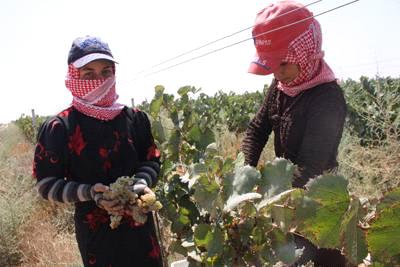
* Photo Credit: Workers harvest grapes at the St George Vineyards near the Syrian border last Saturday (Photo by Taylor Luck)



 comment replay
 الرجاء الانتظار ...