Ammon News - By: Abdulhamid Hamid Al-Kba
Agriculture in Uzbekistan is no longer viewed merely as a traditional rural sector linked to domestic production. Over recent years, it has gradually evolved into one of the central pillars of the country’s broader economic transformation strategy. Since President Shavkat Mirziyoyev came to power, Tashkent has adopted a series of reforms aimed at modernizing agriculture, strengthening food security, improving water-resource management, and expanding value-added production chains.
The current agricultural transformation in Uzbekistan cannot be understood separately from the “Uzbekistan 2030 Strategy,” which represents the broader framework for restructuring the national economy under President Shavkat Mirziyoyev’s leadership. In recent years, agriculture has shifted from a traditional quantity-based sector into a reform-oriented model focused on biotechnology, food security, smart water management, and long-term sustainability, supported by presidential decrees and institutional reforms designed to modernize the sector and attract investment.
These changes have unfolded amid rising geopolitical and economic pressures worldwide, including supply-chain disruptions, climate-related challenges, and increasing concerns over food and water security. In this context, Uzbekistan has begun treating agriculture not only as an economic sector, but also as a strategic instrument for strengthening regional stability, diversifying the economy, and expanding international partnerships — particularly with Arab countries.
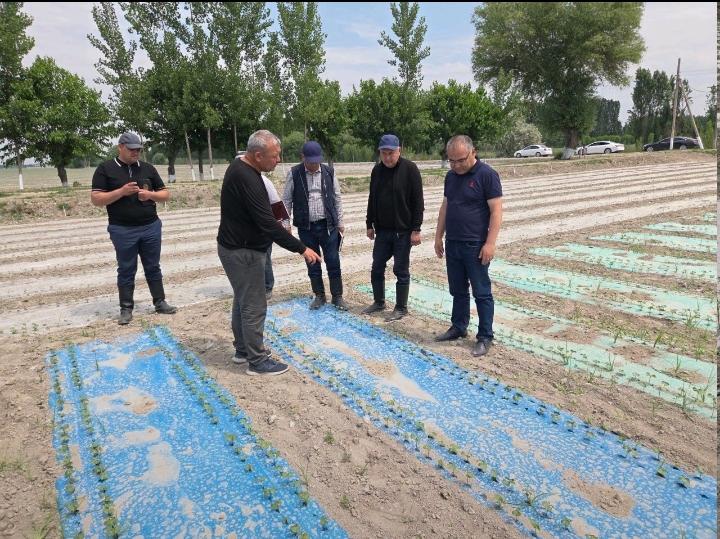
Through continuous observation and multiple visits to Uzbekistan during 2023 and 2024, it became evident that the agricultural landscape beyond major urban centers is undergoing visible transformation. Travel between Tashkent and Bukhara revealed expanding agricultural zones and growing green areas, reflecting broader efforts to reorganize production systems, improve infrastructure, and expand agricultural activity across different regions of the country.
According to official Uzbek data and international estimates through late 2024 and early 2025, agriculture still contributes between 17% and 19% of Uzbekistan’s GDP. More importantly, Uzbekistan today is considered one of the largest producers of fruits and vegetables in Central Asia, while the agricultural sector continues to employ a significant share of the national workforce. The significance of these figures lies not merely in their numerical value, but in the structural transformation they represent. The country is gradually shifting from a model heavily dependent on raw commodity exports toward one increasingly connected to food processing industries, storage infrastructure, logistics services, and integrated agricultural value chains.
Throughout 2025, the government continued implementing plans focused on irrigation modernization, agro-industrial development, supply-chain efficiency, and the expansion of smart-farming technologies. These reforms included upgrading irrigation networks, introducing digital tools, developing agricultural clusters and contract-farming systems, in addition to strengthening food-processing industries. Particular attention has also been directed toward improving water-use efficiency amid growing resource scarcity and the long-term environmental consequences associated with the Aral Sea crisis.
As a result, projects related to smart agriculture, advanced irrigation systems, and renewable-energy integration have gained increasing importance within Uzbekistan’s agricultural development strategy. Nevertheless, environmental pressures — particularly water scarcity, desertification, and climate-related challenges — remain among the sector’s most significant long-term obstacles.
This domestic transformation has coincided with a noticeable expansion of Uzbekistan’s international agricultural partnerships, with several Arab countries emerging as increasingly important partners across multiple areas of cooperation.
Saudi Arabia has shown growing interest in investing in modern agricultural projects linked to irrigation technologies, fodder production, and food industries. Discussions between both sides have also highlighted efforts to attract Saudi agricultural companies to participate in the modernization of Uzbekistan’s agricultural sector.
Meanwhile, United Arab Emirates has played an important role in sustainable water management, saline agriculture, and environmental adaptation projects. Cooperation with the International Center for Biosaline Agriculture has supported initiatives targeting environmentally affected areas surrounding the Aral Sea basin.
At the same time, Egypt has contributed valuable expertise in potato-seed technologies, agricultural quarantine systems, and food-processing industries, reflecting broader ambitions to strengthen agro-industrial integration and technical exchange between Cairo and Tashkent.
Agricultural cooperation has also expanded with countries such as Jordan, Kuwait, Qatar, Oman, Iraq, Syria, Palestine, and Morocco in areas including agricultural trade, research cooperation, food security, and investment opportunities.
Simultaneously, Uzbekistan’s broader agricultural transformation continues to rely heavily on partnerships with major international powers such as China, Russia, and Turkey, alongside several European institutions, particularly in infrastructure financing, logistics services, and agricultural technologies.
In parallel, Uzbekistan has expanded agricultural and environmental cooperation with the European Union and the United States. European institutions have supported projects related to sustainable agriculture, water-resource management, rural development, and environmental adaptation, especially within broader green-transition initiatives in Central Asia. Cooperation with the United States, meanwhile, has focused on agricultural modernization, food-security programs, research collaboration, and support for private-sector development and innovation in agro-industries. These partnerships reflect Uzbekistan’s broader strategy of diversifying its international economic relations while maintaining balance between regional cooperation and global engagement.
Uzbekistan’s geography also grants the country significant strategic potential. Located at the heart of Central Asia, the state seeks to establish itself as a regional agricultural and logistics hub connecting surrounding markets through expanding transport corridors and trade infrastructure. This direction aligns with broader efforts aimed at strengthening regional connectivity and diversifying export routes.
The agricultural transformations underway in Uzbekistan do not appear to be isolated sectoral reforms, but rather part of a broader attempt to redefine the country’s position within Central Asia through economic influence and food-supply capabilities. Tashkent is gradually seeking to transform agriculture from a source of raw production into a form of soft geopolitical leverage capable of attracting investment, expanding regional economic influence, and strengthening Uzbekistan’s role within Eurasian trade networks. If the current reforms succeed in overcoming water shortages and climate-related challenges, Uzbekistan could emerge over the next decade as one of the region’s leading centers for food security and smart agriculture.
Ultimately, agriculture is no longer simply a productive sector within the Uzbek economy. It has become part of a broader national strategy linking food security, technological modernization, environmental adaptation, and regional economic integration. As reforms continue, Uzbekistan appears increasingly positioned to strengthen its role as a rising agricultural power in Central Asia and as an important partner for Arab states and international actors seeking cooperation in food security, sustainability, and regional development.
Abdulhamid Hamid Al-Kba- Opinion writer specializing in Central Asia and Azerbaijan affairs



 comment replay











 الرجاء الانتظار ...