Ammon News - There is a good chance that if you pick up an Arabic-language video game, it was made in Jordan.
In the past several years, the country has emerged as a vibrant source of gaming content that is enjoyed across the Arab world.
Companies such as Wizards Productions, Maysalward, Quirkat, Jawaker and Aranim Media Factory have tasted early success in the region.
“We’re not really competitors. We’re all partners,” says Sohaib Thiab, the chief operating officer of Wizards Productions. “No one really knows about the gaming industry in the Arab world. It’s a fairly new concept to this region. So when everybody is pushing together, it will grow.”
While millions of people in the region play football games on the latest PlayStation or Xbox console, none of the video games sold by Sony, Microsoft and Nintendo, the three major gaming companies, are in Arabic.
Similarly, while the iPhone is now a major gaming device, it has yet to be embraced by regional video game publishers, as the number of smartphone owners in the region is still so small that it is, for instance, just a fraction of Facebook’s estimated 10 million subscribers in the region.
To get their gaming fix, Arab players are increasingly turning to basic mobile handsets, Facebook or online portals.
There are no official statistics on the number of video game enthusiasts in the region, but Muhannad Ebwini, the chief executive of Gate2Play, an online payment platform, says there are 5 million casual online gamers in the Middle East, each spending an average of US$18 (Dh66.11) a month on social media gaming.
A recent report by PricewaterhouseCoopers predicted the global gaming market would grow from $52.5 billion last year to $86.8bn in 2014. The region should experience similar growth. The games are admittedly simple, given the platforms on which they are based.
Mohammed Haj Hasan, a co-founder of Jawaker, Arabic for “jokers”, published 13 traditional Arabic card games online. Users log on and play remotely against each other. No downloads are required as the games take place within the browser.
Jawaker was founded in October 2008 and now has about 300,000 registered users and recently secured in-game advertising, which is displayed on the reverse side of its online playing cards.
“Because not a lot of people actually have credit cards in the region, some users actually give money to their drivers, who send it straight to us,” said Mr Haj Hasan.
“The funny thing is that it is actually more profitable for us that way than to collect payments through SMS short codes, for example.”
Nour Khrais, the founder and chief of Maysalward, is as close to a wise elder as one can get in the Arab gaming world. After initial stumbles, his company has published 45 mobile and 12 Facebook games in the past six years.
“Business is good but the cashflow is tough,” Mr Khrais says. “It’s not because of the business but it’s because of the equation, having the mobile operator, the publisher, the payment itself, that’s where it’s hard.”
He makes a good point. Publishers receive between 10 and 20 per cent of the expenditure on games, with operators demanding high fees for the right to distribute the material on the network. This has caused Arab gaming companies to look at other places to publish their work.
One of those is Facebook, with its estimated 10 million users in the Arab world. That figure is one of the main reasons Suleiman Bakhit, the chief executive of Aranim Media Factory, has decided to publish a game on the social-networking site.
Mr Bakhit, whose company is one of the largest publishers of Arabic-language comic books, did not start out thinking he would move into video games.
But after seeing the limits of the print medium, he decided to a Facebook game to coincide with the launch of some of his upcoming comic titles.
“There’s huge potential here,” Mr Bakhit says. “All of us are going to be online gaming companies. I still think there’s room for all of us to grow and succeed. It’s that big a market.”
One of the more successful Jordanian gaming firms is Quirkat. In 2007, the company released Arabian Lords, a PC game in which players manage their own Middle East cities during the seventh to 13th centuries.
The game, published in Arabic and English, was a hit, selling about 8,000 copies.
Quirkat also operates Fuzztak, an online gaming portal that receives about 30,000 unique hits a month and features titles such as Al-Moosiqar, a Guitar Hero-like game with an oud instead of a guitar.
But now the company has also decided to pay closer attention to Facebook. During the World Cup, Fuzztak released a fantasy football game and signed up 25,000 users.
“We produce more [gaming] talent more than any other country [in the region], mainly because that’s all we have. Our human resources is our oil,” says Mahmoud Ali Khasawneh, the chief executive of Quirkat.
The software firm is now looking to become one of the first console-gaming companies in the region and has signed a development deal with Sony to produce an Arabic title for its PlayStation Portable unit.
All this is good news for IV Holdings, one of the few venture capital firms that have taken a keen interest in the region’s video-gaming industry.
“There’s definitely something there,” says Omar Sati, an associate at IV Holdings, which has invested in Quirkat, Gate2Play and Wizards Productions.
“Each company now is focusing on doing something in a different way. They’re innovating. They’re figuring out that something isn’t working and fixing it.
“This is the Jordan way. Nothing in Jordan has ever come easy and everyone has always found a way to go about it and solve their problems.”
* By David George-Cosh/ The National
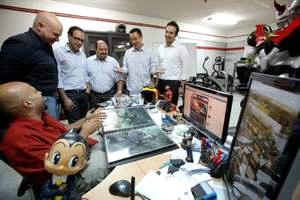
dgeorgecosh@thenational.ae * Photo: From left, Suleiman Bakhit, Afif Toukan, Mohammad Haj Hasan, Muhannad Ebwini, Nour Khrais and Sohaib Thiab discuss the state of the Arabic gaming sector. Salah Malkawi for The National



 comment replay
 الرجاء الانتظار ...