Ammon News - AMMONNEWS – Banan Malkawi - The same organization that had earlier in the year dropped Jordan’s status from ‘Partly Free’ to ‘Not Free’ in its Freedom in the World 2010 index, painted yet another grim picture of the status of press freedoms in Jordan by designating the Kingdom again ‘Not Free’ in its Freedom of the Press 2010 survey.
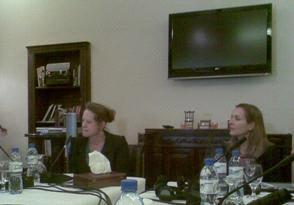
Freedom House’s press survey and media freedoms in Jordan and throughout the world were the topics of discussion at a roundtable held on Thursday with Paula Schriefer, Director of Advocacy at Freedom House, and organized by the American Embassy in Amman on the occasion of the World Press Freedom Day.
Jordan still managed to keep itself in the ‘Not Free’ category, improving an insignificant one point since the 2009 report, to a score of 63. “There was neither substantial improvement nor decline in Jordan’s status,” Schriefer said.
“The survey doesn’t only evaluate what is written [in laws], but also how they are actually being implemented,” Schriefer said of Freedom House’s methodology, using three main criteria for evaluation 1) the legal environment, (constituting 30 points), evaluating whether legislation, including the constitution and access to information laws, protect and enable media freedoms, 2) the political environment (40 points), evaluating the political pressures on the press from both state and non-state actors, and the public’s access to diverse sources of information, and 3) the economic environment (30 points), evaluating the level of state ownership in media and the facilitations of private sector development of media outlets.
The survey uses a scale of 100 possible points; the higher the score the worse the rating. The scores are then converted into one of three broad categories of Free, Partly Free, and Not Free.
The 2010 survey on press freedoms revealed that in 2009, and for the eighth year in a row, the world has been witnessing regression in press freedoms, globally.
“The past eight years have witnessed an increase in laws that limit freedom of the press and expansion of censorship from print media to the Internet and new media,” she explained.
FACTORS THAT PLAY INTO JORDAN’S POOR EVALUATION
Jordan scored 20 out of 30 in the legal environment criteria, 24 out of 40 in the political environment, and 19 out of 30 in the economic environment, giving a total of 63, a mere three points away from being ‘Partly Free.’
A problematic area in Jordan’s evaluation rests in legislation, represented by the Penal Code, Press and Publications Law, and the Press Associations Law, said Schriefer, who has worked for over 17 years in democracy and human rights promotion.
“Journalists should never be forced to join an association to freely practice journalism,” she added. “An easy measure for Jordan to improve its rating is by eliminating this condition.”
“We already have an unfavorable opinion on both the Press and Publications Law and the Press Associations Law, we are already critical of the fact that print media falls under these laws,” so including electronic media as well would only decrease the level of Freedom House’s estimation of Jordan’s performance, she stressed.
Jordan is the first country in the region to legislate the ‘Access to Information’ Law, which counts as a plus for the Kingdom, “but exceptions in regards to security information and the vagueness of the law indicate that the law is not being implemented well,” explained Schriefer. This is also an easy measure to improve Jordan’s status to move to ‘Partly Free,’ she added.
Other factors negatively affecting Jordan's score include the harassments and attacks on journalists by security forces, government appointments of heads of media outlets and editors, and government ownership or influence on broadcast and other media forms.
Self-censorship in Jordan has been openly admitted by editors and journalists, who fear potential harassment, intimidation, and/or legal prosecution. Yet Schriefer added that some areas that count to the benefit of Jordan include active private-owned media outlets, and the ability of the press to criticize public officials.
Jordan had responded to Freedom House’s 2010 Freedom indexes by expressing that such surveys were made from a “purely legal and abstract perspective, without taking into consideration the specificity of the situation on the ground in the Kingdom … by focusing on the dissolution of Parliament, the reports understate the positive achievements, especially in regard to press freedoms,” a statement issued by the Ministry of Political Development had said last month.
“We didn’t find it a convincing argument, so we didn’t take the time to respond to it.. We have a problem with this argument, democratic states do not pick and choose when to apply democratic standards,” Schriefer said, stressing that democratic and free states do not set democracy aside whenever it finds it expedient.
On the credibility and impartiality of freedom and human rights organizations in giving accurate depictions of freedoms in their countries, Schriefer noted that it is true nearly everywhere, in the U.S., as in Jordan, that organizations may have political or ideological leaning, or merely concerned with funding, that may influence its portrayal of conditions in the country, “that’s why Freedom House works to gather as many sources as possible” to get a more accurate status of freedoms, she stated.
“Civil Society and non-governmental organizations gain credibility through their work. We have many critics, governments think we’re too critical, while journalists think we’re too lenient,” Schriefer explained.
Freedom House generally receives two types of responses; countries that receive favorable scores tend to stress that the organization is a respected watchdog whose opinions are important. Yet those countries that receive unfavorable or declined scores claim that the organization is “unreliable, naïve, does not understand the context of the situation in the country, or label us as agents trying to perpetuate a U.S. agenda,” she explained.
The 2010 Freedom of the Press survey also focuses on new media and freedom on the Internet starting last year. The survey looks in more detail at people’s ability to access a diverse array of new media outlets and different kinds of contents.
New media has played a dual role, Schriefer said, both helping increase freedoms of the press, but in other circumstances has instigated authoritarian countries to move towards finding new means to restrict online content and legislating new laws to restrict new media, she noted.
“On-line news media should be held at the same standards as print media in terms of reliability and credibility,” she stressed.
Freedom House is celebrating its 70th anniversary next year, being the oldest Human Rights organization in the United States, established in 1941, working to promote human rights and freedoms around the world.
The UN General Assembly has declared May 3rd of each year to be World Press Freedom Day in order to raise awareness of the importance of freedom of the press and remind governments of their duty to respect and uphold the right to freedom of expression and human rights.



 comment replay