Ammon News - AMMONNEWS – SALT – Al-Balqa’ Applied University's Vice President for Academic Affairs, Professor Abdallah Al-Zoubi announced Monday that the university commenced the implementation of two applied scientific geophysical research projects, entitled “High Resolution Imaging of Active Faults in Aqaba Region” and the “Sinkhole Hazard Assessment of the Dead Sea Area” funded by the Middle East Regional Cooperation (MERC) program.
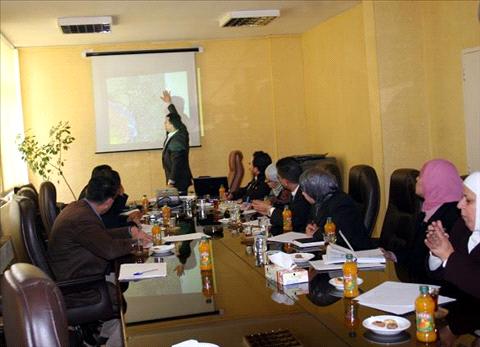
In a press conference held at the Al-Balqa’ Applied University (BAU) headquarters on Monday, Prof. Al-Zoubi noted that the two projects carried out through advanced geophysical surveying and mapping in the Gulf of Aqaba and the Dead Sea regions come within the university's commitment to scientific research that has direct impact on social development and risk mitigation.
Prof. Al-Zoubi stressed the importance of the two projects on the local and international levels and exerted personal efforts to secure generous funding totaling around $423,000 from the Middle East Regional Cooperation (MERC), a program of the United States Agency for International Development (USAID).
The projects have direct impact on public and private sector mega-projects and development in Jordan.
The first project, titled 'High Resolution Imaging of Active Faults in Aqaba Region’ which will be carried out throughout a two-year period, includes high resolution seismic survey, Ground Penetrating Radar, Electro-Magnetic Radiation and coring from the gulf floor.
The aim of this research is to characterize the earthquake hazards by determining the seismic potential of the mapped faults that lie offshore and beneath the city. At the same time the research team is planning to collect marine cores from the Gulf up to a depth of 500 m. The allocated budget for the BAU research team is $190,960 from the total cost of the research project $381,436.
The second project, ‘Sinkhole Hazard Assessment of the Dead Sea Area’ aims to understand the sinkhole mechanism and to develop a methodology for the combined application of several geophysical methods for delineating those areas, which are at high risk of potential sinkhole collapse, thus endangering human life and infrastructure and limiting economic development.
Prof. Al-Zoubi counted the geophysical methods they are going to use such as 3D Seismic Reflection survey, Continuous Vertical Electrical Sounding (CVES) and Time Domine Electromagnetic (TDEM), Micromagnetic and Microgravity survey and Electro-Magnetic Radiation (EMR). The allocated budget for the BAU research team for this research is $232,202 from the total cost of the research project $473,740.
At the same time the study will utilize advanced technological equipment, first of its kind in Jordan such as Microgravity Meter and others, which reflect positively in the human capacity development of the country.
Prof. Al-Zoubi stressed the importance of this study considering the imminent threat posed by Sinkholes in the region, and described various instances where sinkholes appeared instantaneously in populated and agricultural areas such as the town of Ghoar Al Haditha, and the human and financial risks the sinkholes pose, especially since they occur without any prior warning or indicators.
On the benefits of these studies, Prof. Al-Zoubi stressed that these two scientific research projects, along with three other projects (Integrated Geophysical Study along the Dead Sea Rift, High Resolution geophysical survey in the Gulf of Aqaba, and the Salinity curse of the Middle East fossil groundwater: The Radioactivity factor) that he implemented at the university since 2003 and funded from MERC, are essential for both the public and private sectors in carrying out vital mega-projects such as the Red-Dead Sea Canal, energy projects, airports, real estate development, and tourism development, especially considering that the two regions, Aqaba and the Dead Sea, are prime tourist regions for investors and important sources of tourism income for the state.
The total fund for the above-mentioned projects is around $1,149,000.
The projects directly benefit the university and its students from the academic research and training points of view, in addition to contributing to the overall scientific research field in the region. Prof. Al-Zoubi stressed that BAU is committed to sharing the results of the studies with the international scientific community and to providing consultations and data analysis to the government and mega-project investors to ensure that future projects are implemented with precise feasibility studies, and to analyze the risk factor subjected the local community and the region.
This is in addition to the direct social and economic impact of the studies on various aspects of development on Jordan and the region, Al-Zoubi added.
It is noted that Al-Zoubi’s research team has also conducted five projects and several scientific consultations in the last seven years in the field of water, environmental and hazard assessment that had earned the attention of local and international scientific communities. These research projects were funded from BMBF-Germany, NATO and Rotsheled Foundation in sum of about $1,200,000.
Significantly, the scientific results had a direct impact in the development of areas such as Aqaba, Wadi Araba, Dead Sea and the Jordan Valley. The grants covered the cost of post-graduate scholarships of BAU students, participation in training courses in USA, Canada, Germany and France, besides to the participation in the international scientific conferences and equipping the labs with highly sophisticated geophysical equipment, software and accessories in a sum of around $900,000.
By Banan Malkawi



 comment replay