Ammon News - AMMAN - The 2005 Amman hotel bombings had a significant and continuing impact on the Jordanian public and the way they view terrorism, according to analysts.
Prior to the November 9, 2005 terrorist attacks on three hotels in Amman, which left dozens dead or injured, there was “significant popular support” for Osama Ben Laden and Al Qaeda network, the experts said.
In a poll carried out by the Centre for Strategic Studies, 66.8 per cent of Jordanians said they considered Al Qaeda as a "legitimate resistance group", in 2004.
In a similar poll taken one month after the bombings, however, only 20 per cent of Jordanians saw Al Qaeda in Iraq as a “resistance group”.
According to the findings of the 2006 survey, the percentage of Jordanians viewing Al Qaeda as “legitimate” plummeted to 6.2 per cent, while 72.2 per cent of the polled national sample considered Al Qaeda in Iraq to be a terrorist organisation.
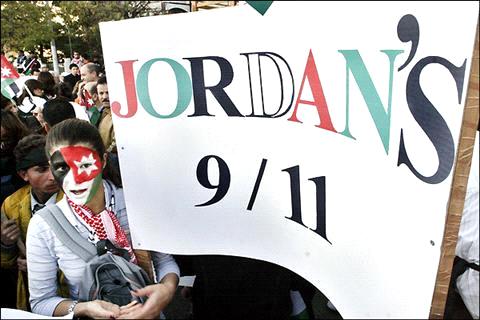
“The bombings of our 9/11 changed Jordanian public opinion of Al Qaeda,” said Fares Braizat, who conducted the polling and currently heads the Qatar University Research and Surveys Centre.
“It was no longer something you saw on TV, but on the streets of your neighbourhood, which made it much more personal,” Mohammad Momani, analyst and professor of political science at Yarmouk University, told The Jordan Times.
Columnist Jamil Nimri agreed.
“Before the attacks, support for Ben Laden was high as some saw him as a pro-Islamic hero. But in the aftermath of these horrible attacks, everything changed, and the polls reflect this,” Nimri said.
Prior to the attacks, the Jordanian public did not differentiate between terrorism in Iraq and resistance in Palestinian lands and many saw Al Qaeda as an extension of resistance against the agendas of the US, Israel, and other foreign countries, according to Nimri.
Terrorism analyst Mohammad Abu Rumman said that after the bombings, Jordanians realised that unlike traditional resistance groups, Al Qaeda was without a “political or resistance agenda”.
“People realised Al Qaeda can only damage more than it can build,” he said, stressing that although the attacks swung public opinion against Al Qaeda, it did not generate support for American and Israeli policies in the region.
Nimri condemned the attitude of some moderate Islamists, which he said initially tried to “distort public awareness” and deflect the blame of the attacks from the actual perpetrators to the US and Israel.
“There were many conspiracy theories surrounding the attacks in the first few days. It was easy to say it was the CIA or Mossad, but it initially gave the terrorists a free pass for what they had done,” he said.
After the apprehension of would-be suicide bomber Sajida Rishawi, however, and as facts behind the attacks became known, “people could no longer blame these attacks on someone else, and Jordanians truly saw Al Qaeda for what they really were”.
Over time, however, Jordanian’s view of Al Qaeda has evolved, with many “fluctuations” between 2005-08, according to Braizat. Those who reportedly answered “I don’t know” to the terrorism survey, swelled to around 40 per cent last year.
Meanwhile, the proportion of Jordanians who considered Al Qaeda in Iraq as a terrorist organisation has dropped by half since the 2006 survey, he pointed out.
This, according to the expert, is due to a proportion of the population whose views on Al Qaeda are influenced by regional events. If surveyed shortly after an attack where many civilians were killed, the “don’t know” camp would define the organisation as terrorist, he said. If the poll was taken after an attack on the US-led coalition in Iraq, however, the “swing respondents” are more likely to label the organisation as a resistance group.
“The general trend is that although following the bombings of Amman - the majority of the public viewed Al Qaeda as a terrorist organisation; over time, the situation has turned to one of ambivalence -especially towards Al Qaeda in Iraq,” Braizat said.
In the most recent survey, the WorldPublicOpinion.org poll on Islamic world opinions of terrorism and US policy earlier this year, 27 per cent of Jordanians have positive views of Ben Laden, compared to 20 per cent who have negative views and 27 per cent reported to have "mixed" feelings towards Al Qaeda leader.
Abu Rumman expressed scepticism over certain studies purporting a significant amount of Jordanian support for terrorism, stressing that the outcome depends on the wording of the surveys.
“Jordan still condemns terrorism at face value, but some may differ over its definition,” he said.
* Taylor Luck/ The Jordan Times



 comment replay
 الرجاء الانتظار ...