Ammon News - By Ann Hornaday
Let the wild rumpus start.
Washington Post
There are few movies this season more hotly anticipated than Spike Jonze's adaptation of Maurice Sendak's beloved children's book. That 1963 picture book about a boy named Max who is sent to his room without supper and then embarks on a journey to the far reaches of his imagination accomplished in a handful of sentences what novelists struggle to achieve in hundreds of pages. It provided a screen onto which readers of every age could project their own realities. It made space for parents and children to acknowledge their deepest anxieties. It created a world.
Jonze creates a world, too: a big, weird, richly imagined universe that will outrage literal-minded purists as surely as it will please those who understand that, at their best, adaptations destroy as much as they build. It's a rule that Jonze, best known for the mind-bending "Being John Malkovich," followed to the bizarro letter in "Adaptation," his trippy take on the book "The Orchid Thief."
No surprise then that Jonze, who was reportedly handpicked by Sendak to bring his enigmatic little book to the big screen, has done what any serious, self-respecting artist would do when faced with a task guaranteed to disappoint as many fans as it delights. He's thrown away "Where the Wild Things Are" as a holy text, using it more as a psychological template for a different kind of story about a child grappling with rage and abandonment and his own fearsome power. The resulting movie is more an extended riff than a mere illustration, and one that manages to its own reality and meaning, even while it brings Sendak's visual world to life with startling accuracy.
Jonze makes a number of radical departures from the book in "Where the Wild Things Are," which he wrote with the novelist Dave Eggers. In the book, Max was the sole protagonist until he reached the monster-inhabited island of his dreams, the omnipotent force of his mother remaining out of the picture. In the film, Jonze populates Max's world with an indifferent older sister and a busy single mother (Catherine Keener), whose date with a suitor ignites the tantrum that sends Max out to sea. Rather than being banished to his bedroom, Max played in a restrained, quietly convincing performance by Max Records runs out of the house, giving his escape far higher stakes and a much more dangerous psychological edge.
Viewers expecting a consoling, soft-focus version of an anodyne children's story should be forewarned: Jonze takes the story to the dark and edgy place where devotion slips into aggression, where loneliness and fear are indistinguishable from liberation and desire. This isn't to say that "Where the Wild Things Are" isn't suitable for children; it's just that it will probably be most enjoyable to children with a working knowledge of Bruno Bettelheim's "The Uses of Enchantment" and psychoanalytic theory.
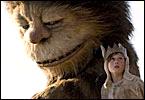
Most of "Where the Wild Things Are" transpires on the island, where Max explores the forests and headlands of his subconscious, and where he is crowned king by a tribe of giant, furry behemoths. In the book, of course, these ogres were nameless creatures who danced anonymously with Max in a flickering world of shadows and firelight. Jonze faithfully re-creates that atmosphere in the movie, which is steeped in a golden, autumnal palette. But he and Eggers have also given the monsters names, like Ira and Judith and Douglas, as well as distinct personalities.
As Max is crowned king of the island and navigates his new family which, guess what, turns out to recapitulate the very tensions he sought to flee as well as his newfound autocratic powers, he develops a special friendship with a temperamental hairball named Carol, whose explosive anger and destructive bent Max instinctively recognizes.
It turns out that Carol is played underneath a magnificently scruffy costume by James Gandolfini, which might be the only poor decision Jonze made. Film buffs may recognize the voices of the other monsters, but for the most part they're allowed to emerge as the vivid, prickly, sad and funny characters that they are. But Gandolfini's nasal slur is by now so familiar that it's impossible to hear Carol and not see some hirsute, roly-poly version of Tony Soprano gamboling with Max through the island's sandy expanse of dunes, or showing off his own imaginative world, made entirely of sticks and mud.
That creation, like every other visual flourish and detail in "Where the Wild Things Are," is flawless, a meticulously conceived amalgamation of the organic and the surreal that completely captures the austere cross-hatched detail and half-toned color scheme of Sendak's original drawings. Coupled with a hip, lushly emotional score by Carter Burwell and the Yeah Yeah Yeahs' Karen O, the production design plunges filmgoers into an altogether convincing world of both earthy realism and lyrical escapism. (Piling reality on top of surreality, Jonze occasionally injects real creatures into the magical proceedings, such as when a birdlike creature named Douglas cradles a real-life kitty cat, or Max and Carol happen upon an enormous dog.)
As cherished as Sendak's book is by generations of parents and children, it's hard to call "Where the Wild Things Are" a family movie unless the family in question happens to dig poetic, elliptical films that plumb the depths of separation, loss and forgiveness. Some viewers will no doubt be put off by Jonze's more digressive departures from the text, his psychological emphasis, his focus on dysfunction and real-world dramas. But plenty of filmgoers, packaged in a nuclear unit or not, will appreciate the sheer artistry, ambition and integrity with which Jonze has tackled a nearly impossible cinematic mission.
So, a desecration? Far from it. A work of art? No question. In elaborating on the original book so boldly, and repopulating it so richly, Jonze has protected "Where the Wild Things Are" as an inviolable literary work. In preserving its darkest spirit, he's created a potent, fully realized variation on its most highly charged themes. Most important of all, he's achieved with the cinematic medium what Sendak did with words and pictures: He's grasped something true and terrifying about love at its most unconditional and voracious.
In a case of felicitous timing, "The Horse Boy" also opens in Washington on Friday, and it plays like the documentary version of Sendak's allegory of unbridled impulses and how they become civilized.
The film chronicles a journey undertaken by journalist Rupert Isaacson and his wife, Kristin Neff, a psychology professor, who were raising their 5-year-old autistic son, Rowan, in central Texas when they made a discovery. Rowan, given to epic tantrums, screaming fits and unruly toilet habits, calmed down the minute he got on a horse, just one example of the child's seemingly intuitive bond with animals. Isaacson, who had covered traditional healing practices in Africa, decided to take his son to Mongolia, where horseback riding was invented and where, it turns out, shamans with the most highly developed powers live herding reindeer in the country's northern territories.
The Isaacson family's sojourn may not last "in and out of weeks," but in many ways Rowan's adventures uncannily mirror Max's travels in "Where the Wild Things Are." And, like Maurice Sendak's book and Spike Jonze's film, "The Horse Boy" is about many things, among them passionate parental devotion that is so often experienced as irrational, capricious will. There are moments in "The Horse Boy" when Isaacson's determination to cure his son despite the boy's full-throated distress at being jumbled along the Mongolian steppe on a recalcitrant horse looks like nothing more than bourgeois, New Age arrogance. Rowan may not be alone in a tiny sailboat, but he's undeniably at sea.
But just when "The Horse Boy" begins to look like a supreme exercise in self-deception, little miracles begin to happen. There are wild rumpuses all the way through the film, from the family's first, eerily dramatic encounter with shamanic healers and Rowan's incipient friendship with a Mongolian contemporary, to a climax that rivals Sendak himself in its depiction of a child's inner life.
It's surely too easy to romanticize the struggles and breakthroughs that Rowan and his parents go through in "The Horse Boy" and no doubt continue to contend with. But the questions their story raises are too provocative to ignore, as are the haunting ways it rhymes with its fictional counterpart. "The Horse Boy" offers an intimate, deeply affecting glimpse of coming to terms with a kind of wildness, and deciding which parts to tame and which parts to claim.
Where the Wild Things Are (101 minutes, at area theaters) is rated PG for mild thematic elements, some adventure action and brief profanity.
The Horse Boy (93 minutes, at Landmark's E Street Cinema) is not rated.



 comment replay