Ammon News - By Banan Malkawi
AMMONNEWS - A Jordanian press freedom watchdog on Saturday said that the attacks on journalists during the peaceful pro-reform protest in Al Nakhil Square near downtown Amman on July 15th by security and gendarmerie forces were "premeditated, intentional, and systematic."
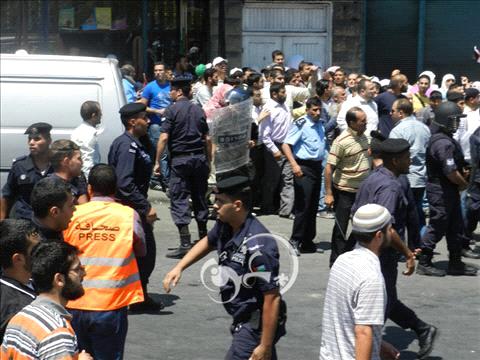
The Center for Defending the Freedom of Journalists (CDFJ) noted in a report it issued after conducting an inquiry into the Friday July 15 events that after collecting evidence, testimonies, and photo and video coverage that many journalists who were beaten, insulted, or their cameras destroyed or confiscated were wearing the special vests distributed by the Public Security Directorate (PSD).
PSD had issued bright orange vests with clearly marked "Press" logos to journalists after coordinating with the Jordan Press Association (JPA) and CDFJ a day before the events to ensure the safety of journalists and facilitate their coverage.
In a press conference held at CFDJ on Saturday, the center said that the security forces' attacks on journalists who were covering the protest is a "clear and evident violation of the Jordanian constitution, Jordanian laws, and human rights conventions that Jordan had ratified."
The report relied on interviews with journalists and eye witnesses who were at the scene, visited the injured journalists in hospitals, and distributed a form on a number of protestors to give their testimonials.
The inquiry committee also reviewed pictures and video shoots from journalists who were in Al Nakhil Square, in addition to statements given by government officials before and after the events.
CDFJ sent copies of the report to King Abdullah II, and state officials including the Prime Minister, House Speaker, Senate President, Chief of the Royal Court, ministers, head of PSD, head of Jordan's General Intelligence Department, and civil society institutions and professional associations.
Regarding its charge that the attacks on journalists were intentional, the report stressed that evidence collected for the probe revealed that many of the journalists were wearing the Press vests, and many others were insulted and beaten after repeatedly informing the security personnel that they were journalists.
Many of the journalists who were attacked were carrying cameras and recording the clashes, which led security personnel to attempt to stop the press from recording.
"The attacks were not individual acts or random and incidental attacks, the narratives [by journalists] constitute indisputable evidence that there was prior intention to target journalists and media personnel to prevent them from covering the events and obstruct their freedom of press," the report said.
The report cited statements by Prime Minister Marouf Bakhit a day before the protest that "no open protests will be tolerated," and Minister of Interior Mazen Saket who stressed that "Jordan will not allow a duplication of Tahrir Square."
CDFJ stressed that the Nakhil Square events were not the first incident of systematic attacks on journalists, rather it was preceded by the Interior Ministry Circle events on March 25th, and the "Right of Return" demonstration in Karamah on May 15th, in addition to numerous attacks, threats, and intimidations of journalists.
The center recorded 16 main incidents of physical attacks on journalists on July 15, in addition to ongoing interviews with other journalists, including Fahim Kareem of the New York Times, Khalil Mazra'awi, a JPA board member, Lina Ejeilat of Reuters, Muhammad Hannoun of Associated Press, and others.
The report also stressed that the attacks were systematic, specifically targeting journalists, and was not incidental or random.
"Most of the reported cases revealed a specific methodology of attacks on journalists, including hitting journalists' arms and hands to their cameras.. the number of security forces who took part was very large, and they formed groups of ten or more to attack individuals in an effort to stop journalists from covering and relaying the facts on the ground," the report claimed.
It also noted that security forces were not wearing their name badges or service numbers, which is usually an essential part of security uniforms, "in an effort to hide their identities," according to the report.
The center also reported numerous incidents of verbal abuse and use of foul language by security forces against journalists.
The center held the government, including PSD, responsible for the attacks, and noted that despite that the government admitted its responsibility, it described the attacks as "incidental and random."
The attacks violated freedom of press, freedom of expression and opinion, and violated human rights and the right for peaceful assembly, it added.
The center listed a number of recommendations based on the report, including demanding from the government to conduct an objective and independent investigation, without the interference of any PSD officials.
It also recommended putting security personnel and government officials suspected of violations or links to the attacks on trial, ensuring compensation to harmed journalists for material and psychological harm, and training security forces in all its departments on international standards related to human rights and press freedoms.



 comment replay
 الرجاء الانتظار ...