Abdulhamid Hamid Al-Kba
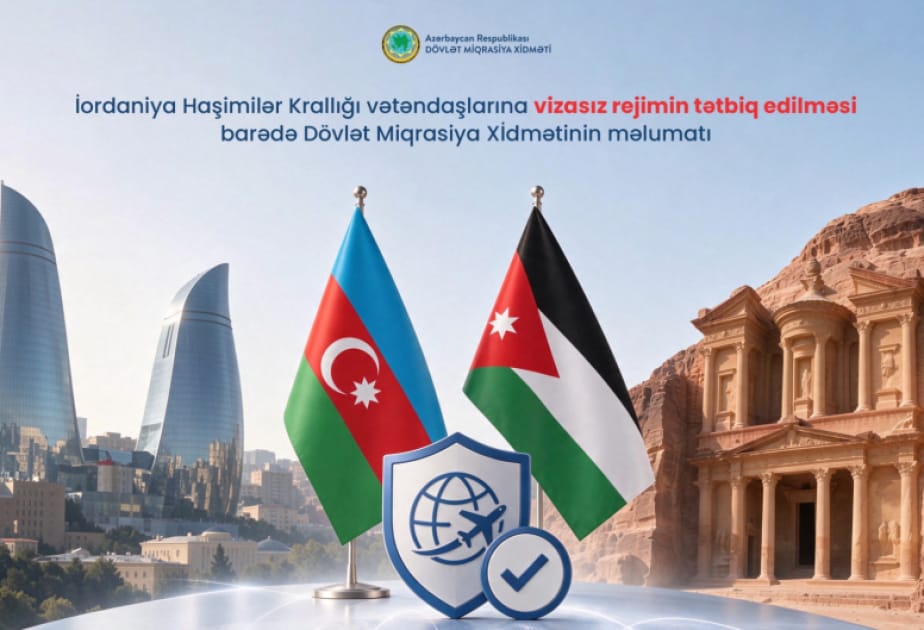
In recent days, Azerbaijan’s State Migration Service has been informing travelers of new details that may seem straightforward on the surface, yet they clearly signal the direction of relations between Amman and Baku. As of 22 November 2026, the visa requirement has been lifted for holders of ordinary passports from both countries. Holders of valid ordinary passports may now enter, leave, or transit through the other country without a visa, and stay for up to 90 days within any 180-day period.
The stated aim is clear: to ease travel, support tourism, and strengthen cooperation. Visitors to Azerbaijan are reminded that stays longer than 15 days require registration of their place of residence under the Migration Code. Applications to extend a temporary stay or obtain a temporary residence permit must be submitted before the authorized period expires, provided the legal conditions are met, either in person at migration service desks in ASAN centers or online through the Service’s official website. These practical details reflect a desire to regulate movement without complicating it.
This step did not emerge from a vacuum. Diplomatic relations between Jordan and Azerbaijan were established on 13 February 1993 and developed gradually through reciprocal visits. King Abdullah II’s visit to Baku in August 2006 marked a significant milestone in bilateral ties and helped advance political and economic cooperation. President Ilham Aliyev reciprocated with a visit to Amman in 2007, during which a package of agreements was signed and he was awarded an honorary doctorate by the University of Jordan. The King made further visits in 2008 and 2010, followed by a working visit in December 2019 focused on joint investments and coordination in international forums, particularly during Azerbaijan’s chairmanship of the Non-Aligned Movement.
In recent years the pace has accelerated. In November 2025 the fourth session of the Jordanian-Azerbaijani Joint Committee was held in Baku, co-chaired by Jordan’s Minister of Industry, Trade and Supply Yarub Qudah and Azerbaijan’s Finance Minister Sahil Babayev. It resulted in the signing of an executive cooperation program for 2025–2027 covering science, education, culture, youth, sports, antiquities, health and media; a customs cooperation and mutual assistance agreement; a tourism memorandum of understanding and executive program; and a memorandum between the Jordan Enterprise Development Corporation (JEDCO) and Azerbaijan’s Small and Medium Business Development Agency (KOBIA).
In July 2026 Jordan’s Foreign Minister Ayman Safadi visited Baku, where he met President Aliyev and his counterpart Jeyhun Bayramov. The two sides signed the mutual visa exemption agreement for ordinary passport holders and a memorandum of understanding on energy, while exchanging official invitations for high-level visits. On 2 November 2026 the Azerbaijan Tourism Board organized an event in Amman attended by its CEO Florian Sengstschmid and the Azerbaijani ambassador. Sixty-six representatives from 48 Jordanian tourism companies took part. The two sides discussed the possibility of increasing air connections and strengthening tourism cooperation, against the background of weekly charter flights operated by Azerbaijan Airlines (AZAL) and Fly Jordan.
On the economic front the picture is more complex. Annual bilateral trade remains modest. According to UN Comtrade data, Jordanian exports to Azerbaijan reached approximately $3.68 million in 2024, led by tobacco and manufactured tobacco products at about $1.29 million, followed by miscellaneous chemical products at roughly $1.2 million and pharmaceuticals at around $836,000. Azerbaijani exports to Jordan stood at about $1.02 million in 2025, concentrated mainly in cocoa products and mineral fuels and oils. By contrast, the Azerbaijani ambassador in Amman has cited a bilateral trade volume of around $6.5 million for 2024. While the figures are not directly comparable, they point to a relatively limited trade relationship that remains below its potential.
Officials on both sides acknowledge this reality. At the joint committee meeting the Azerbaijani finance minister noted growth in trade and an increase in Jordanian tourist arrivals, while stressing that the numbers still fall short of ambitions. The main challenge lies in limited direct freight connectivity and high logistics costs, despite the availability of charter flights. Attention is therefore focused on specific sectors: the pharmaceutical and healthcare industries, where Jordanian companies hold competitive expertise; tourism and aviation following the entry into force of the visa waiver; and the development of transport links connecting Azerbaijan to the port of Aqaba. Such links could position Aqaba as a potential gateway to regional markets, including Syria, while opening avenues for Jordanian products to reach the Caucasus and Central Asia. Opportunities also exist in renewable energy, agriculture and food security.
On 29 October 2026 Jordan’s Minister of Investment Tariq Abu Ghazaleh met Azerbaijan’s ambassador in Amman, Shahin Abdullayev, to discuss ways of strengthening investment relations and exploring cooperation in areas of mutual interest. Both sides are seeking to translate political warmth into concrete projects through the private sector.
The mutual visa waiver is not an end in itself. It is a practical tool that can facilitate greater movement of people, ideas and investment. Relations between Amman and Baku are marked by stability and mutual respect, yet sustained effort is still needed to close the gap between diplomacy and economic figures. Success can be measured in practical terms by growth in passenger numbers, increased flight frequency and joint investments over the next two years. If high-level visits and follow-up continue, and if the private sector takes concrete steps in pharmaceuticals, tourism and transport, trade volumes may gradually rise to a level that matches the strength of the relationship between the two capitals. The current step is realistic and balanced. It lays a foundation for broader partnership if it is properly leveraged.
Abdul Hamid Hamid Al-Kba / Opinion writer specializing in Central Asia and Azerbaijan affairs




 comment replay











 الرجاء الانتظار ...