Abdulhamid Hamid Al-Kba
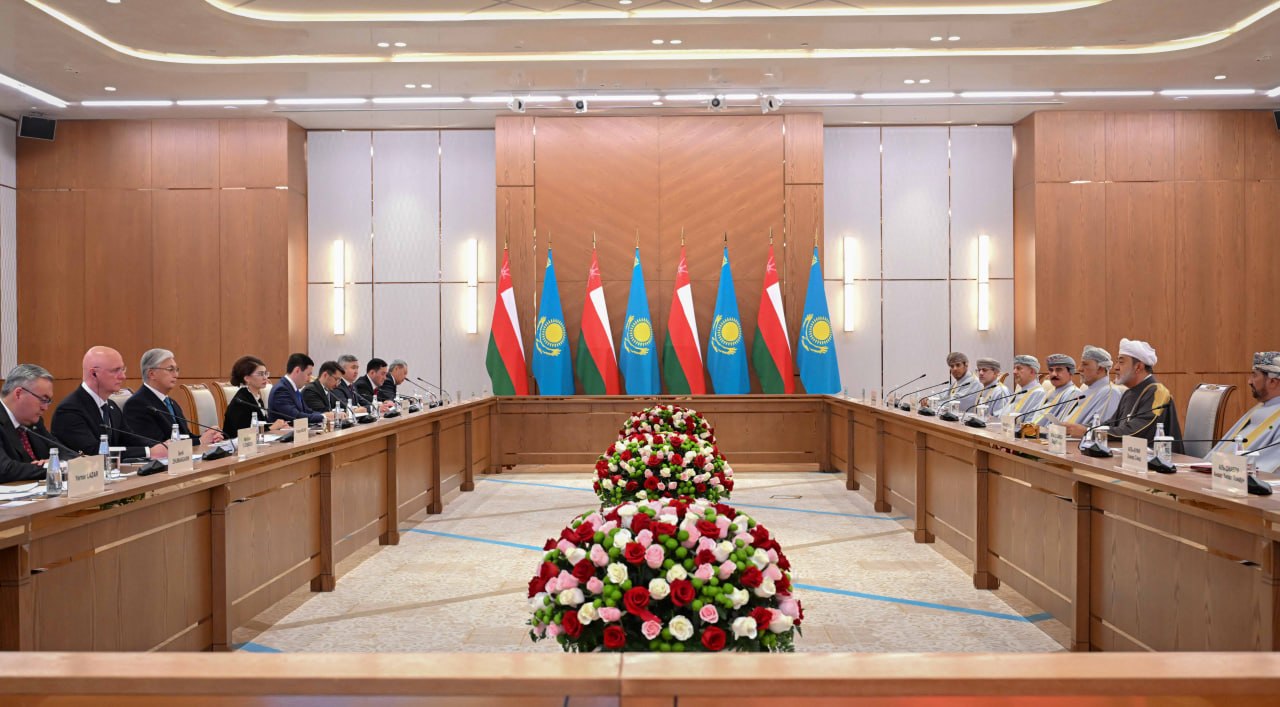
On October 5, Sultan Haitham bin Tariq Al Said arrived in Astana for the first official visit by an Omani sultan to Kazakhstan—and to Central Asia as a whole.
This was no ordinary diplomatic protocol. It was a moment in which two countries at opposite ends of Eurasia tried to turn geographic distance into a strategic advantage. Kazakhstan is looking for new outlets toward the Gulf and the Indian Ocean. Oman is searching for a reliable partner in the heart of the continent that can connect it to China and Europe overland.
The visit followed a quiet buildup of high-level contacts over the past two years. In February 2025, Omani Foreign Minister Badr bin Hamad Al Busaidi made his first official trip to Astana, discussing energy, transport, logistics, and agriculture. The number of Kazakh visitors to Oman then rose by 37 percent, reaching around 21,000. Muscat responded by introducing a 30-day visa exemption for Kazakh citizens. In April 2026, President Kassym-Jomart Tokayev received Oman’s Deputy Prime Minister for Economic Affairs, Sayyid Theyazin bin Haitham Al Said. Samruk-Kazyna and the Oman Investment Authority began talks on a joint investment platform. The current joint portfolio already includes five projects worth $3 billion, two of them valued at $1.1 billion in energy and rail transport.
Transport and logistics form the potential backbone of this relationship. Kazakhstan has the ports of Aktau and Kuryk on the Caspian Sea and an extensive railway network. Oman has deep-water ports overlooking the Arabian Sea and the Indian Ocean. Cargo moving from China to Europe through Kazakhstan takes 18 to 19 days. The same journey via the Suez Canal can stretch to 45–60 days amid current disruptions. That time difference is not a technical detail—it is a genuine commercial opportunity for both sides, especially after geopolitical tensions exposed the risks of relying on a single transit corridor through Iran.
On the second day of the visit, the two sides signed a package of agreements: an intergovernmental deal on the promotion and mutual protection of investments, an air services agreement, an agreement establishing a joint business council, another creating a joint investment fund between Samruk-Kazyna and the Oman Investment Authority, and an arrangement defining the terms of presence for the Eurasian Development Bank in Oman. The joint statement adopted by the two leaders underlined priorities in energy, transport, agriculture, digital technologies, education, and tourism.
At the parallel business forum held at the Astana International Financial Centre, Tokayev spoke plainly about the need for a stronger legal and institutional framework that would protect investors and create a more transparent, predictable environment. He called for political agreements to be turned into concrete projects, described Oman as an important logistics partner thanks to its location and ports, and stressed that Kazakhstan, with its vast agricultural lands, is ready to become a reliable partner in long-term food security for the entire Gulf region. Sultan Haitham, for his part, said Oman sees significant opportunities in energy, mining, agriculture, transport, financial services, technology, and artificial intelligence. He called for the development of a trade corridor through Omani ports and for stronger direct air links.
What set this visit apart is that it did not stop at traditional sectors. In August the two countries held a second round of political consultations that already discussed joint projects in artificial intelligence and new technologies. Kazakh officials had earlier presented Omani delegations with initiatives such as Alem.ai and Astana Hub. This openness to digital cooperation aligns with Oman Vision 2040, which seeks to diversify the economy away from oil dependence, and with Kazakhstan’s ambition to become a digital hub in Central Asia.
Why the visit to Astana—the decision-making capital and leader of Central Asia—matters
Astana is no longer just the administrative capital of Kazakhstan. It has become the political, economic, and diplomatic decision-making center of Central Asia, the place against which the weight of any new regional partnership is measured. The fact that Sultan Haitham chose Astana for his first visit to the region—rather than any other capital—carries a clear strategic message: recognition that Kazakhstan, and its capital in particular, is the actor best placed to turn diplomatic intentions into workable projects.
Kazakhstan accounts for more than half of Central Asia’s combined GDP. That figure alone makes Astana a natural venue for serious economic dialogue. More important than sheer size, however, is what the city has built over the past quarter-century: modern institutions, a multi-vector foreign policy, and an international financial centre operating under English common law. The Astana International Financial Centre is not merely a glass tower. It is a functioning platform that links the region to global capital markets and offers a legal environment familiar to Gulf, Asian, and European investors. The Sultan’s visit to the Centre and his participation in the business forum held there were not protocol gestures. They signalled that Muscat sees Astana as a reliable financial and logistics partner.
Astana has also cemented its role as the region’s diplomatic capital. It regularly hosts summits of Central Asian leaders and maintains a careful balance between China, Russia, and the West without fully aligning with any single power. This ability to stay in the middle while preserving independent decision-making is what makes high-level visits to Astana more than bilateral encounters. When the Sultan of Oman arrives at the Palace of Independence, he is not addressing Kazakhstan alone. He is sending a message to the entire region that Astana is the address to approach when long-term partnerships are the goal.
Geography reinforces this role. Kazakhstan sits at the heart of the land corridors linking China to Europe, with Caspian ports and a wide railway network. Oman offers direct maritime access to the Gulf, the Indian Ocean, and Africa. Combining these advantages turns Astana from a landlocked capital into a connecting link in a logistics chain stretching from the Caspian to the Arabian Sea. The idea is not theoretical. Tensions affecting traditional routes through Iran or the Red Sea have made the search for alternative corridors a shared priority, and Astana is the most institutionally prepared to lead that diversification.
Most importantly, Astana is no longer content to act merely as a geographic intermediary. It is investing in digitalisation, artificial intelligence, renewable energy, and modern agriculture—the same areas that intersect with Oman Vision 2040. When the two sides discuss joint projects in technology, food security, or investment funds, they do so within a ready-made system: protected investment laws, an active financial centre, and government experience in managing large-scale projects.
Astana remains today the most capable player at bringing parties together, providing institutional frameworks, and turning symbolic visits into measurable agreements. The awarding of the Altyn Qyran (Golden Eagle) order by President Tokayev to the Sultan, and the exchange of high state decorations, was mutual recognition that the relationship is no longer peripheral and that Astana now regards its Omani partner as part of its wider network of interests in the Arab world.
Expectations, however, should stay realistic. The agreements signed are still at the legal-framework stage. Turning them into operating projects will require actual financing and sustained political will from both sides. Competition for Eurasian logistics corridors is intense, and sovereign funds have many options. Success will not be measured by the number of memoranda, but by the ability to launch direct flights soon, to start tangible logistics projects, and to attract Omani capital into Kazakhstan’s digital and agricultural sectors.
In the end, Sultan Haitham’s first visit to Astana opened a door that was never completely closed, but was previously narrow. The door is now a little wider. What happens next depends on the capacity of both sides to convert political goodwill into shared economic interest, and on the recognition that the distance between the Caspian and the Arabian Sea is no longer a geographic obstacle—it is an opportunity that needs to be filled with projects rather than speeches. Astana has shown it is the decision-making capital of Central Asia. Anyone who wants to build something lasting in the region now knows where the address is.
*Abdulhamid Hamid Al-Kba - Opinion writer specializing in Central Asia and Azerbaijan affairs



 comment replay










 الرجاء الانتظار ...