Ammon News - AMMAN - "Traditional music is a manifestation of not only a country's culture, but also its history," Sakher Hattar, the maestro of Bayt Ruwwad, told The Jordan Times.
Hattar said he founded Bayt Ruwwad in 2009 in order to help preserve and revive a musical heritage that he believed was in danger of disappearing by bringing together the Kingdom's most distinguished folk musicians in one band.
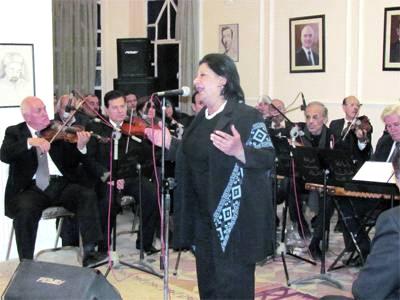
The band, which consists of 28 artists, includes such famous faces as Tawfik Nemri, Fouad Hijazi, Ismail Khader, Salwa Al Aass and Asaad George.
"The golden age of these artists and their unique songs was about to vanish from people's memories. Bayt Ruwwad rescued these memories," he said.
Before the introduction of Bayt Ruwwad, the once-popular folk musicians were struggling, Hattar claimed, as their images faded from the public consciousness and they performed less and less.
Furthermore, he added, the personal and professional connections among these musicians had become weak, as they seldom had the opportunity to meet and perform together.
"The situation of these musicians was really harsh, and the classic songs had started to be forgotten. So I thought of creating a band gathering all these singers to start singing these songs again," the 47-year-old bandleader said, noting that he took his idea to the Greater Amman Municipality, which helped him form the ensemble.
"It was a step towards preserving the artistic heritage of Jordan and reviving traditional songs," the conductor pointed out.
"We assemble three days a week to rehearse and to meet with each other in a bid to strengthen the bond between artists," he said.
Hattar described the group's first meeting at Prince Hashem Park during Ramadan as very emotional, noting that many of the artists started crying as they hadn’t seen each other in 15 years.
Since then, he said, Bayt Ruwwad has proven a great success.
During the band's first concert, which took place at the Jordanian House of Poetry (JHP) in November, the audience was thrilled to see Jordan's musical masters on stage once again, according to Hattar.
"The audience was really excited since they were able to see their favourite singers and to listen to the traditional songs again," the maestro said, pointing out that in addition to Jordanian folk music the band also performs traditional and popular tunes from around the Arab world.
“At every concert, the Jordanian House of Poetry is packed with people who are excited to meet us. A mood of jubilation envelops the JHP whenever the band performs," said Musa Hijazeen, one of the group members.
Mohammad Waheeb, who sings with Bayt Ruwwad, emphasised the importance of the ensemble in allowing older musicians like himself to reconnect with each other and the audience.
“It's an opportunity to meet up with our faithful audience once again and to perform their favourite songs,” said Waheeb, now in his 70s.
Prior to the new year, Bayt Ruwwad performed regularly at the Jordanian House of Poetry, where Hattar said over 7,000 people came to see them. Earlier this month, they began performing at Prince Hashem Park in Hashemi Shamali, which Hattar said would be their main venue.
The band has also given three concerts in other governorates across the Kingdom.
Ahmad Harasis, the director of the Jordanian House of Art, said the band revives Amman's 20th-century culture and atmosphere.
“Bayt Ruwwad concerts bring back the great era of Jordanian art. They embody not only the history of Jordan’s art, but also our memories,” he said.
“Their performance is superb and they attract many people at every concert, who interact enthusiastically with them,” Harasis added.
Roshan Irani, a surgeon and a fan of Bayt Ruwwad, told The Jordan Times that these artists are the "most distinguished" in the history of Jordan, and represent the "golden age" of Jordanian music.
Hattar pointed out that the band is working on numerous plans to preserve its members' songs and to revive them as much as possible.
"We are working on a musical library to archive all the old traditional and national songs to promote these songs in the minds of people," he noted.
According to singer and band member Salwa Al Aass, evoking the Kingdom's musical "golden age" is indeed central to the idea behind the ensemble.
"The band shows how hard we worked to develop Jordanian song. It brings back the greatest era of Jordanian music," she said.
By Muath Freij/ Jordan Times
**** Salwa Al Aass sings with Bayt Ruwwad at the Jordanian House of Poetry (Photo by Muath Freij)



 comment replay