Ammon News - By JASON BRONIS
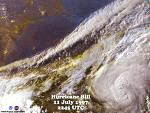
EDGARTOWN, Massachusetts (AP) — Hurricane Bill taunted the New England coastline from a distance Sunday, after closing beaches and setting off a string of safety warnings for weekend boaters, swimmers and surfers along the eastern
seaboard.
President Barack Obama took no chances and planned a later arrival for his family vacation at Martha's Vineyard, which remained under a tropical storm warning early Sunday.
Forecasters said that the hurricane was moving away from the New England coast offshore and closer to Nova Scotia, and was expected to approach Newfoundland by Sunday night.
By early Sunday, it was about 275 miles (445 kilometers) south-southwest of Halifax, Nova Scotia, and about 185 miles (300 kilometers) east of Nantucket, according to the
US National Hurricane Center in Miami.
A tropical storm warning was in effect for the Massachusetts coastline and a storm warning covered Nova Scotia's Atlantic coast.
Even as it weakened to a Category 1 hurricane Saturday, the tempest churned up rough seas and dangerous rip tides.
In Nova Scotia, provincial parks were shut down and people were advised to stay clear of beaches.
"The waves, they're very pretty to look at but very dangerous," said Barry Manuel of the Halifax Emergency Management Office.
By early Sunday, the storm had maximum sustained winds near 85 mph (140 kph) and was moving 26 mph (42 kph) in a north-northeast direction.
The Obamas delayed their planned Sunday morning departure from Andrews Air Force Base to Sunday mid-afternoon because of the weather, White House aides said. The worst of Bill was expected to pass east of Martha's Vineyard before the
Obamas arrival.
Nearly all south-facing beaches on the island were closed to swimmers and large signs blocked roadways to shorefronts. Lifeguards used caution tape to rope off
access points, and police patrolled the beach to enforce the closings.
"The concern we have now is that the riptides are very strong," said lifeguard James Costantini. "There's a very strong undertow."
At Robert Moses State Park in New York, the beach was shut down as the high tide submerged the sand, though the beach opened later for sunbathing. Along some beaches in Delaware and New Jersey, no swimming was allowed.
The same high waves that worried safety officials, however, had surfers buzzing.
In Atlantic City, New Jersey, surfers gathered Saturday on beaches where 20-foot waves were expected. But only a few were willing to take their boards into the big swells.
Atlantic City Beach Patrol Chief Rod Aluise told The Press of Atlantic City that some surfers just stood on the beach "with their eyes popping out" at the size of the waves.
"This is only for experienced surfers," Aluise said. The stormy conditions were expected to last through the weekend.
"It takes a while for the ocean to relax" after strong storms, said Gary Conte, a meteorologist with the National Weather Service. "Until it does, riptides will make
dangerous sport" for surfers and swimmers.
Hurricane Bill moved past Bermuda earlier Saturday, leaving behind sunny skies, debris and flooding, but no casualties. The storm cut power to about 3,700 customers
and flooded some roads. All ferry service was canceled until Sunday.
Meanwhile, forecasters said Sunday that Tropical Storm Hilda had strengthened slightly far out in the Pacific but was not threatening land. It had maximum sustained winds of 45mph (75 kph) and was about 2,025 miles (3,260 ilometers) west-southwest of the tip of Mexico's Baja California peninsula, and 1,125 miles (1,810 kilometers)
east-southeast of Hilo, Hawaii.



 comment replay