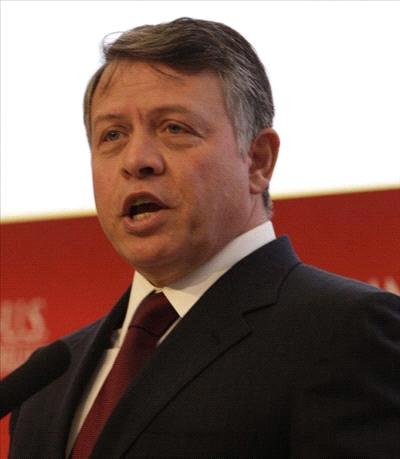
Ammon News - Transcript of ABC's Christiane Amanpour's interview with King Abdullah II of Jordan, May 22, 2011.
The revolution is happening now. And my guest today is caught right in the middle. He is King Abdullah of Jordan, a key American ally and the author of a new book, "Our Last Best Chance: The Pursuit of Peace in a Time of Peril."
I sat down with him earlier this week.
AMANPOUR: King Abdullah, thank you for joining us.
ABDULLAH: Thank you, Christiane.
AMANPOUR: How do you describe what's going on? Is it a wake-up call for yourself and other world leaders in that region?
ABDULLAH: Definitely it's a wake-up call. And this is a new and definitely defining moment for the Middle East. Which way the Middle East goes, I hope, reaching out to the aspirations of the youth, this will be a good story when we look back on it years from now.
AMANPOUR: What is it that you are being asked to wake up to? And what can you do about it?
ABDULLAH: Well, there's two aspects to this. Obviously, when this was started in Tunis, was because of the world economic crisis, a large portion of youth in the Middle East that are suffering from economic hardships, that want a better life. So it was economic frustration and and desires that led, I think, to political awakening, that they want to be able to chart their own destiny.
AMANPOUR: The latest polls say about two-thirds, maybe even three-quarters of Jordanians want democracy. What are you as King Abdullah going to do to realize that dream?
ABDULLAH: From right at the beginning of of this, we brought all sectors of society together. We created what we called sort of the national dialogue to all sit around the table and decide what it is that Jordanians want. The committee has embarked on two laws, a new election law and new political party law, which is I think critical for the future of Jordan. We'll have new elections at the end of the year, and it will be the start of new democracy in our country.
AMANPOUR: In Jordan, 13 percent of the people polled say they have a positive view of the United States. Americans are concerned that a new democracy in your country and elsewhere could be an Islamist scary future. Do you feel that that is possible in Jordan?
ABDULLAH: Not in Jordan. It could be possible elsewhere. In my particular position, I have the responsibility to lead the debate in the right direction. And I think Jordan will move towards the light; I have no worries about Jordan.
I don't know how in other countries they're developing. And each country in the Middle East is different. You alluded to the United States not being very popular, but, again, we've got to remember, the reason I think for the most part where America is not popular is because its perceived lack of ability to move the Israeli-Palestinian process forward.
AMANPOUR: In your book, you're pretty relentless about criticizing Prime Minister Benjamin Netanyahu. Is he an obstacle to peace?
ABDULLAH: Well, in my discussions with him and they've been, I think, very thorough when he speaks to me, I see his vision of peace for the Palestinians, peace for the Arabs, and I've always left those meetings feeling very optimistic.
But unfortunately, the circumstances that we've seen on the ground for the past two years does not fill me with much much hope. I just have a feeling that we're going to be living with the status quo for 2011. And as you well know, whenever we we accept the status quo, we do so until there is another war. And so that is of tremendous concern to me.
AMANPOUR: Do you feel that there might be another war?
ABDULLAH: Well, if you look to the past 10 years, every two to two-and-a-half years there's either the intifada or a war or a conflict. So looking back over the past 12 years, my experience shows me that if we ignore the Israeli-Palestinian issue, something will burst.
AMANPOUR: Israel is saying that it cannot have peace talks with a group like Hamas, who they deem is terrorists. America, as well, deems Hamas to be a terrorist organization. And yet before everybody was saying we can't have peace talks because the Palestinians are divided. How to get beyond that?
ABDULLAH: Well, look, if I can play the devil's advocate here, I wish that our Israeli colleagues would, you know, pick one argument and bloody well stick to it, because, you know, the past couple of years, the Israelis were saying, well, you know, Abbas is not a partner for peace because he doesn't represent the Palestinian people. Therefore, we're not prepared to move forward.
Abbas has now made reconciliation with Hamas, does represent the Palestinian people, and the Israeli argument is, well, we can't deal with him because of Hamas. Abbas had been very clear that Hamas will not be part of the government. They will not have any role in the security apparatus in the West Bank, which is important for the United States, it's important for Jordan, because we worked tirelessly together to train the Palestinian security forces.
You know, Christiane, it's always easy to find an excuse why not to do the right thing. And if we continue along those lines, then we will never solve this problem. And at the end of the day, it's going to be the Arabs and Israelis who are going to pay the ultimate price. You have seen our region. For how many decades have we suffered from the Israeli-Palestinian conflict? So we need leaders with courage to take the tough decisions and solve this once and for all.
AMANPOUR: Let's talk about some of the neighboring states. Syria is obviously in a pretty bad state right now. There's violent repression of people who want democracy. Many people thought that Bashar al-Assad was a reformer. Would you say he's a reformer?
ABDULLAH: Well, today he has a major challenge of, how do you reach out to the people and bring them in on the table? That hasn't happened in Syria. And I think to turn things around and bring common stability, dialogue, national reconciliation, outreach is the only way that you can do so.
AMANPOUR: Is Bashar al-Assad, the president of Syria, in charge?
ABDULLAH: I've talked to him on several occasions to see what Jordan can do to bring stability and, obviously, calm to Syria. And from my discussions with him and from what I hear, he is in charge, yes, and he is calling the shots.
I think Bashar needs to reach out to the people and get people around the table. I learned from his late Majesty King Hussein...
AMANPOUR: Your father.
ABDULLAH: ... my father, is to keep as close to the people as possible. And on a weekly basis, I go out and visit different sectors of society. I sit down with people from all walks of life. And we discuss all the issues that are relevant to them.
AMANPOUR: The queen, Queen Rania, has been rather viciously attacked in Jordan. In your book, you write that you have an equal partnership. Why is she being attacked? And are there any merits to the grounds that there have been land grabs that she's organized for her family or other corruptions?
ABDULLAH: Everything that I've heard is absolutely ludicrous and very sad, when many, many Jordanians know what she has done for women, for children, not only in Jordan, but across the region and further afield. I think we're in an atmosphere where anybody that wants to look at destabilizing Jordan and having a go at me, looking at a weaker link. And having a go at Rania I think has been very, very sad for all of us that people would stoop to that level.
AMANPOUR: Does she have any powers to pick certain ministers or civil servants or anybody?
ABDULLAH: She has never, ever gotten involved in the government. Her mandate, if there is any, has always been education, education, education. And I'm hoping that our society will wake up to this and put a stop to this, because it's become so destructive in Jordan, not just Rania. Many, many people have been accused by people that just feel that they can get away with it.
AMANPOUR: Your majesty, thank you very much, indeed.
ABDULLAH: Thank you.
* ABC



 comment replay










 الرجاء الانتظار ...