By Osama Al Sharif/ Arab News
THE Palestinians are being dragged, kicking and screaming, to direct negotiations with Israel, a far cry from 20 years ago when the PLO made a historic decision to engage in secret and direct talks with its bitter enemy.
The innocence and high expectations that engulfed those early encounters in Oslo have all but disappeared. Today the Palestinians are loath to be goaded into what could be a penultimate round of negotiations where they are likely to emerge from it as the biggest losers.
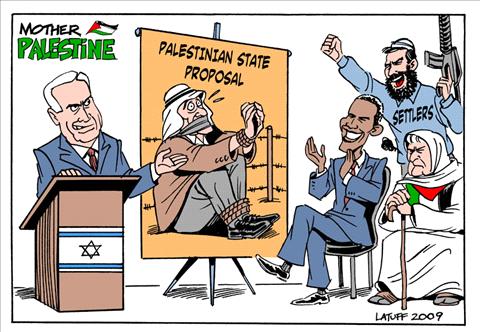
On the other hand, Israel’s Benjamin Netanyahu is riding a wave of euphoria. Everything is going his way, for now. His recalcitrance has paid off in the end. He has managed to shrug off US pressure, brush off Palestinian protests, ignore pleas by the International Quartet and keep his shaky coalition alliance intact. The US has adopted his stand; that direct talks should be unconditional, meaning that Israel will go to the negotiations’ table totally absolved from all previous commitments.
The Palestinians can complain all they want about the expansion of Jewish settlements in the West Bank, the systematic Judaization of East Jerusalem and Israel’s insistence that its security needs take top priority over anything else. In the end it is Israel that is taking the lead and dictating the agenda.
It’s a big risk for the Obama administration. A first-term president would have hesitated before committing himself to a final deal between Arabs and Israelis. Moreover, the talks, which will be launched on Sept. 2, face difficult odds. Few people expect the one-year negotiations to lead to anything. The specter of failure looms heavy while Israel, which had insisted that no preconditions will be accepted, is already throwing preconditions of its own.
There are many viewpoints to what the future of these direct talks may hold. The optimists believe that final status negotiations are long overdue and that the two parties will have to come to a compromise under US prodding and guidance. Those who are less optimistic claim that talking is better than anything else, and that even if the circumstances are not ideal, the process will eventually bring the two parties closer to each other or at worst it will pave the road for a future settlement.
The pessimists are clear in their position. They believe that Israel sees a golden opportunity to impose a unilateral settlement on the weaker Palestinian side. Thus a final, but inequitable deal will be reached, denying Palestinians of their most coveted demands; East Jerusalem as their state capital, control of all pre-1967 West Bank territory, including the Jordan Valley, and a satisfactory implementation of the right of return for millions of Palestinian refugees. Already Israel has made it clear that it will not be involved in any talks that put the future of Jerusalem on the negotiations’ table. Israel wants to talk about secure borders rather than withdrawal, and about annexing settlements rather than vacating them. It wants to focus attention on its own concerns rather than legitimate Palestinian rights.
The choice is not between what the pessimists see and what the optimists believe in. It is what the realists think will happen. The Palestinians have lost the Arab backing and they are now on their own. Those who bless this latest episode of direct negotiations are also taking a big risk. They could be seen as culprits in the largest sell-out of Palestinian rights in modern times.
The benchmarks for a just and lasting peace in the Middle East have been shattered, and today the Palestinians go to the talks disarmed of legal claims and previous agreements. An alternative scenario is already being proposed that is contrary to anything the Palestinians have struggled for.
Israel is on the verge of clinching a rare bounty; the mother of all concessions from its hapless victim. By the end of a year-long direct negotiations Israel will most probably offer a plan that gives the Palestinians control over major cities in the West Bank, with relief corridors with Jordan, a territory less than half of what they wanted, where they can practice self-rule or even sovereignty. Attach this to Gaza and the target of Palestinian statehood would have been achieved—on paper no less.
It will be a hypothetical state, with artificial borders, and whose livelihood will depend on its two biggest neighbors, Israel and Jordan. Such an accommodation will suit Israel very nicely. But it falls way short of Palestinian ambitions.
Another scenario proposes that the Palestinians will refuse a humiliating final settlement and that will walk away from talks and take their case to the UN. Israel will react by annexing West Bank territory and leaving the Palestinians to form a commonwealth of territories under their control on which they will establish a provisional state of their own. In both cases Palestinians ambitions will hardly be fulfilled. The struggle will continue but with almost zero prospects of achieving anything.
It is a dismal view of things but there is no reason to be jovial about the restart of negotiations. PNA President Mahmoud Abbas is a man who appears to have no choices. But every man has one, even if that choice spells his own doom. So far he has opted to play along even when the odds are against him. The endgame in this latest round is calamitous to the Palestinians, and yet he chooses to engage. This is the biggest dilemma of all!
— Osama Al Sharif is a veteran journalist and political commentator based in Amman.
* Illustration by Carlos Lattuf



 comment replay











 الرجاء الانتظار ...