Ammon News - Investigators looking into what led to a nationwide ground stop earlier this month have been able to recreate the mysterious technical failure in a lab and believe they found the culprit, according to a source familiar with the investigation.
Investigators have focused on determining why a new router at a remote Arkansas radio site overwhelmed the nation’s air traffic control system with a massive amount of data, triggering gaps in radar and radio communications.
They found an overlooked router setting affected how it interfaced with other decades-old routers that the FAA is decommissioning, the source said. Investigators believe software updates are needed and that those patches will prevent a repeat of the system failure.
The investigators are preparing a report on their findings. There are still some unanswered questions, but the source familiar with the probe said investigators are “90% sure” the disruption wasn’t caused by nefarious actors. The investigation also involved the FBI and other national security representatives.
The findings come as FAA administrator Bryan Bedford and Transportation Secretary Sean Duffy are set to appear at hearings next week on Capitol Hill, where they are expected to face tough questions about the investigation and what happens next as they race to modernize the nation’s air traffic control system.
CNN has reached out to the FAA and L3Harris, a contractor that owns and operates the telecommunications system, for comment.
This month’s ground stop not only focused attention on upgrades being made to the aging system, which have been paused as the agency investigated the incident, but also raised questions about FAA oversight of private companies charged with maintaining the network.
“This does expose the system’s vulnerability as the FAA continues the work of upgrading its system,” said Peter Goelz, CNN aviation analyst and former managing director of the National Transportation Safety Board.
The Trump administration has directed billions of dollars to upgrades, and Duffy is asking Congress to approve another $50 billion.
‘It’s not reasonable’
Federal Aviation Administration signage is displayed on the exterior of its headquarters in Washington, DC, on October 13, 2025.
On the day of the network meltdown, L3Harris was undertaking a maintenance job that involved switching the system from a decades-old router to a new one. In the past, this kind of work typically involved at least six FAA employees.
Under the Trump administration, it’s now often coordinated by one employee: an FAA liaison. And there are only four people in the country with that title, according to sources familiar with the process.
The liaison’s job involves coordinating and scheduling these upgrades — not approving them, sources said. A Trump administration directive aimed at speeding up network maintenance eliminated the need for FAA approval.
The Professional Aviation Safety Specialists, the union that represents FAA technicians, has been critical of the new process.
“It’s not reasonable to have four people coordinating telecommunications maintenance and outages for the entire national air space system,” David Spero, president of the union, told CNN in a phone interview.
One of the sources familiar with the process said: “Their workload is unimaginable; they are working massive amounts of overtime.”
The Trump administration’s effort to move maintenance work along faster also eliminated a layer of FAA review that was critical to assessing risk, the source said.
Previously, local technical operations managers, site technicians and others would determine when the work could be done with the least impact on air traffic and to game out worst-case scenarios. The union contends that process did not happen before L3Harris arrived at the El Dorado, Arkansas, site on November 13.
“How do we mitigate the risk if we don’t have a say in the approval of the work and the timing for when the work is done,” Spero said.
The FAA defended its oversight and said the policy change has only altered how maintenance is prioritized.
“The FAA performs continuous risk assessments for changes in the National Airspace System. However, L3 Harris owns and is responsible for maintaining the FAA Telecommunications Infrastructure,” the agency said in a statement.
“Under FAA orders, the agency oversees L3 Harris through service performance monitoring, not with over-the-shoulder supervision in the field. FAA personnel never certify or sign off on the internal workmanship of an L3Harris router installation,” the FAA added.
Spero contends the FAA has given private companies “too much authority and generally unfettered access.”
He points to the Trump administration’s efforts to fast-track maintenance and says the FAA’s own technicians are still required to obtain agency approval and go through the more extensive review.
Another router failure
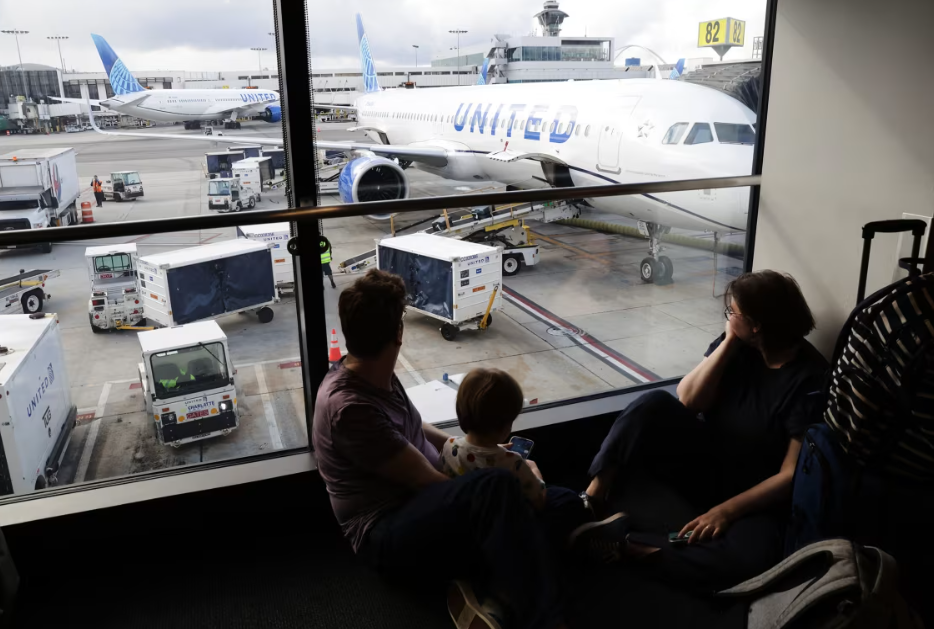
Travelers wait to check-in for departures at the San Francisco International on November 19, 2009, as an FAA computer glitch caused flight delays throughout the country.
The FAA previously had problems with oversight of the contractors who maintain and upgrade the air traffic control system.
On November 19, 2009, 129 of the nation’s air traffic facilities experienced an outage of the Federal Aviation Administration’s telecommunications that delayed thousands of travelers and grounded hundreds of flights nationwide
The cause: A technician with Harris Corp., which later merged with L3 Technologies to form L3Harris, incorrectly configured an FAA telecommunications router at the Los Angeles Center, which directs air traffic data such as flight plans through the network. The error sent air traffic data down the wrong routes, blocking about 75 percent of the network.
Restoring service was delayed five hours because an automatic tool that alerts technicians to network failures and their locations did not work as intended. That meant Harris technicians could not readily identify the source of the problem, which could have minimized the impact of the error on the national airspace system.
The Department of Transportation inspector general at the time put it bluntly: FAA’s oversight of the contractor “could have been more effective.”
The inspector general said the “FAA was unaware that Harris officials had configured the network in error and made other procedural errors,” noting that the year before it had recommended the agency “develop improved controls” and “take steps to prevent unscheduled outages and restore them on time to improve service reliability.”
CNN




 comment replay










 الرجاء الانتظار ...