Abdulhamid Hamid Al-Kba
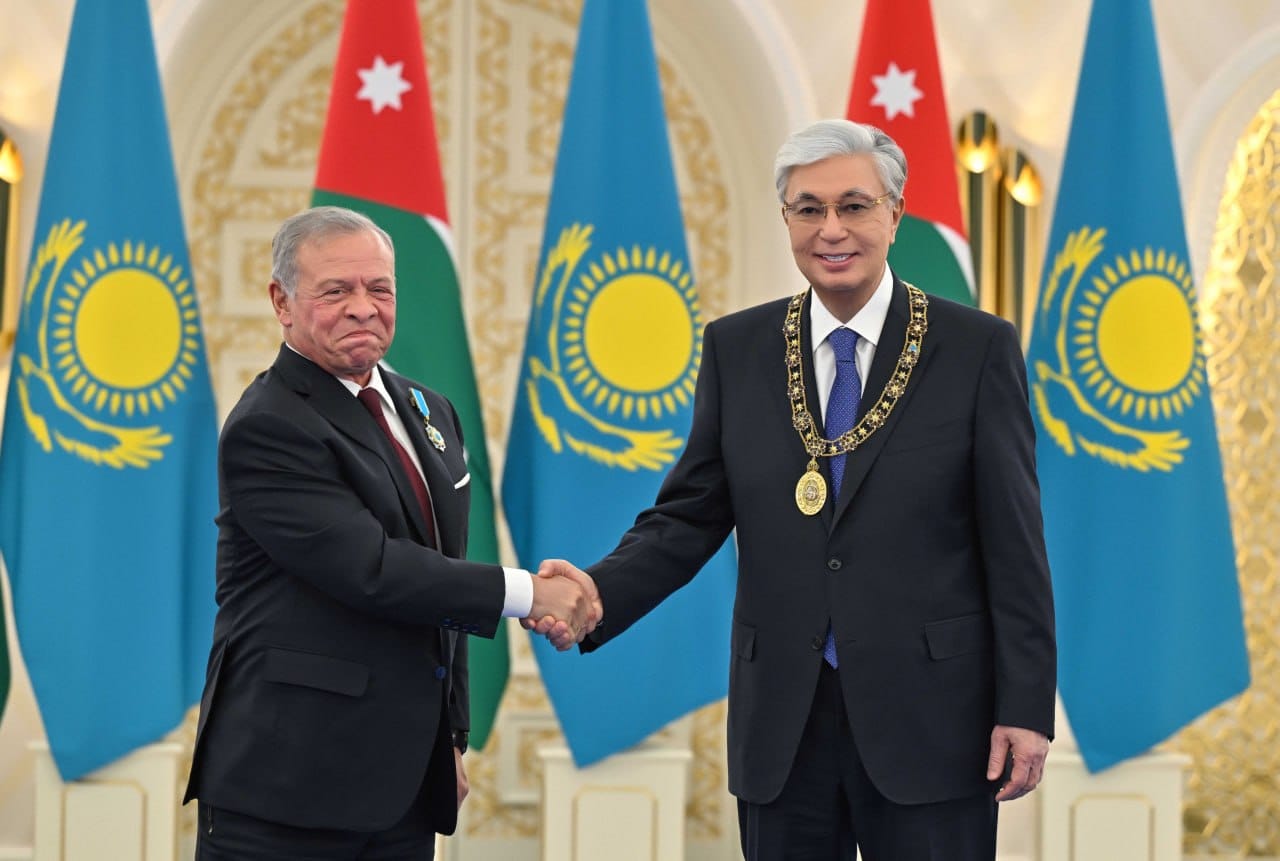
The official visit by King Abdullah II to Astana on 5–6 November marks an important milestone in the bilateral relationship between Jordan and Kazakhstan. It comes roughly 15 months after the King’s previous visit to Astana in August 2025, and less than two years after President Kassym-Jomart Tokayev’s visit to Amman in February of the same year. This sequence of high-level exchanges reflects a shared desire to move the relationship beyond mutual respect and political statements toward a practical partnership covering the economy, security and regional cooperation.
The reception at the Akorda Presidential Palace underscored this direction. President Tokayev described the visit as evidence of strong ties of friendship, mutual respect and solidarity, noting that Jordan is a reliable partner for Kazakhstan in the Arab world and that cooperation has gained new momentum in recent years. Economic indicators paint a clearer picture: last year saw reciprocal high-level visits, a joint statement and multiple agreements between government bodies and business representatives. Both sides spoke frankly about implementing previous understandings and expanding cooperation in trade, investment, tourism, technology and defence.
Economic ties remain at an early stage. Bilateral trade stood at around $6.3 million in 2024. In earlier talks the two sides had set a target of raising trade volume to $500 million — an ambition that reflects the scale of their economic aspirations, yet remains far from current levels. Previous agreements in agriculture, pharmaceuticals, peaceful nuclear energy, digitalisation and transport are still in place. The joint working group on wheat supplies, the interest of Jordanian companies in entering the Kazakh market, the memorandum of understanding on the peaceful use of nuclear energy, and plans for direct flights between Amman and Almaty all confirm that earlier visits produced practical, follow-up steps. The exchange of state decorations — the Order of Al-Farabi for King Abdullah II and the Order of Al-Hussein bin Ali for President Tokayev — added a symbolic dimension that reflects the level of mutual political esteem between the two countries.
The security and political dimension received particular attention during this visit. Tokayev praised Jordan’s role in promoting peace and stability in the Middle East, and recalled the Aqaba Process launched by the King more than a decade ago. Jordan, for its part, reaffirmed its interest in expanding cooperation on regional security and countering terrorism and extremism. Here the interests of the two countries clearly intersect: Kazakhstan sees itself as a bridge between Central Asia and the Arab world, while Jordan seeks partners outside its traditional circle to help address the challenges facing the region.
On 6 November Astana hosted the Aqaba Process summit on artificial-intelligence security, co-chaired by King Abdullah II and President Tokayev. Participants included the presidents of Tajikistan, Turkmenistan and Uzbekistan, the Speaker of Azerbaijan’s National Assembly, the Foreign Minister of Kyrgyzstan, other officials and experts, as well as representatives of international AI companies. The initiative, launched in 2015 to counter terrorism and violent extremism, evolved in this round to address the challenges of artificial intelligence, including ways to employ its technologies in the fight against terrorism and extremism, and to develop mechanisms for cooperation, coordination and the exchange of experience.
From an analytical perspective, Kazakhstan used its diplomatic position and balanced relationships to provide a regional platform for these discussions. Jordan found in the same platform an opportunity to deepen its diplomatic engagement with Central Asia. This was the first Aqaba Process meeting of this format in Central Asia, giving the initiative a new geographical dimension. The risks that increasingly demand regional attention include the use of artificial intelligence in extremist propaganda, deepfakes and cyber attacks. On the margins of the summit the King held separate meetings with the presidents of Tajikistan, Uzbekistan and Turkmenistan to strengthen bilateral cooperation in economic, defence and technological fields.
The summit reflected a shared desire not to leave the issue of AI security exclusively in the hands of the major powers. The Central Asian states and Jordan recognise that ignoring this agenda could leave them lagging behind or exposed to risks they cannot control. Focusing on the region’s perspectives and giving fresh impetus to joint efforts is therefore logical. At the same time, expectations should be kept in check. The challenges are complex, technical gaps between the participating countries exist, and security coordination on such issues requires time and accumulated trust. The open question remains: will these meetings translate into the exchange of technical expertise, the development of early-warning mechanisms, and stronger cooperation in confronting the use of artificial intelligence for terrorist purposes? The answer to that question will determine the practical value of the summit in the months ahead.
Overall, the current visit continues a trajectory that has become clearer since last year — a trajectory aimed at building a partnership that combines economic, security and cultural interests. Jordan finds in Kazakhstan a geographically distant partner that is close in its vision of stability and dialogue. Kazakhstan finds in Jordan a reliable Arab gateway and experience in Middle Eastern issues. Whether the economic agreements succeed in raising trade volume or the AI security summit produces practical mechanisms, the visit confirms that the relationship between the two countries has moved from the stage of acquaintance to a phase of substantive partnership-building.
*Abdul Hamid Hamid Al-Kba - Opinion Writer Specializing in Central Asia and Azerbaijan Affairs



 comment replay








 الرجاء الانتظار ...