Ammon News - Deputising for His Majesty King Abdullah, Deputy Prime Minister and Minister of Foreign Affairs and Expatriates Ayman Safadi received a rare Jordanian archaeological artifact discovered through Jordanian-Australian cooperation in Wadi Al-Hammah, in the Pella area, which Australia has decided to return the artifact to Jordan.
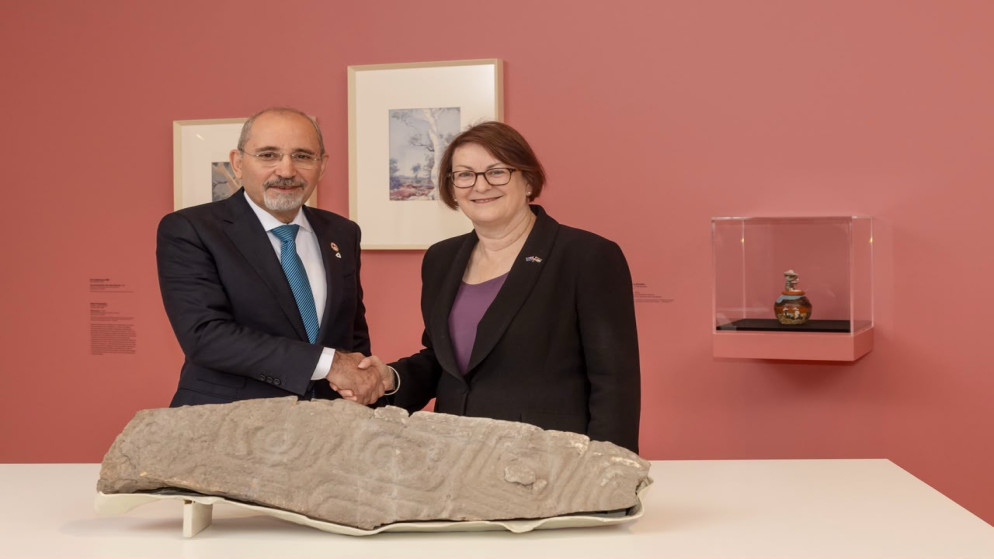
Safadi received the artifact during a ceremony held at the National Gallery of Australia on the sidelines of His Majesty the King's state visit to Australia.
The move reflects cooperation between the two countries in protecting cultural heritage, preserving archaeological artifacts, and returning them to their country of origin.
The artifact dates back to approximately 12,000 BC. It is one of three pieces that together formed an engraved stone architectural panel made of claystone.
The pieces were discovered in 1983 during excavations conducted by a joint mission from the University of Sydney and Worcester College, before being transferred to the National Gallery of Australia in 1985 under arrangements agreed upon by the two countries.
The artifact holds exceptional archaeological and historical significance, as it is one of three components that together constitute the world's oldest known large-scale sculpture. Jordan preserves the other two pieces at the Jordan Museum in Amman and Dar Al-Saraya Museum in Irbid.
During the handover ceremony, attended on the Australian side by Susan Templeman, the Australian Government's Special Envoy for the Arts, as well as museum officials responsible for cultural and artistic affairs, Safadi highlighted the importance of cooperation between Jordan and Australia in archaeological excavations and preservation. He thanked the Australian government and the museum for their cooperation and for returning the artifact to Jordan.



 comment replay








 الرجاء الانتظار ...