Ammon News - By: Abdulhamid Hamid Al-Kba- In Baku on 26 September 2026, officials and investors representing institutions that manage assets measured in the tens of trillions of dollars gathered under one roof. This was not just another conference added to the international calendar. It was a deliberate attempt to reposition Azerbaijan as a serious player in supply chains, energy and digital infrastructure at a moment when the world is simultaneously searching for alternatives and wary of disruption. Under the patronage of President Ilham Aliyev, the second Azerbaijan International Investment Forum took place alongside an infrastructure investment dialogue jointly organised by the State Oil Fund of Azerbaijan (SOFAZ) and BlackRock. The headline numbers were striking: 23 documents covering projects worth $10.8 billion, rising to $16.7 billion when combined with deals announced during Baku Energy Week. Yet numbers alone do not build a future. The real question is whether this confidence can endure or whether it is simply a fleeting geopolitical moment.
The day opened with the infrastructure dialogue across three focused sessions. The first, moderated by Charles Hatami of BlackRock, brought together Economy Minister Mikayil Jabbarov, Digital Development and Transport Minister Rashad Nabiyev and executives from Temasek and other firms. Discussion centred on rising demand for data-processing capacity and the necessity of public-private partnerships in digital infrastructure. The second session, led by Eric Farwell of Global Infrastructure Partners (GIP), featured Energy Minister Parviz Shahbazov, SOCAR President Rovshan Najaf and renewable-energy executives. It examined energy security and shifting investment priorities. The final session addressed strategic transport corridors, with contributions from a deputy transport minister and executives from holding companies and airports. The shared message was clear: long-term institutional capital and genuine public-private partnerships form the backbone of modern infrastructure. The presence of these names signals serious interest. It does not, however, guarantee delivery. Building data centres, power transmission lines or expanded ports requires a stable regulatory framework, transparent processes and skilled people—things that cannot be settled in a single conference hall.
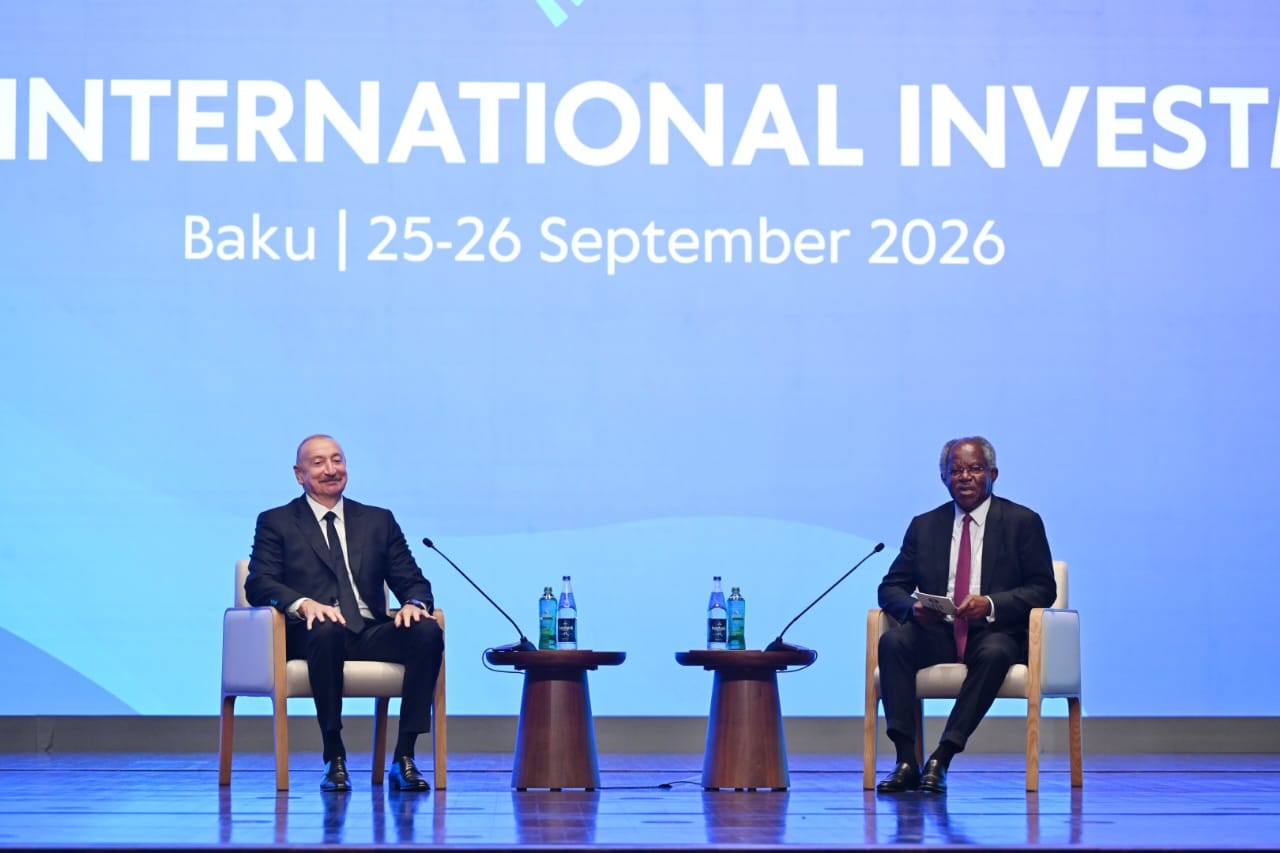
The centrepiece was the fireside conversation between President Aliyev and Adebayo Ogunlesi, Chairman and CEO of GIP. Ogunlesi reviewed key economic indicators: GDP growth from roughly $7 billion to $76 billion, per-capita GDP rising more than eightfold, poverty falling from 45 per cent to 5 per cent, and SOFAZ assets expanding many times over to around $75 billion. The non-oil-and-gas economy now accounts for 71 per cent of GDP, while gas production has risen from 5 billion cubic metres to 50 billion. Public debt remains low and physical infrastructure has been transformed. On the political front, the restoration of control over internationally recognised territory and the peace agreement signed at the White House provided important context.
Aliyev thanked the moderator and turned to the decade ahead. His priorities were explicit: renewable energy, logistics and connectivity, mining, and data centres that can draw on surplus power. He cited a theoretical potential of 157 gigawatts of offshore wind in Azerbaijan’s sector of the Caspian Sea, in addition to existing onshore solar and wind projects. The goal is to minimise the use of natural gas for domestic power generation and free more of it for export. Oil and gas will continue to dominate and generate the wealth that funds diversification—an unusually candid acknowledgement. On competitive advantages he stressed more than three decades of political and economic stability, external debt of around 5.6 per cent of GDP, foreign-exchange reserves roughly twenty times external debt, and a currency that has remained stable against the dollar since April 2017. He also pointed to security and the fact that the major oil and gas contracts signed three decades ago have never been altered. Domestic infrastructure, he said, is largely complete: 96 per cent gasification, 100 per cent electricity and broadband coverage. What Azerbaijan now needs is infrastructure that serves multinational interests—digital and customs systems for transport, new power transmission lines toward Europe and Central Asia, and energy storage.
The vision is realistic on its face. Yet the gap between a non-oil share of GDP above 70 per cent and export dependence still exceeding 90 per cent on oil and gas remains the central structural challenge. Building human capital, as the president himself recalled from the oil experience of the 1990s, is a condition that money alone cannot buy.
The same day Aliyev received the heads of three major investment houses: Neuberger Berman ($613 billion in assets under management), Brookfield (more than $1 trillion) and GIP (approximately $170 billion, now part of BlackRock, which manages $15.3 trillion). Cooperation with Neuberger Berman dates to 2015; Brookfield operates extensive platforms in telecoms, rail and data centres. These meetings send a clear political signal: Azerbaijan is seeking long-term capital for infrastructure, energy and digitalisation.
Executives from ACWA Power and Masdar reinforced the regional logic. Azerbaijan, they argued, is not merely a site for individual renewable projects but a node in a broader strategy linking Central Asia to the South Caucasus, Turkey and Europe. ACWA Power described it as a core part of its regional plans; Masdar called it one of its most promising and strategically important markets, already functioning as a regional hub for expertise exchange. Both credited the government’s open and supportive approach as decisive.
On transport, the deputy chairman of Kazakhstan Temir Zholy reported that the Trans-Caspian International Transport Route moved about 44,000 TEUs in the first eight months of 2026—a 58 per cent increase on the same period the previous year. The Middle Corridor is no longer just a route; it is an emerging multimodal system that still requires better coordination on tariffs, digitalisation and maritime capacity. Azerbaijan’s stated target is 25 million tonnes of cargo by 2030.
The Central Bank governor added an important financial layer: strategic reserves exceed GDP and cover 41 months of imports, standing at 3.5 times the broad money supply (M2). External public debt is around 6 per cent of GDP, dollarisation has fallen to a historic low, inflation remains within the target range, and non-oil GDP is forecast to grow 4.4 per cent by the end of 2026. These indicators provide genuine policy space in an uncertain global environment.
The signing of 23 documents worth $10.8 billion, and a combined pipeline of $16.7 billion with energy-week projects, reflects declared confidence. Presidential aide Shahmar Movsumov noted that participating funds manage more than $30 trillion in assets and that the groundwork has been laid for larger projects, particularly in digitalisation and transformation. A modest reduction in transfers from the oil fund to the state budget, while the overall budget continues to grow, can be read as an attempt at longer-term resource management alongside incentives for the non-oil private sector.
A balanced reading, however, requires looking at the other side of the ledger. Export dependence on hydrocarbons remains very high. Data centres and artificial intelligence need skilled people, fibre connectivity and clear regulatory frameworks—assets that take time to develop. The Middle Corridor is growing, yet it still faces competition and logistical constraints linked to ferries and multi-country coordination. A prolonged period of lower energy prices or regional instability could pressure the budget and reserves. The invitation to visit the country and form one’s own judgement is understandable, but it does not replace continuous transparency and administrative reforms that give investors confidence after they leave the conference hall.
What happened in Baku is neither illusion nor miracle. It is a shrewd investment in a geopolitical moment that allows a relatively small country, rich in resources and possessed of strategic geography, to present itself as a reliable partner in a world looking for alternatives. The numbers are strong, the vision is stated, and the major players attended. Yet economies are not built by press releases. They are built by projects completed on time, on budget and to standard, by people who stay, and by rules that do not change overnight. Azerbaijan today has financial headroom, strategic location and clear ambition. The coming decade will decide whether that headroom is converted into a more diversified and less vulnerable economy, or whether oil and gas continue to set the rhythm as they always have. The answer will not come from the applause in the hall. It will come from the ground after the guests have gone home.



 comment replay








 الرجاء الانتظار ...