Abdulhamid Hamid Al-Kba
On the changing economic map of Central Asia, Almaty and Astana stand out as established centers that have built their positions over decades of accumulation in financial and commercial infrastructure and corporate ecosystems. They are not merely large cities, but hubs that benefit from a broader national economic base providing them with greater capacity to finance urban development and support business activity. Yet Bishkek and Tashkent are not standing still; they are seeking to catch up through faster growth rates and ambitious expansion plans, creating healthy competition that may ultimately lead to a more interconnected and competitive regional economy.
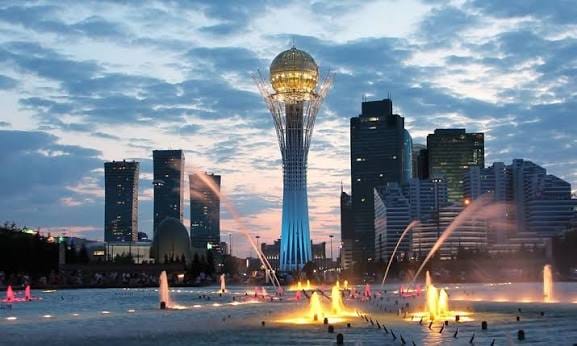
Almaty and Astana occupy an advanced position thanks to their economic scale and well-established financial infrastructure. Almaty has long combined commercial and political functions and established itself as a leading business center in the region. After Astana became the capital, the two cities gradually developed more complementary roles: Almaty remained the main commercial and financial hub, while Astana gained political, institutional, and corporate weight.
Updated figures show that Astana’s economy grew by around 10% in 2025, while Almaty recorded growth of about 5%. Together the two cities generated nearly $107 billion in economic output last year. These numbers are not mere statistics; they reflect Kazakhstan’s broader weight, which accounts for more than half of Central Asia’s GDP and nearly two-thirds of the region’s inward foreign direct investment stock. This scale gives the two cities greater financial capacity to fund infrastructure and urban development, which in turn supports ongoing business activity. Kazakhstan also possesses the most developed capital markets in the region, through the Kazakhstan Stock Exchange in Almaty and the Astana International Financial Centre along with the Astana International Exchange, providing companies with access to equity and debt financing as well as institutional investors at a level currently unavailable elsewhere. Kazakhstan is the only country in Central Asia with an investment-grade sovereign rating, which helps lower the country risk premium and financing costs compared with lower-rated regional markets.
Bishkek comes first among the cities seeking to catch up. The Kyrgyz capital recorded real GDP growth of 15.8% in 2024, a rate significantly higher than that of Astana and Almaty. This figure reflects notable dynamism, yet it comes from a much smaller economic base. Bishkek is distinguished by a relatively low corporate profit tax rate (10%) compared with its neighbors, along with an energy base that relies mainly on hydropower, providing a relatively low-carbon environment with additional development potential. Nevertheless, this path faces challenges such as seasonal electricity shortages, in addition to its smaller economic size and narrower domestic market, which limit its ability to easily finance major infrastructure projects.
Analysis of the figures reveals a clear paradox: Bishkek is growing at a faster rate (15.8%) compared with Astana (around 10%) and Almaty (around 5%), yet the gap in economic scale remains large. The combined output of Almaty and Astana, totaling around $107 billion, reflects a solid base that is difficult to overtake quickly. Even if Bishkek continues to post elevated growth rates, its smaller size means it will need many years of sustained superior growth to approach the scale of the two Kazakh cities. Bishkek’s administrative and geographic expansion, together with long-term plans to develop newly incorporated areas and improve water networks and social infrastructure, aims to accommodate significant population growth, but its limited economic base remains a fundamental constraint on competing with the region’s larger centers in the near term.
As for Tashkent, population growth risks becoming a burden if infrastructure in housing, transport and services fails to keep pace, raising the question of whether Uzbekistan can mobilize the sustained investment needed to prevent this demographic shift from straining resources and economic capacity. At the same time, Tashkent’s ambition opens a set of questions that are difficult to overlook. Large-scale population and urban growth does not automatically translate into economic strength; what is required is capital, infrastructure, labor market reform, and the building of institutions capable of turning scale into productivity.
Tashkent does not need to defend itself with words; the numbers will determine whether it can convert its demographic and economic size into genuine competitive power. Will this growth turn into higher productivity, or will it gradually become pressure on housing, transport and services? Can the city attract long-term capital on the scale its expansion requires? Will capital markets and institutions develop at the same pace as the city expands? And most importantly, can it narrow the gap with Almaty and Astana, or is demographic and economic size alone insufficient to create a competitive regional center?
The same test applies to the ambition of the Tashkent International Financial Centre. The greatest challenge facing any international financial center lies not only in its location or tax incentives, but in the independence of its regulatory and judicial institutions and their ability to convince international investors that market rules will remain stable and predictable.
Competition with the Astana International Financial Centre will not be decided merely by establishing a legal framework or a new financial zone, but by Tashkent’s capacity to build trust, accumulate institutions, and attract investors and companies over the long term. Here the real question becomes: can Tashkent build a financial system that competes with what Astana has accumulated, or does reaching that level require years of institutional accumulation that cannot be shortened by ambition alone? Another factor that may determine Tashkent’s ability to convert its economic size into a competitive advantage is the efficiency of the bureaucratic environment.
Market size alone is not enough if investors face lengthy procedures, multiple agencies, or slow decision-making. The more the city expands and its need for private capital rises, the more the speed of licensing, clarity of rules, and ease of dealing with government institutions become part of competitiveness itself. Therefore, Tashkent’s success will depend not only on the size of its economy or population, but also on its ability to reduce administrative friction and turn institutional reform from an announcement into a practical experience that the investor actually feels.
Lower operating costs in Bishkek may help it attract investment in selected sectors, benefiting from its hydropower advantage, yet the figures confirm that Almaty and Astana enter this phase with clear cumulative advantages stemming from their combined economic output, financial infrastructure, corporate networks, and access to Kazakhstan’s wider resource base.
The economic map of Central Asia is indeed changing, and the most likely outcome is not necessarily one city replacing another, but rather the emergence of a more competitive and interconnected regional economy. Almaty and Astana enter this contest with solid structural advantages backed by stable growth figures and substantial economic scale, while Bishkek seeks to leverage its higher growth rate to offset the difference in size.
In the end, the competition is less about one city surpassing another than about the ability of the region’s major urban centers to convert growing economic scale into higher productivity, stronger connectivity, and greater international competitiveness. True success will depend on continuity and practical reforms more than on ambitious promises alone, as the current figures for the three cities confirm.



 comment replay











 الرجاء الانتظار ...