Ammon News - Jordan and Egypt agreed Sunday to deepen cooperation in the energy and mining sectors through strategic projects and joint investments aimed at enhancing energy security, supporting industrial development and advancing Arab economic integration.
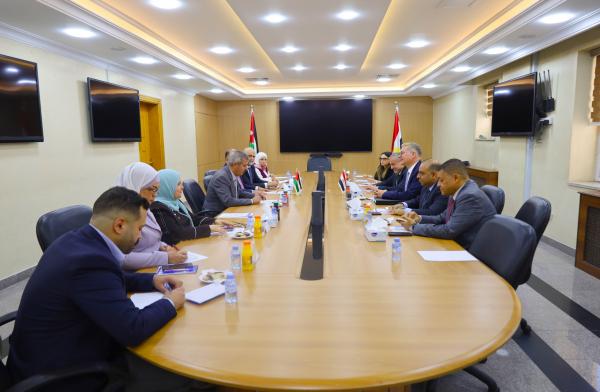
During talks in Amman, Minister of Energy and Mineral Resources Saleh Kharabsheh and Egyptian Minister of Petroleum and Mineral Resources Karim Badawi agreed to expand the strategic partnership between the two countries by launching high-value projects and strengthening collaboration in natural gas, mining, infrastructure and value-added industries.
The ministers emphasized the need to maximize the economic value of natural gas by expanding downstream industries, developing integrated infrastructure and securing advance purchase agreements to ensure the commercial viability of future investments. They also reviewed ways to build on the success of the Jordanian-Egyptian Fajr Company for Natural Gas Transmission and Supply and ongoing cooperation with the Egyptian Natural Gas Holding Company (EGAS), leveraging the two countries' advanced gas infrastructure to bolster energy security and support development projects.
In the mining sector, the two sides discussed developing phosphate and mineral-based industries, expanding cooperation in exploration and geological services, and establishing joint ventures across mining value chains to increase the added value of natural resources and strengthen the sector's contribution to economic growth. They also agreed to encourage partnerships between Jordanian and Egyptian national companies by combining technical, engineering and administrative expertise to implement projects in both countries and expand into regional markets.
Kharabsheh said Jordanian-Egyptian relations represent a leading model of Arab cooperation, particularly in the energy sector, adding that recent achievements have laid the groundwork for a new phase of collaboration centered on strategic projects with sustainable economic returns, in line with the directives of the leadership in both countries.
He said the ministry is expanding natural gas distribution to industrial cities, noting that two agreements with Egyptian companies are expected to be signed soon to supply gas to industrial projects in Ma'an and Muwaqqar. Work is also underway to extend gas networks to Mafraq and Zarqa as part of efforts to increase natural gas use across Jordan's industrial sector.
Kharabsheh said Jordan also aims to benefit from Egypt's expertise in constructing and operating natural gas networks to reduce energy costs and improve industrial competitiveness. He highlighted additional opportunities for cooperation in ammonia and green hydrogen production, as well as other natural gas-based industries.
Badawi said Egypt's experience, including the operation of eight ammonia production plants and the adoption of advanced production technologies, provides a strong foundation for joint projects with Jordan.
He said relations between the two countries are built on longstanding trust and close coordination, praising Jordan's efforts to develop its energy infrastructure. He said the next phase of cooperation would focus on broader collaboration between national companies and institutions in the energy, infrastructure and mining sectors to strengthen regional energy security and support economic development.
Both sides stressed the importance of translating the strong bilateral relationship into tangible economic and investment projects that promote Arab economic integration, expand partnerships between national institutions, increase intra-Arab trade and joint investment, and maximize the region's resources.
The meeting concluded with an agreement to establish joint technical working groups to develop implementation mechanisms for projects in natural gas, mining, value-added industries, infrastructure and investment partnerships.



 comment replay












 الرجاء الانتظار ...