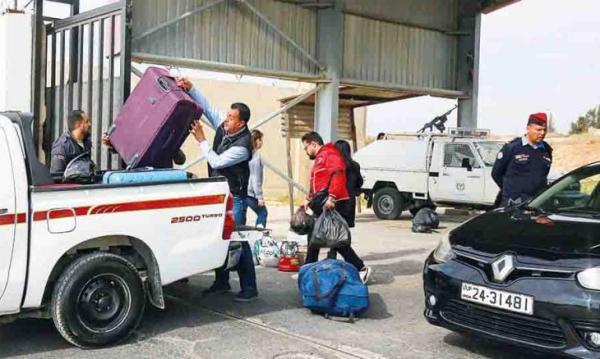
Ammon News - The number of Syrian refugees who have voluntarily returned from Jordan to Syria has exceeded 200,000 registered refugees with the UN Refugee Agency (UNHCR) between 8 December 2024 and 18 June 2026, amid continuing voluntary return movements to various Syrian governorates.
A spokesperson for the UNHCR in Jordan, Youssef Taha, said that 23,150 refugees returned to Syria since the beginning of this year, including 2,500 refugees between 1 and 13 June, stressing that return movements are still ongoing and are entirely voluntary based on personal decisions.
He added that women accounted for 49% of total returnees compared to 51% for men, while children made up 41% of all returnees—around 82,000 children.
He noted that 58% of returnees went back as complete families, while 42% returned individually or without all family members. He also pointed out that 24% of returnees were living in the Zaatari Refugee Camp and Azraq Refugee Camp, amounting to around 48,000 people, while 76% returned from outside camps.
He explained that 23% of returnees were residing in the capital Amman, 22% in Irbid, while the rest were distributed across Zaatari Refugee Camp (15%), Mafraq (14%), Zarqa (7%), and Azraq Refugee Camp (7%).
Taha indicated that most returns occur spontaneously, meaning refugees decide individually, and UNHCR does not have data on their exact destinations inside Syria.
Survey data suggests that most returnees go back to their areas of origin, with 40% originating from Daraa, 19% from Homs, and 11% from the Damascus countryside.
UNHCR continues to implement voluntary return support programs, including cash assistance for refugees in the Zaatari and Azraq camps, where 7,686 refugees have benefited so far, while around 11,500 refugees have returned via buses provided by UNHCR to facilitate their return to Syria, he added.
Taha confirmed that Jordan still hosts more than 400,000 refugees, including over 380,000 Syrians, and that UNHCR continues to provide assistance, although funding shortages are affecting support services.
He stressed that the international community should not forget Jordan, which has hosted refugees for many years.
World Refugee Day is observed annually on 20 June, an occasion established by the United Nations to honor refugees worldwide, highlight their suffering and humanitarian conditions, and showcase their resilience in the face of displacement, conflict, and persecution.
The day aims to strengthen international solidarity with refugees, raise awareness of their issues, and support efforts to find durable solutions, whether through voluntary return, resettlement, or integration into host communities.
Its origins trace back to 2001, when the first global observance was held marking the 50th anniversary of the 1951 Refugee Convention, the main legal framework for refugee protection. It was previously known as “Africa Refugee Day” before the UN General Assembly designated 20 June as World Refugee Day in December 2000.




 comment replay









 الرجاء الانتظار ...