Ammon News - The Jordan Economic Forum (JEF) has underscored the significant economic potential of football in the Kingdom, highlighting Jordan’s historic qualification for the 2026 FIFA World Cup as a strategic opportunity to stimulate investment, tourism, and sustainable growth across multiple sectors.
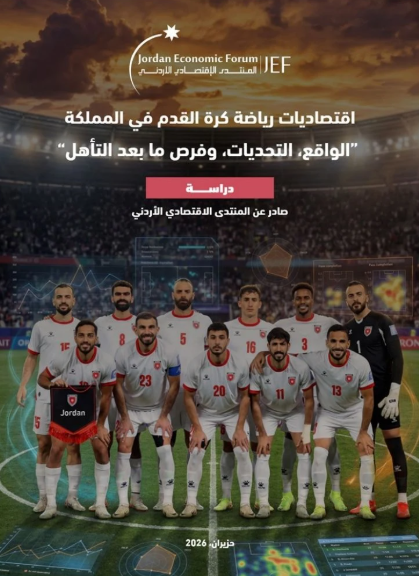
In a paper titled "The Economics of Football in the Kingdom: Reality, Challenges, and Post-Qualification Opportunities," the forum examined the current state of Jordan’s sports sector, with a particular focus on football as the Kingdom’s most popular sport and a key driver within the global sports economy.
The paper noted that the national team’s achievements in recent years have reinvigorated Jordan’s sports landscape, attracting growing local, regional, and international attention to Jordanian football and generating economic and developmental opportunities that extend beyond the sporting arena.
According to the forum, the Kingdom’s continued support for the youth and sports sectors is reflected in its institutional infrastructure, sports facilities across the governorates, Royal directives supporting youth and sports initiatives, and the sustained efforts of His Royal Highness Crown Prince Al Hussein and His Royal Highness Prince Ali bin Al Hussein, President of the Jordan Football Association, in advancing Jordanian football and strengthening its competitiveness.
The paper said this approach is aligned with the Economic Modernization Vision 2022-2033, which identifies sports as part of the future services sector due to its role in enhancing quality of life and supporting comprehensive economic and social development.
On the sector’s economic performance, the paper indicated that the output of sports, recreation, and leisure activities reached JD29.5 million in 2023, according to Department of Statistics data, compared with more than JD56 million before 2019. While the sector has gradually recovered from the effects of the COVID-19 pandemic, its contribution remains below previous levels.
The sector’s added value totaled approximately JD20.9 million in 2023, reflecting its direct contribution to the national economy after production costs, although the paper noted that its economic impact remains modest relative to public interest in sports.
The forum highlighted the Ministry of Youth’s role in developing the sports environment through operational and capital spending, noting that capital expenditures accounted for an average of 38 percent of the ministry’s total spending over the past five years.
Reviewing football’s development in Jordan since its introduction in the late 1920s, the paper described the sport as a major economic and social asset linked to an integrated ecosystem that includes clubs, competitions, broadcasting rights, sponsorships, player transfers, sports infrastructure, and employment opportunities.
The paper also praised reforms implemented by the Jordan Football Association and the launch of the Jordanian Football Strategy 2025-2029, noting that these efforts have contributed to a series of landmark achievements, including reaching the AFC Asian Cup final, finishing runners-up in the Arab Cup, and securing the Kingdom’s first-ever qualification for the FIFA World Cup.
It added that Jordan’s FIFA ranking has climbed to 63rd globally, while the national team’s market value has risen to approximately €19.83 million. Meanwhile, the market value of the Jordanian Pro League has reached around €31.03 million, supported by increasing fan attendance, digital engagement, and growing public interest in domestic competitions.
The paper stressed that World Cup qualification represents more than a sporting milestone, describing it as a catalyst for economic growth that could increase tourism flows, attract investment, expand sponsorship opportunities, and strengthen sectors such as hospitality, transportation, marketing, and sports-related services.
It further noted that the global visibility generated by participation in the World Cup can enhance Jordan’s international profile, create new opportunities for tourism promotion and foreign investment, and support broader cultural and economic outreach efforts.
The forum pointed to a sharp rise in public and digital engagement with the national team, saying the expanding fan base presents opportunities to develop new business models in sports marketing, sponsorships, broadcasting rights, and digital content.
To maximize these opportunities, the paper called for strengthening sports investment through enhanced governance, deeper private-sector partnerships, and the gradual transformation of clubs into professionally managed sports companies capable of generating sustainable revenues and attracting long-term investment.
It also urged continued investment in sports infrastructure, modernization of stadiums and facilities, expansion of sports tourism initiatives, and stronger financial and administrative support for clubs to improve competitiveness and sustainability.
The paper stressed the importance of updating legislation governing sports investment, introducing incentives to attract private capital, streamlining procedures for sports projects, and expanding the role of sports support funds and sustainable financing mechanisms.
Additionally, it highlighted the need to improve governance, diversify revenue streams, strengthen sports marketing strategies, and develop specialized databases and performance indicators to support evidence-based policymaking and economic analysis within the sports sector.
The forum concluded that Jordan’s ability to capitalize on its historic World Cup qualification will depend on transforming current public enthusiasm and international attention into long-term development projects, sustainable investments, and economic opportunities that reinforce the national economy and elevate the standing of Jordanian football in the years ahead. Petra




 comment replay









 الرجاء الانتظار ...