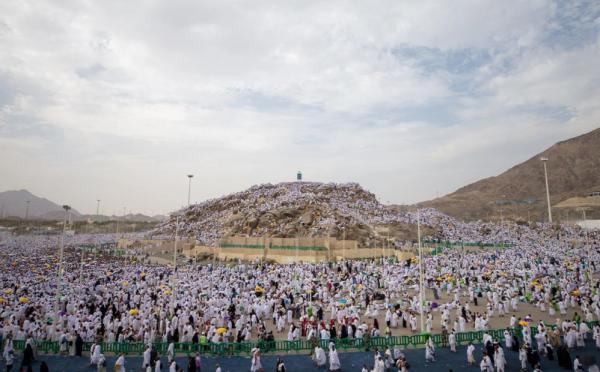
Ammon News - More than 1.6 million pilgrims gathered Tuesday on the Plain of Arafat for the most sacred and spiritually defining stage of the Hajj pilgrimage, in scenes of intense devotion and prayer reported by the Saudi Press Agency.
From dawn on the ninth day of Dhul-Hijjah, pilgrims streamed into Arafat, where they will spend the day in worship, Qur’an recitation, remembrance of God and supplication, remaining within the designated boundaries of the sacred site until sunset.
Widely regarded in Islamic tradition as the pinnacle and heart of Hajj, the standing at Arafat — known as Wuquf Arafah — is considered the pilgrimage’s central rite. Prophet Muhammad said: “Hajj is Arafah,” emphasizing the essential nature of the gathering.
Islamic scholars describe the day as one of the holiest in the Islamic calendar and a moment associated with mercy, forgiveness and spiritual renewal. It also coincides with the Farewell Pilgrimage of Prophet Muhammad in A.D. 632, during which he delivered his final sermon at Mount Arafat, outlining principles of justice, equality and the sanctity of life and property.
• Hajj 2026: Pilgrims gather at Mount of Mercy on the plain of Arafat for most sacred stage of Hajj
At noon, the Arafah sermon will be delivered to pilgrims, offering religious guidance and reminders about the virtues of the day. Pilgrims will then perform the Dhuhr and Asr prayers combined and shortened in accordance with the Sunnah of Prophet Muhammad.
Throughout the day, worshippers raise their hands in prayer, recite the Talbiyah and Takbeer, and seek forgiveness in an atmosphere marked by humility and reflection.
Arafat, located about 20 kilometers southeast of Makkah, is an open plain dominated by Jabal Al-Rahmah, or the Mount of Mercy, where many pilgrims gather for prayer and contemplation. Islamic tradition holds that the site is linked to the reunion of Adam and Eve and remains deeply symbolic for Muslims worldwide.
The movement to Arafat followed the Day of Tarwiyah in Mina, where pilgrims spent Monday preparing spiritually and physically for the most demanding phase of Hajj.
Saudi authorities deployed extensive operational plans to facilitate the movement and safety of pilgrims, supported by crowd-control systems, medical services, transportation networks and emergency response units across the holy sites.
Health authorities remained on high alert amid temperatures exceeding 45 C, urging pilgrims to stay hydrated and avoid prolonged exposure to direct sunlight.
At sunset, pilgrims began departing Arafat for Muzdalifah, where they were set to perform the Maghrib and Isha prayers combined and shortened before spending the night in worship and rest ahead of the symbolic stoning ritual.




 comment replay









 الرجاء الانتظار ...