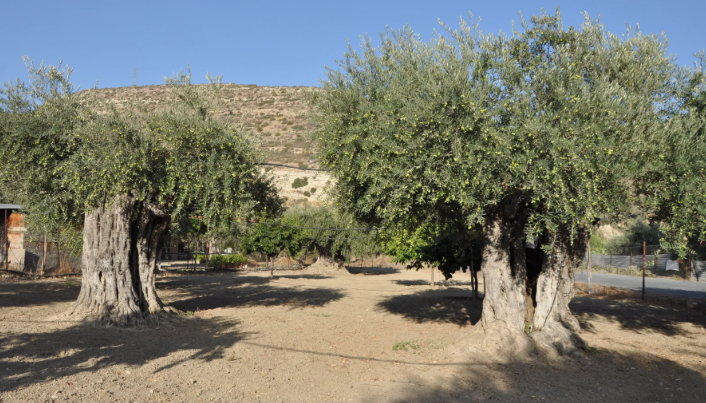
Ammon News - Jordan's ancient Mehras olive tree is reshaping global understanding of olive history, as new scientific evidence positions it not just as a centuries-old survivor on the hills of Ajloun, Jerash, and Irbid, but as one of the oldest and most influential olive lineages in the Mediterranean.
Its genetic significance and cultural value have propelled it toward inscription on UNESCO’s Representative List of the Intangible Cultural Heritage of Humanity, marking a major milestone for Jordan’s natural and cultural heritage.
According to researchers, the Mehras tree is far more than a relic of past civilizations. Advanced genetic mapping conducted by the National Agricultural Research Center (NARC), in collaboration with Jordanian universities, shows that the tree represents a foundational ancestor to several olive varieties that later spread to countries such as Italy, Spain, Greece, and Cyprus.
Dr. Nizar Haddad, head of the research team and former NARC director, said that extensive DNA analyses confirm Jordan as one of the central geographical origins of olive domestication. He said Mehras trees found in the Maysar–Al Hashimiyya area of Ajloun form one of the oldest lineages in the Mediterranean and are genetically closest to the olives of Spain, Italy, and Cyprus.
This research is part of a wider national effort to document genetic maps of key agricultural species. NARC previously published genetic blueprints of Jordanian honeybees and the native Awassi sheep.
Haddad explained that the name "Mehras" was chosen over the older term "Roumi" due to local cultural traditions in Ajloun, where large olive trees with trunks too wide for three people to encircle are known as Mehras. The name was adopted for international genetic registration to reflect Jordan’s cultural heritage.
Additional studies led by horticultural researcher Eng. Raed Lutfi and biotechnology professor Dr. Mundher Al-Sadr further support the tree’s central role in early olive cultivation.
Scientific evidence, including carbon dating from archaeological sites in Wadi Al-Rayyan, Tulaylat Al-Ghassul, the Jordan Valley, and Wadi Rum, shows that olive growing and oil extraction began in Jordan as early as 5400 BC, predating many of the world’s earliest known olive cultivation records.
Western research aligns with these findings, tracing the spread of olive varieties from the Eastern Mediterranean toward Greece and Turkey, and later into Italy and Spain, a trajectory in which the Mehras lineage appears to be a key ancestral source.
Historical olive trees, commonly referred to as "Roman olives", remain widespread in villages across Ajloun, Irbid, Balqa, Jerash, and Tafileh. These ancient trees still make up 15–20 percent of Jordan’s olive-growing areas, reinforcing the deep-rooted presence of olive cultivation in the region.
Researchers say the expanded genetic fingerprint reveals that Mehras trees possess one of the richest and oldest genetic profiles in the Eastern Mediterranean. They exhibit remarkable resilience to harsh climates and maintain exceptionally high oil quality.
Mehras olives also produce up to 30 percent oil content, among the highest globally, and contain around 70 percent oleic acid, giving the oil a distinctive fruity flavor and superior sensory characteristics.
A 2023 postal stamp featuring the "Ancient Local Mehras Olive Trees" further underscores the heritage and scientific importance of this lineage.
Olive expert Dr. Salam Ayoub highlighted the presence of ancient stone olive presses dating back to the Roman era, emphasizing Jordan’s long relationship with olive cultivation. He noted archaeological findings in Wadi Rum’s Hudeib Al-Reeh suggesting olive use as early as 5400 BC, far earlier than the 4200 BC date often cited as the world’s earliest olive cultivation.
Mehras trees today are found in abundance across Ajloun, particularly in Al Hashimiyya and Khirbet Al-Wahadneh, as well as in Irbid, Balqa, Jerash, Tafileh, and Karak, where the climatic conditions and fertile soils support their growth. These trees withstand drought, low rainfall, pests, and diseases, making them living markers of Jordan’s agricultural heritage. Roman-era olive trees are estimated to cover 15–20 percent of the Kingdom’s olive-growing land.
Ayoub stressed that preserving the Mehras lineage requires coordinated actions, including documenting and conserving the variety in genetic collections, expanding its cultivation among farmers, studying the age and distribution of trees, adopting sustainable agricultural practices, and linking Mehras cultivation to eco-tourism and rural development. He also called for registering Mehras olive oil as a geographical indication to protect its quality and enhance its market value.
Experts agree that the upcoming UNESCO recognition offers a major opportunity to safeguard this unique genetic heritage and elevate Jordan’s presence on the global olive map. They say the move will not only protect the tree but also boost the economic value of Mehras olive oil worldwide.
Petra



 comment replay











 الرجاء الانتظار ...