Ammon News - Since 2008, U.S. taxpayers have contributed more than $60,000 for research to study the prevalence of water pipe, or "hookah," smoking is among college students in Jordan.
The research was paid for by the Fogarty International Center and the National Cancer Institute, both of which are elements of the U.S. National Institutes of Health (NIH).
In 2009, NCI awarded a $48,402 grant to Virginia Commonwealth University researcher Thomas Eissenberg, and in 2008, the Fogarty International Center paid him $12,401 for the research, according to NIH records.
The aims of the research, as stated in the NIH grant abstract, were to study, over three years, “changes in waterpipe tobacco smoking prevalence, knowledge and beliefs among Jordanian university students; 2) examine relationships among waterpipe users' dependence, smoking behavior, and CO (carbon monoxide) exposure; and 3) enhance local and regional tobacco-related research capacity."
The grant abstract (which is a summary and description of the research proposal provided by the researcher to the NIH) noted that there has been a world-wide increase in hookah smoking--and with it, an increase in disease and death.
“Global popularity and disease risk highlight the need to learn more about waterpipe smoking, including its regional prevalence and user toxicant exposure profile,” according to the NIH profile. A toxicant is a poisonous agent or something toxic or harmful to the body.
One of the main reasons cited for why U.S. taxpayers should fund the grant was the desire to help countries like Jordan build up their ability to carry-out tobacco-related research.
“This capacity is particularly needed in the countries of Southwest Asia, where tobacco use rates can exceed 50 percent and waterpipe tobacco smoking is common,” the abstract said.
“Some countries, like Syria and Lebanon, have been building tobacco research capacity [e.g., NIH- funded research at the Syrian Center for Tobacco Studies (SCTS) and the American University of Beirut (AUB)]. Others may require more research capacity before they can join regional tobacco research efforts,” it said.
The summary added: “For example, Jordan has high tobacco use rates and waterpipe tobacco smoking seems common. Studying Jordanian waterpipe use prevalence and user toxicant exposure would provide needed local data while developing regional tobacco-related research capacity.”
Jordan was specifically chosen, according to the study summary, because it lies in an area known for hookah smoking--the Middle East--but little is known about hookah smoking in Jordan itself.
“Although water pipe tobacco smoking is common in Lebanon and Syria, prevalence in neighboring Jordan is uncertain,” the NIH grant abstract stated.
According to the abstract, the study was carried out in Irbid, Jordan, by Eissenberg and researchers Mohammed Azab and Omar Khabour at the Jordan University of Science and Technology.
The Jordanian research is part of a larger U.S. effort to learn more about hookah smoking--and is an extension of a $536,000 "parent" grant that Eissenberg had received to study waterpipe smoking among U.S. college students.
Eissenberg did not respond to requests from CNSNews.com for comment for this story.
According to the federal Office of Management and Budget, the annual U.S. budget deficit rose from $459 billion in 2008 to $1.4 trillion in 2009, while the grant money to study hookah smoking in Jordan was being distributed. (CNS News)
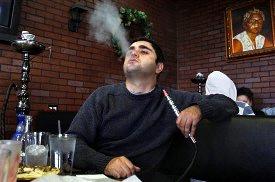
Photo: Timur Nersesov enjoys a plate of hummus, an Orange Crush and a hookah filled with rose and mint tobacco at Arabica Bistro in Dearborn, Mich., Friday, April 9, 2010.. (AP Photo/Carlos Osorio)



 comment replay