Ammon News - IRBID - Down the street from the municipality building and situated on the oldest hill in Irbid, stands a shrine to one of the Arab world’s greatest poets and the Kingdom’s first celebrities.
Mustafa Wahbi Tal, known to the literary world as Arar, was born in 1899.
With his distinctive use of Jordanian dialect, Arar’s poetry and advocacy for the underprivileged, made him one of the Kingdom’s most revered and colourful figures.
In the 1890s, his father Salah Mustafah Tal built the seven-room Damascene-style home with a blend of various Arab and Islamic architectural influences on Tel Irbid.
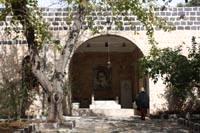
The interior walls of the home were made of mud brick and straw, with outer walls built of black basalt situated around a large courtyard, featuring five bedrooms and two salons. The centrepiece of the building is a berry tree in the courtyard that has stood for over a century.
Maeen Tal, Arar’s son, said he has vivid memories from the time his family lived in the home.
“It was a really distinctive building. My grandfather built the layout in an ‘L’ shape, which was unheard of at the time,” the 84-year-old said, noting that the structure was constructed using original stone from the surrounding area.
Shortly after the Great Arab Revolt, British political adviser Major F.R. Somerset occupied the historic home.
According to Arar’s memoirs, Somerset spent many a night trying to convince him of the virtues of the British mandate in historical Palestine and Trans-jordan.
“It was a nice house, with a large courtyard overlooking the surrounding area. Why would the British want to stay anywhere else in Irbid?” the younger Tal said with a laugh.
A bohemian and a philosopher, Arar moved frequently across the Kingdom, and wrote extensively on the romantic life of the gypsies, bedouin and the virtues of a free life.
Despite his various travels, the poet would always find his way back to his ancestral Irbid home, making the residence a cradle of his creativity.
The home was rented for a time to a British physician of Indian origin, who used the building as a hospital and a clinic for the greater Irbid area. Arar and his family briefly inhabited the home in the 1930s.
Between 1944 and 1950, the house was transformed into an elementary school by Mohammad Subhi Abu Ghaneema before it again housed a member of the Tal family, this time Arar’s brother Salim Tal.
After a school constructed adjacent to the building was converted to a church, blocking off the Western entrance, the Tal family built an entrance on the southern slope of the hill, which has since become an iconic feature of the building.
“The home of Jordan’s most famous poet is situated in between a church and a mosque. What can be better than that?” Arar’s son remarked.
In 1989, Arar’s sisters donated the house as a trust to house his artefacts and serve as a cultural centre. Pictures of the famous poet adorn the walls of its rooms, depicting Arar posing with kings, politicians and gypsies alike - chronicling the early years of the Kingdom’s history and the charm and allure of Jordan’s national poet.
With the trust established and the museum in place, the Tal family decided that after decades of restless roaming, it was finally time to bring Arar home.
In 1989, 40 years after his death, Tal’s remains were transferred from his grave in Northern Irbid and were reburied in the building’s courtyard, with a larger than life mural of the poet welcoming visitors who come to pay homage.
The building was renovated with several truckloads of original stone from nearby quarries, according to Tal.
The home, now a cultural centre devoted to Arar and run by the Ministry of Culture, is open to the public, its lush green courtyard as welcoming as it was when the country was in its infancy.
With its arched entranceway open, beckoning those looking for inspiration and adventure, literary fans, historians and people of all walks of life will always have a home at Beit Arar.
(By Taylor Luck/ Jordan Times)
******Built in the 1890s, Beit Arar in the northern city of Irbid now serves as a cultural centre and museum (Photo by Taylor Luck)



 comment replay