Ammon News - BEIDHA - Carved into the rocks outside Wadi Musa are the remains of a suburban paradise.
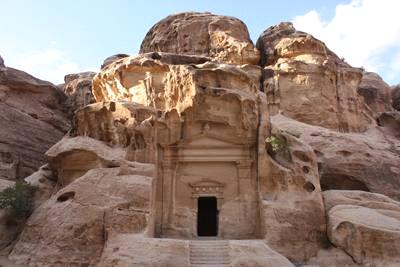
The lesser-known Beidha area, dubbed “Little Petra”, is most famous for its Siq Al Barid, a scaleddown version of the iconic Petra Treasury.
In contrast to Little Petra’s monuments, however, the stature of its inhabitants was anything but diminutive.
The area, some eight kilometres north of the rose-red city, served as a Nabataean Abdoun, home to the power-brokers and wealthy merchants that wielded influence in the ancient civilisation.
Little Petra was prime location for wealthy Petra residents looking to build villas away from the main city and in the cool shade of the surrounding canyon.
In the first century AD, the upscale neighbourhood transformed into a commercial hub, after over-development and population growth within Petra itself made it impractical for large caravans to enter the rose-red city.
Caravans from the Negev, Gaza, Jerusalem and the Phoenician coast would arrive and station themselves in the suburb, carved out of a canyon, to engage in trade.
Over time, the area developed into a miniature Petra complete with places of worship, tombs, villas, water channels and cisterns to meet the needs of the Nabataean elite.
Though much has been lost as a result of earthquakes or theft, signs of the area’s grandeur are still evident.
The wall paintings of Little Petra, ancient frescoes dating back to the 1st century BC, provide insight into the residents’ wealth and ties to the Hellenistic world and Egypt.
The vault-covering paintings, some 300 metres from the entrance at Siq Al Barid, depict intertwining vines, flowers, birds and mythological figures, a passing glimpse into the once-flourishing civilisation’s cultural values and artistry.
The frescoes, considered one of many advanced forms of artistic expression in the community, adorn arched alcoves and walls of what is believed to be the dining room of a wealthy family.
Despite Roman occupation starting with the emperor Trajan, and Byzantine influences, the suburb retained its prominence as home to the ancient world's rich and famous for centuries.
As empires clashed and waned and trade routes shifted north to Damascus and Palmyra, traffic through Petra decreased, and the Nabataean capital fell into economic decline.
As residents began to migrate from Petra itself, its suburb also became deserted.
After being abandoned for several centuries, the stone-carved palaces most recently housed the Ammarin tribe, who now live in the modern village of Beidha and operate nearby tourist camps.
Now the once-upscale neighbourhood’s only visitors are trickles of tour groups from across the world looking to get away from the bustle of Petra and Wadi Musa.
Though Little Petra’s glory days are long gone, visitors can still walk along the grand promenade between the engineering marvels of the rock-carved city, following in the footsteps of the ancient world’s elite.
By Taylor Luck / The Jordan Times
* Little Petra, the Abdoun of the Nabataean civilisation, was home to wealthy merchants and decision makers around the 1st century BC (Photo by Taylor Luck)



 comment replay