Ammon News - AMMAN, Jordan — Archaeologists in Jordan have unearthed a 3,000-year-old Iron Age temple with a trove of figurines of ancient deities and circular clay vessels used for religious rituals, officials said Wednesday.
The head of the Jordanian Antiquities Department, Ziad al-Saad, said the sanctuary dates to the eighth century B.C. and was discovered at Khirbat 'Ataroz near the town of Mabada, some 20 miles (32 kilometers) southwest of the capital Amman.
He said the complex boasts a main room that measures 388 square feet (36 square meters), as well as two antechambers and an open courtyard.
The sanctuary and its artifacts — hewn from limestone and basalt or molded from clay and bronze — the complex religious rituals of Jordan's ancient biblical Moabite kingdom, according to al-Saad.
"Today we have the material evidence, the archaeological proof of the level of advancement of technology and civilization at that period of time," he said.
The Moabites, whose kingdom ran along present-day Jordan's mountainous eastern shore of the Dead Sea, were closely related to the Israelites, although the two were in frequent conflict. The Babylonians eventually conquered the Moabites in 582 B.C.
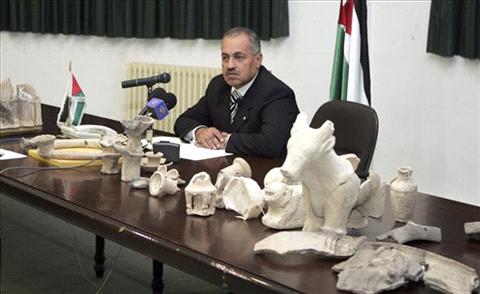
Archaeologists also unearthed some 300 pots, figurines of deities and sacred vessels used for worship at the site.
Al-Saad said it was rare to discover so many Iron Age items in one place.
Excavations began in Khirbat 'Ataroz in 2000 in cooperation with the California-based La Sierra University, but the majority of the items were only discovered in the past few months.
Among the items on display Wednesday, there was a four-legged animal god Hadad, as well as delicate circular clay vessels used in holy rites. Al-Saad said the objects indicate the Moabites worshipped many deities and had a highly organized ritual use of temples.
The items will be scientifically analyzed and conserved before going on display in Jordan's archaeological museum. (AP)



 comment replay











 الرجاء الانتظار ...