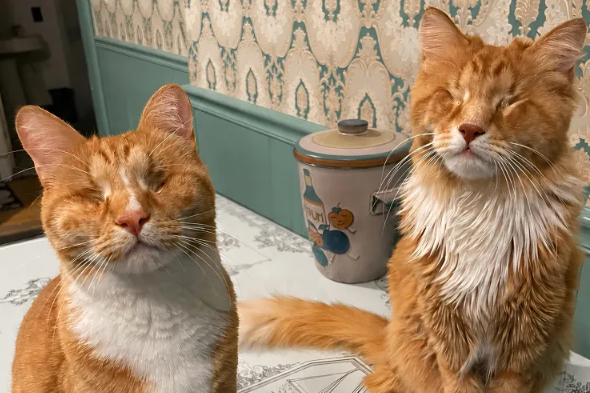
Ammon News - Two cat siblings have been diagnosed with the first documented cases of Marfan syndrome in domestic cats. The findings, published Saturday, Sept. 19 in Scientific Reports, centered on feline brothers Gary and Shaggy.
Marfan syndrome is a genetic condition best known in humans that affects the body’s connective tissues, including structures in the eyes, bones, skin, ligaments and blood vessels. People with the condition are often tall and slender, with unusually long arms, legs, fingers and toes, per the Mayo Clinic. They may also have extreme nearsightedness, crowded teeth and a curved spine.
The condition affects about 1 in 4,000 people, and has never been found in cats before now, Cornell University said in a press release on Tuesday, Sept. 22.
Gary and Shaggy’s owners first noticed something was different about the siblings when they displayed unusually long limbs as kittens.
As the cats got older, veterinarians also found abnormalities involving their eyes and an enlarged aorta — a combination that led the team to test for the syndrome.
“The findings provide a foundation for improved veterinary diagnostics,” Dr. Jacquelyn Evans, the study’s senior author and an assistant professor in Cornell’s Department of Biomedical Sciences and Baker Institute for Animal Health, said, per the release.
She added, “It can help veterinarians recognize similar cases in the future and may help develop genetic tests.”
To investigate the cats’ condition, researchers from Cornell’s College of Veterinary Medicine and Baker Institute worked with collaborators at Ghent University, the University of Pennsylvania and the Schwarzman Animal Medical Center in New York City.
The team combined clinical exams with genetic sequencing and identified changes in FBN1, the gene responsible for producing fibrillin-1, a protein that plays an important role in connective tissue.
Researchers found that Gary and Shaggy each carried two altered copies of the gene — one inherited from each parent.
That stood out because in humans, a single altered copy of FBN1 can be enough to cause Marfan syndrome, while having two altered copies is exceptionally rare.
“This discovery is a great example of how pet parents can collaborate with veterinary and genetic experts to learn something that could help other animals in the future,” Evans said. “It also showcases the comparative approach that has long been central to research at the Baker Institute for Animal Health.”
People



 comment replay









 الرجاء الانتظار ...