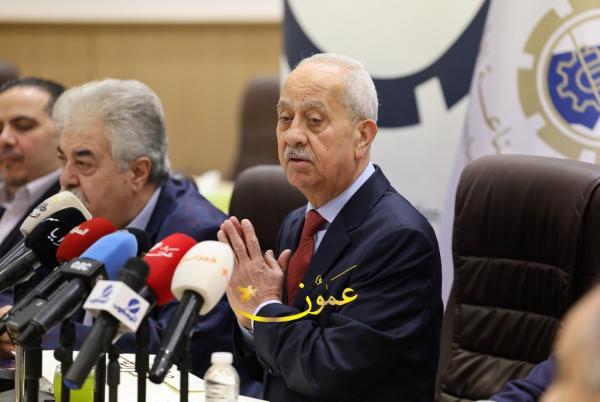
Ammon News - The industrial sector has recorded significant growth in production, added value, exports and employment in recent years, while expanding its export base across products and markets, Jordan Chamber of Industry Chair Fathi Jaghbir said Thursday.
At a news conference, Jaghbir noted that industrial added value rose from about JD8 billion in 2020 to nearly JD9.9 billion in 2025, an increase of more than 23 percent, while industrial production increased from JD12 billion to JD20 billion.
He pointed out that the sector directly accounts for about 24 percent of gross domestic product and has contributed approximately 40 percent to economic growth, in addition to its indirect impact on transportation, services, logistics, trade, energy, investment and employment.
Industrial exports recorded particularly strong growth, rising from JD4.7 billion in 2020 to JD8.9 billion in 2025, an increase of more than 90 percent, according to Jaghbir.
The compound annual growth rate of industrial exports reached about 15 percent between 2021 and 2025, compared with approximately 3 percent from 2016 to 2020 and 2 percent from 2011 to 2015, reflecting a marked acceleration in export growth.
The expansion was accompanied by greater diversification of products and export markets. The number of commodities with annual exports exceeding JD1 million increased from 455 in 2019 to 754 in 2025, while the number of export markets receiving more than JD1 million in goods rose from 72 to 93.
Jaghbir highlighted employment as one of the most significant outcomes of the sector's expansion, noting that the industry has generated about 56,000 jobs since 2022, bringing total industrial employment to approximately 274,000, or about 21 percent of the Kingdom's workforce.
More than 16,000 industrial jobs were created last year alone, he added, describing the sector as a model of growth that combines increased production and exports with job creation and income generation.
Regarding the Economic Modernization Vision, Jaghbir noted that following completion of its first executive program through 2025, the industrial sector had achieved about 31 percent of its targeted added value, 27 percent of its industrial export target and 22 percent of its overall employment target for the vision's timeframe.
He stressed the importance of maintaining consultation with the private sector and regularly monitoring implementation to reinforce the industry's role as a partner in setting and implementing economic priorities.
Jaghbir also highlighted the expansion of government support and empowerment programs targeting the industrial sector in recent years, benefiting more than 1,200 companies and industrial establishments.
In the energy sector, he cited reductions in industrial electricity tariffs, removal of the fuel price differential clause, and suspension of peak-hour tariffs, alongside measures to expand energy efficiency and renewable energy use.
Other initiatives included a program to extend natural gas networks to cities and industrial zones, and a 100-megawatt renewable energy project, he added.
The Chamber chair also pointed to raising the price preference for national products in government procurement from 15 percent to 20 percent, as well as measures to strengthen their presence in public tenders.
In investment, he highlighted incentives tailored to the industrial sector, the incorporation of most of the Chamber's proposals into amendments to the Investment Environment Law, the establishment of new industrial cities, incentives for industrial investment in governorates and reductions in industrial land prices.
He further noted the sector's ability to respond to various crises, including measures to mitigate higher shipping costs, establish alternative routes and exemptions, maintain supply-chain continuity, and accelerate administrative procedures.



 comment replay












 الرجاء الانتظار ...