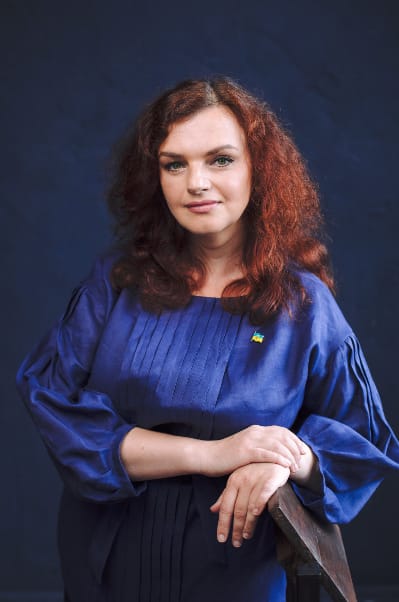
Myroslava Shcherbatiuk- Ambassador of Ukraine to Jordan
The end of November will see elections to the Executive Council of the Organization for the Prohibition of Chemical Weapons for the period of 2026–2028.
In this context, it is worth noting that global security - and one of its key pillars, the Chemical Weapons Convention (CWC) - are being deliberately undermined by Russia’s systematic use of chemical weapons in Ukraine.
Such actions by Russia threaten not only the safety of the Ukrainian people but also the integrity of the international community’s commitment to achieving a world free of chemical weapons.
On a daily basis, the Ukrainian authorities are compiling evidence of these violations of the CWC and reporting them to the Organization for the Prohibition of Chemical Weapons (OPCW) and its member states.
From February 2023 to August 2025, the Ministry of Defense of Ukraine reported more than 10,640 cases of Russia’s use of munitions containing hazardous chemicals in violation of the CWC. Verified evidence indicates that Russian forces have turned to chemical agents as part of their military tactics, using them to stall Ukraine’s advances and destabilize Ukrainian positions, leaving Ukrainian forces vulnerable to other forms of attack. More than 2,753 Ukrainian servicemen have sought medical care due to symptoms of chemical exposure.
These violations have been confirmed in three OPCW reports (18 November 2024, 14 February 2025, and 20 June 2025), as well as in a Joint Statement of 59 countries adopted at the 29th Session of the States Parties to the CWC.
The pattern of Russia’s violations of the Chemical Weapons Convention is not limited to Ukraine. Moscow’s complicity in the use of chemical weapons in Syria - notably the repeated chlorine and sarin attacks carried out by the Assad regime between 2014 and 2018 - was extensively documented by the OPCW Fact-Finding Mission and the Joint Investigative Mechanism of the United Nations. Despite overwhelming evidence, Russia repeatedly used its veto power in the UN Security Council to block accountability for these crimes. This legacy in Syria serves as a stark reminder to the international community of what impunity for chemical weapons use looks like - and why it should be stopped in Ukraine.
These reports emphasize that the evidence provided by Ukraine -specifically, seven grenades, along with corresponding soil and grass samples -was collected and transferred to OPCW representatives in full compliance with chain-of-custody procedures and relevant protocols. Two independent OPCW-designated laboratories confirmed that the evidence contained CS, a substance used in riot control agents. Its use as a method of warfare is explicitly prohibited by the CWC.
The international response to Russia’s actions has been strong but still insufficient. On 1 May 2024, the United States imposed sanctions on Russia for its use of chemical agents, including chloropicrin, against Ukraine. On 6 June 2024, a coalition of countries, including Canada, Finland, Italy, Norway, Sweden, the United Kingdom, and the United States, issued a joint statement condemning Russia’s use of chemical agents against Ukrainian forces. On 8 October 2024, the United Kingdom imposed restrictions on Russia’s Radiological, Chemical, and Biological Defense troops, including their commander, in response to documented chemical weapons use in Ukraine.
Most recently, on 20 May 2025, the Council of the European Union, based on OPCW reports, imposed additional restrictive measures on three Russian entities involved in the development and use of chemical weapons: the Radiological, Chemical, and Biological Defence Troops; the 27th Scientific Centre; and the 33rd Central Scientific Research and Testing Institute of the Ministry of Defence of the Russian Federation - all belonging to the Russian Armed Forces.
Russia has not provided any credible explanation regarding its widely reported use of riot control agents and has consistently denied its involvement, often through state-sponsored disinformation campaigns. Yet, its record speaks otherwise: in 2018, the OPCW confirmed that Russia used a ‘Novichok’ nerve agent against its own citizens - Sergei and Yulia Skripal, who found shelter in the United Kingdom - and in 2020, Alexei Navalny, a prominent Russian opposition leader who was killed, was similarly poisoned.
Ukraine is currently a member of the OPCW Executive Council for the period 2024–2026. As a victim of the use of chemical weapons, Ukraine is uniquely positioned to contribute to the OPCW mission. As the OPCW explores emerging technologies, Ukraine’s advancements and expertise offer innovative and practical solutions in artificial intelligence and drone technologies for remote monitoring, chemical agent detection, and open-source data analysis.
Ukraine continues to assess additional measures to ensure compliance with international law, particularly the CWC. These efforts focus on identifying perpetrators, organizers, and sponsors, as well as pursuing further international accountability to uphold the provisions of the CWC.
In this regard, the mechanisms of the OPCW are of crucial significance for bringing violators of the CWC to justice.
Against this background, Russia’s application for a seat on the OPCW Executive Council for the 2026–2028 term is absolutely cynical. For many, this bid is viewed as an attempt by Russia to shield itself from accountability within the very body tasked with preventing the use of chemical weapons.
The international community must minimize the influence of the Russian Federation - currently waging unjustified and illegal military aggression against Ukraine - on the impartial activities of such organizations as the OPCW. Therefore, it should prevent Russia’s election (for the third time in a row) to the OPCW Executive Council for the period 2026–2028 by supporting the candidacies of Ukraine, the Slovak Republic, and the Republic of Slovenia - active, credible, and responsible OPCW members committed to a multilateral system based on international law, the purposes and principles of the UN Charter, and the common goal of achieving a world safe from the threat of chemical weapons.
Granting the Russian Federation a seat in the OPCW Executive Council would send a dangerous message - that those who violate the rules can also shape them. For the sake of numerous victims of the chemical weapons the international community must stand united, both in demanding accountability and in reaffirming that the Chemical Weapons Convention remains a shield for humanity and rules based international order, not a tool for those who seek to ruin it.
The victims of chemical weapons attacks in both Syria and Ukraine are not statistics – they are families, friends, and loved ones who once lived ordinary lives, now shattered by the indiscriminate cruelty of these weapons. From the children who suffocated in Douma to the Ukrainian soldiers and civilians who suffered chemical burns and poisoning in their own homeland, their stories remind us that the use of chemical weapons is not an abstract violation of law – it is a crime against humanity itself. Their memory calls upon the international community to ensure that such atrocities are never repeated, and that those responsible are held fully accountable.



 comment replay











 الرجاء الانتظار ...