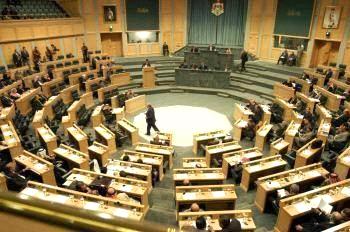
Ammon News - AMMONNEWS - The Lower House on Monday endorsed a mixed electoral system that features a majority vote at the governorate level and a closed proportional list at the national level under the 2012 draft elections law.
During an afternoon session, a majority of deputies voted in favour of the Legal Committee’s amendments to Paragraph C of Article 8 of the legislation under which each voter will be given two votes: one for a candidate at the district level and another for a closed proportional list that will compete for 17 seats at the national level.
In addition, a similar majority voted for approving the panel’s amendments to Paragraph C of the said article as worded by the former government under which the number of Lower House seats at the governorate level will stand at 108, which will be contested in 45 constituencies in the Kingdom’s 12 governorates and the three badia regions.
The House also approved the allocation of 15 seats for the women’s quota under the committee’s amendments to Paragraph C of Article 8 of the key reform-related legislation. Under the amendments, the next Lower House will consist of 140 seats.
A majority of MPs also voted for removing from the 73-article legislation the provision stipulating that compensation seats are to be awarded to districts from which no candidate makes it to Parliament as recommended by the panel.
During the session, Prime Minister Fayez Tarawneh commended the panel’s amendments to the legislation as progressive, adding that the changes have taken into account recommendations of the Independent Elections Commission and the National Dialogue Committee.
The premier noted that he has chosen not to defend the original formula of the law to avoid claims that the government is trying to influence deputies.
“If we keep silent they will say that the government is not defending the law and if we speak they will say that the government is attempting to influence deputies,” he added.
Tarawneh said political parties are not confined to candidates at the national level, stressing that “no one” is preventing them from nominating candidates at the district level.
Earlier in the session, several deputies called for increasing the number of parliamentary seats allocated for their districts, arguing that certain heavily populated areas have long been given fewer seats in the Lower House than other regions with smaller populations.
Amman MP Khalil Atiyyeh called for adding six more seats to the 26 seats designated for the capital and three additional seats for Irbid and Zarqa governorates due to their large populations.
Deputies Ahmad Hmeisat (Amman, 4th District), Salah Al Din Sabra (Amman, 4th District), Abdullah Nsour (Balqa, 1st District), Wasfi Rawashdeh (Maan, 2nd District), Rida Hadad (Ajloun) and Habes Shbeeb (Northern Badia) also called for increasing the number of seats allocated for their districts.
Mafraq MP Mefleh Khazaaleh said most people working in Amman, Zarqa and Irbid are from other governorates and they go back to their districts at the time of elections to vote for their relatives.
“The greatest percentage of the 17 deputies in the closed proportional list at the national level will be from Amman, Irbid and Zarqa anyway and there is no need to increase the parliamentary seats for these regions,” Khazaaleh said.
Ahead of the vote, several MPs charged that the panel’s amendments reinstate, one way or another, the one-person, one-vote system, calling for either increasing the number of seats at the national level or giving voters an additional vote at the governorate level.
“The controversial one-person, one-vote system has to be buried forever as it destroyed the country’s social fabric,” said Balqa leftist MP Mustafa Shneikat who also called for giving voters two votes to be cast at the governorate level.
Karak Deputy Atef Tarawneh called for increasing the 17 seats for the closed proportional list at the national level to at least 21 and that each list has to be formed by candidates from seven governorates.
For MP Tamer Bino (Amman, 5th District), deputies were unable to “make decisive amendments to the legislation” because they fear that a certain political party would gain a majority of seats in the next Chamber, alluding to the Muslim Brotherhood’s Islamic Action Front.
“The panel held several brainstorming meetings with political powers on the law but did not adopt any of their recommendations,” said Ajloun MP Samih Momani, who added that the law under its current version is just another version of the one-person, one-vote system and will not lead to parliamentary governments.
*Jorean Times / By Raed Omari



 comment replay










 الرجاء الانتظار ...