By Madeleine Mezagopian
During a crucial stage in Jordan's history, the life span of its governments has become even shorter as yet another outcome of trial and error strategy adopted to launch the much needed reforms path.
Since the recent replacement of the Prime Minister (PM), an exceptional phenomenon emerged with the resigned PM Awn Khassawneh becoming the focal attention of the outside media very much invited by Khassawneh and his comments adopted as indicators of Jordan's past, present and future status.
While the news targeted the motives behind PM's resignation, it becomes intriguing to tackle why and how Khasswneh was appointed as PM. At a time when Jordan is in desperate need for a team of inside dedicated experts who can escalate the process of socioeconomic and political reforms through coordination and cooperation among all relevant public apparatus. Khassawneh, a renowned figure however been absent from Jordan's domestic scene over a decade and previously engaged in foreign policy issues, not only accepted to become Jordan's PM, but upon resignation makes latent claims of his super understanding of local developments and his government's magnificent contribution of saving the country from verge of a civil war and considerably restoring calm albeit without identifying the actors nor the early indicators of possible national security threatening escalation.
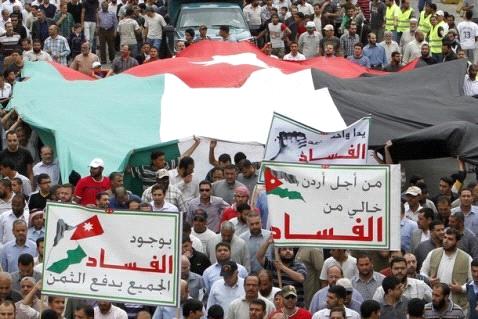
Did Khassawneh avert a civil war during his tenure as PM? A civil war involves two opposing armed actors to engage in military confrontation whose interests precede the unity and sovereignty of the state. In Jordan, majority of the population are proponents of change spearheaded by the Monarch, while a privileged minority supports the status quo to preserve their personal interests and benefits. Anger, discontent, frustration drove the non-militarized majority to protest peacefully involving different political actors seeking reforms which will secure justice without jeopardizing Jordan's integrity and unity.
How did Khassawneh respond?
First, amid preceding and concurrent calls to put Jordan house in order, Khassawneh unilaterally questioned the unconstitutionally of Hamas departure from Jordan attributing such a sensitive decision to the Intelligence, whose decisions and those of other Jordanian authorities are outcome of cooperation and coordination with all the local, regional and international concerned parties, and considered the return of Hamas members and their families while resorting to legal arguments and ridiculing its painfully tested security implications. Khassawneh's recent declaration of his advocating Palestinian rights being not his most popular move contradicts his previous statement of treating Meshaal and his family as Jordanian citizens and conditioning their return to becoming apolitical while in Jordan.
Second, upon resignation Khassawneh underlined his establishing goodwill with the Islamist through dialogue and inviting them to become stake holders instead of opposing the state and rejected demonizing and excluding the Islamists within his policy of inclusion overlooking Islamists boycotting previous elections, governments and the Committee for National Dialogue, not least the several attempts exerted by the Royal Court to engage all political actors in dialogue and discussions including the Islamists and the youth comprising big segment of the Jordanian society.
Third, without any reference to the outcome of the Committee of National Dialogue, Khassawneh proposed electoral law which antagonized rather than responded to the demands of old and newly emerging political parties.
Fourth, while criticizing the upper hand of the royal court and three governments ruling the country: the Royal Court, the Intelligence and the real government, Khassawneh attributed his resignation to having, against his wish, the parliament ordinary session extended. The ordinary session when the checks and balance would secure a balanced institutional performance while the parliament going into recession, favored by Khassawneh, would have consolidated his upper hand in shaping Jordan's political future.
Fifth, amid calls for urgent political reforms and uprooting corruption, Khassawneh prioritized economic reforms and overlooked arbitrary measures of arrests, emerging military tribunals and suffocating freedom of expression. Instead he discouraged defaming people rather than stressing the need for transparent government which will deter future corruption.
Sixth, Khasawneh's last respond hitherto described the last 12 years as complete regression with no reforms implicating either ignorance or carelessness to carry out some informative readings of scholarly literature on Jordan's socioeconomic and political development as following:
"Jordan strives simultaneously to modernize its industry and develop the civil, political and social rights of its citizens with intensified efforts during the last two decades. In his speech to the 14th parliament's first ordinary session on December 1, 2003, King Abdullah II announced his vision of 'Jordan First' incorporating comprehensive plans and national programs to influence the positive change and respond to the ambitions and hopes of youth. In 2005, Jordan developed its 10-year National Agenda. The third national process for political reform ' We are all Jordan' was inaugurated at the Dead Sea in July 2006. The forum evoked six major topics: the Palestinian issue, political reform, external challenges, domestic development, economic reform and social security. In September 2006, in response to the forum's recommendation, the same year, Jordan's parliament approved the International Covenant on Civil and Political Rights, and approved and promulgated anti-corruption law, which established the Anti-Corruption Commission. Access to Information Law was endorsed in June 2007, making Jordan the first Arab country to enact freedom of information (FOI) legislation. On October 29, 2009, the Jordanian government launched the 'code of conduct and work ethics' endorsed by the government in 2006, aiming to fight corruption, boost citizen confidence, prevent the abuse of public posts for personal interests and improve social equality.
During a debate on 'Democracy is not for everyone' (BBC World, October 18, 2009), Michael Wesley strongly advocated that awareness of values of democracy is enhanced through the communication revolution. Furthermore, during the discussion, liberty, rule of law, human rights, freedom of expression, women's participation, among others, were introduced as indicators of democracy. Sørensen argues that computers/microelectronics technologies make decentralized, democratic structures a real possibility (1985:72).
Since his accession to the throne, King Abdullah II launched an energetic drive to make IT industry the main engine of economic growth (Mezagopian: 2001)… Ahmad I. Abu-El-Haija, the director of National Tempus Office Jordan, referred to the International Computer Driving Licence program which has been introduced in Jordan, the first Arab state to receive such program, in 2001 to deliver training in IT skills through 110 centres located all over Jordan where 62% out of 150 000 registered and 10,000 completed participants are women. Decentralisation through reactivating local government administration in Jordan has been introduced to expand the basis of public participation and to foster political, economic and social development." (Mezagopian: 2009).
This said, and while acknowledging exceeding mandates and serious shortcomings by different public entities and personnel and others whose performance and deeds undermine the image and credibility of Jordan's first statesman the Monarch and foremost the national interest of Jordan and the well being of Jordanians, I leave one key question to be answered by the readers, was Jordan on the verge of a civil war or a civil war was to be incited by a latent autocrat?
Madeleine Mezagopian
Academic Researcher and Advisor
Conflict Resolution/Peace and
Socioeconomic and Political Development
Amman, May 8, 2012



 comment replay












 الرجاء الانتظار ...