Ammon News - King Abdullah has accused Israel of trying to block Jordan from developing a peaceful nuclear programme.
He said Israel had been pressuring states like France and South Korea not to sell Jordan nuclear technology.
Israel, believed to be the only country in the Middle East that has nuclear weapons, has denied the accusation.
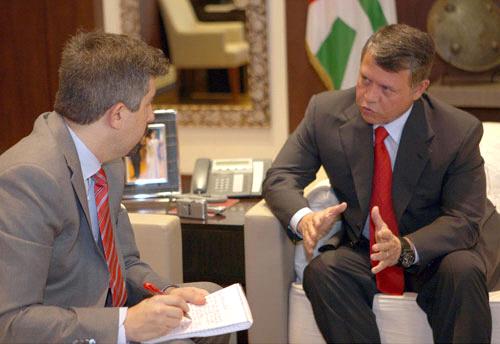
In a lengthy interview in The Wall Street Journal, King Abdullah strongly criticised Israel for what he said were its efforts to persuade potential suppliers to abandon plans to sell Jordan nuclear power generating reactors, something Israel denies.
He said Israel's "underhanded" actions have helped bring Jordan-Israeli relations to their lowest point since a 1994 peace agreement.
"There are countries, Israel in particular, that are more worried about us being economically independent than the issue of nuclear energy," King Abdullah said. "There are many such reactors in the world and a lot more coming, so [the Israelis must] go mind their own business."
Full interview
The Peace Process: "I think that the challenge we have at this stage is, you know what's happening with the Palestinians is I think out of cheer desperation that nothing is moving and you know we talked to our western counterparts in the early spring. We all knew this deadline of UN General Assembly and many of us were saying well look unless we find an alternative to get the Israelis and Palestinians sitting at the table this is going to happen.
That was also expressed in my visit to Washington last April. So we said ok, but we all agree that this creates more pressure from all of us but what is the alternative? And there's a lot of talk by different countries of creating an opportunity to get the Israelis and Palestinians together so that we wouldn't head to the UN General Assembly and have the problem that we're facing now today.
But nothing credible happened during that period of that time." "I believe the US and Israel are going to be more isolated and the pressure on Israel is going to be greater. I know that there are Israeli that are saying you know that the Arab Spring is a good thing for them and I don't think that is necessary the case as we've seen by recent examples. Israel has got to decide whether it continues to want to be a fortress mentality or whether they want to treat us as equals and be part of the neighborhood. So I am more concerned that if we failed in the United Nations to find somewhere to get out of this to move people – the Israelis and the Palestinians forward. That is going to be very unkindly to all of us."
"Well if the U.S. vetoes it's going to have, you know, the Middle East will have a very negative view towards the United States that's part of the problem and again the aspirations of people are being spoken in much louder voices. And so again I think Israel is becoming more and more isolated." "The problem with the full peace process is we'll always look towards the light and try to move people forward. There is an unhealthy relationship today people to people because although the benefit of peace is always peace. The inability of Israel to address the justice of the Palestinian problem has not come down well with the people and we're just seeing – from the Jordanian street – Israel is being more and more difficult in coming to the table and finding an agreement that is acceptable to both sides." "So you know when this is a cry we have seen in many other countries what does the peace process or the peace treaty with Israel give and so this is, I think Israel is at a very critical juncture today where denying that they have nothing to do with what's going on in the area denying that the Palestinian issue does not involve them in the region is going to make it much more difficult for them to engage with us in the future.
So I think that you know the buzz word is Israel has to decide; does it want to be part of the neighborhood or does it want to be fortress Israel and the decisions that we've seen over the past year or so are not encouraging." "In discussions I've had with Israeli Prime Minister Benyamin Netanyahu and his government, there has been very positive statements over the past several years. The vision that he has for the region which has been reassuring, having said that everything we see on the ground has been completely the opposite and as a result I think we're all disappointed and I think my best way to describe my view toward Israel is my increasing frustration because they're sticking their head in the sand and pretending that there's not a problem." Arab Spring: "I think it's almost impossible for any expert to predict for the rapid changes we see in the Middle East. They are rapid and they will continue for quite while.
The Arab Spring I think we will look back whether it's two years, five years, ten or fifteen. And say it's a good thing. Having said that, in the meantime there's going to be a lot of blood, sweat and tears and the hope that all of us that are working together is to make sure that there is a lot less blood and ideally a lot less sweat and tears. But definitely the Arab Spring has gone we're into for many countries including Jordan into the Arab Summer, which means we need to roll up our sleeves and do the hard work specifically when it comes to Jordan. We've now benchmarked on political reforms we've done changes to the constitutions that I'm sure that you're aware, new election law, new political party law and independent commission etc etc. the challenges now is to pass these through Parliament as quick as possible so that we can have national elections in the second half of 2012. And each country is going on its own pace. I think that we're way ahead of the curve because we have a plan, and the job of the leaders is to make sure that government and parliament stick to those benchmarks so that we have a new Jordan as quickly as possible.
I don't know if that could be said for a lot of countries in the region, some of them maybe going from an Arab Spring to an Arab Summer to an Arab Winter and maybe it takes a while for them to come back up to the Arab Spring again." "I think this is the issue, my belief is that the more you develop left, right and center based on political party programs the more challenge it's going to be for the Muslim Brotherhood to integrate into the new system because the way that they look at their desire to govern is inconsistent with left right and center political parties, equality, transparency and as a result they're having to go through some soul searching I guess to say how can they adapt to what I see as the change in the Middle East and will they be able to integrate into the mentality of left right and center based on political platforms. When I think
"Throughout the whole of the Middle East the only organized people, and the fault is because of the way the region was coming up in the Cold War, the only people who are organized are the Muslim Brotherhood. But again I think you see in Egypt where they're saying lets go for elections and there has been a push back saying no lets go down on the issue of elections lets figure out the Constitution and then go to elections, because what they don't want is go to elections now having the Muslim Brotherhood in a more organized go into a position of power and then they are the ones who would change the constitution to their liking. What we've done in Jordan by national outreach is quite the opposite.
We defined the framework of the future identified where we need to go and now get people involved in the political process through voting and through creating parties to vote for." "And so the pendulum I think is swinging back and forth in countries like Egypt and elsewhere and this is why I think we have the edge because I think we have been very fortunate that Jordanians have really stuck to common sense, we have had demonstrations every week since January. We had one person died of heart attack who was watching the demonstrations.
Demonstrations happening every week they're peaceful but people are now saying well ok lets roll up our sleeves because we all believe in the vision of a government elected from political parties it's time for us to do the hard work. The challenge as I said is going back to the platform, and I was with an activist, a group of people , one of them was an activist ok well ,this was earlier in the summer, were about to do the constitutional changes, elections law is going to be ratified, the political parties law, municipal elections that's about to pass. Ok so you keep saying that, but once you get past October and those were actually passed. What are you going to do then? Are you going to continue to stay on the street or you're your own political party or join a political party that express your expression." "I think throughout the Middle East, there is a clear majority that are interested mainly in economic reform and economic prosperity as opposed to political reform. But because of frustrations that gives them more political out voices and I think that goes not only the Middle East but throughout Europe and other places, Israel is having demonstrations too that there is a major economic problem throughout the world.
The Middle East has the highest unemployment percentage of any region in the world we have a largest youth cohort of history coming into the market place that frustration does translate into the political sphere when people are hungry and with out jobs. On the issues of corruption, we need to fight corruption but again a lot of people are using us as tools to attack other people.
So ok you're corrupt and there is no mechanism in Jordan to defend yourself from that. So corruption is being used as a political weapon and here is distrust." "On the issue of political reform, Yes and again four months from now, God willing, I want to feel much better. And you'd understand that the way my life was six months ago, to four months ago to two months ago, I'm learning and we're all maturing as the process goes forward. So my view of, and I think as a head of state, my job is to layout the landscape and get the debate going.
You know now the constitutional amendments are in Parliament, the municipal elections have been ratified and we've announced on the second half of December. So on the political aspect it's now being finalized and put into place at least in the short –medium term. But I am always the type of person who takes a couple of steps ahead, what is the next stage and then we have to debate on that." "when I first came to this position was my responsibility is to put food on the table for Jordanians. And what I meant by that is creating a middle class. And my belief – and I have mentioned it I think many times – once you a middle class, the stronger the middle class is the smoother the political reform goes through."
"Economically, GCC will be tremendous help, but again we bring a lot to the GCC table. But it definitely positions Jordan in a much stronger position economically in the region. And I see that Jordan, specially with the instability that's happening in the area we are much stronger as an IT and services and transportation center for the Middle East because of all these that are coming in.
So I think you'll see a lot of people looking to Jordan Because you know, historically, if you look at every problem they've had in the Middle East, they'd say Jordan is going to crumble. Nobody has learned that lesson yet, that Jordan has always been able to sustain the shocks of the region and has always come out historically very stable and I'm actually very optimistic for the future."
"America has had major challenges internally. And you've been faced with the a challenging economy, the issues of healthcare and taxes, two wars, there's a lot on the plate, but my stroke of lessons learnt is you can never ignore the Israeli-Palestinian problem because if you want to ignore it will later come back and bite you in the backside. So you can keep it at arms length but whether you like it or not the bottom fact that you will have to deal with it. And I think that again what happens in the UN this week is going to resonate positively or negatively for quite a while depending on what the outcome is. If the outcome is positive it's going to be hard work for all of us to try and move to the end game, and if it doesn't succeed then I think we all need to be very concerned.
* Wall street



 comment replay




 الرجاء الانتظار ...